
Filter
1695
Text search:
vector
Featured
159
458
Language
Document type
658
389
250
124
115
53
39
16
15
13
6
5
4
4
3
Countries
123
65
57
31
30
29
27
22
21
21
21
20
18
18
18
18
17
17
16
16
16
15
15
14
13
12
11
10
10
10
10
10
10
9
9
9
8
7
7
7
7
7
6
6
6
6
6
5
5
5
5
5
5
5
4
4
4
4
4
4
4
3
3
3
3
3
3
3
3
3
3
3
3
3
3
3
3
3
3
2
2
2
2
2
2
2
2
2
2
2
1
1
1
1
1
1
1
1
1
1
1
1
1
1
1
1
1
1
1
1
1
1
1
1
1
1
1
1
1
1
Authors & Publishers
Publication Years
Category
580
134
112
109
26
24
23
Toolboxes
260
183
163
128
117
60
56
46
46
30
22
21
17
16
15
13
12
10
10
9
6
4
4
3
1
Training module on malaria control
The intention of this handbook on integrated vector management (IVM) is to provide
guidance to the managers of vector-borne disease control programmes, including
comparable officials in health and
...
Environmental Health in Emergencies and Disasters
Chapter 10
Training module
Armed Forces Pest Management Board Technical Guide No. 47
A practioner's guide

This document provides recommendations on essential measures to protect the health and safety of operators and other persons involved in emergency vector control of Aedes spp. mosquitoes, including space spraying of insecticides, larvicide applicati
...
Zika virus is primarily transmitted by the Aedes species of mosquito which is also responsible for the spread of dengue, Chikungunya and yellow fever viruses. In most areas, the primary vector of these viruses is Aedes aegypti, with Aedes albopictus
...
2nd edition. WHO's recommendation has not changed: the standard WHO susceptibility tests should remain a primary method by which resistance is detected. However, it was considered necessary to update the existing resistance-monitoring procedures to also highlight the need for operationally meaningfu
...

This document provides the specifications for major pesticide application equipment used for control of vectors of diseases. The specification guidelines contained herein are intended to assist national authorities and other public health users in selecting equipment of assured quality for applicati
...

The Global vector control response 2017–2030 (GVCR) provides a new strategy to strengthen vector control worldwide through increased capacity, improved surveillance, better coordination and integr
...
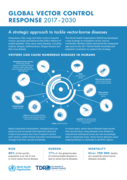
Mosquitoes, flies, bugs and other vectors transmit viruses, parasites and bacteria that infect millions of people globally. They cause many diseases, including malaria, dengue, leishmaniases, Chagas disease and Zika virus disease.
The World Health Organization (WHO) has developed a new strategy to
...
The purpose of this handbook is to provide guidance to Member States on the practical aspects of maintaining sanitary standards at international borders at ports, airports, and ground crossings (points of entry) as set out in the International Health Regulations (2005). It provides technical advice
...
This toolkit for integrated vector management (IVM) is designed to help national and regional programme managers coordinate across sectors to design and run large IVM programmes.
The toolkit provides the technical detail required to plan, imple ...
The toolkit provides the technical detail required to plan, imple ...

Guidelines for malaria vector control
recommended
Vector control is a vital component of malaria prevention, control and
elimination strategies because it can be highly effective in providing
personal protection and/or reducing disease transmission.
This document outlines the evaluation process that WHO undertakes to assess novel tools and strategies targeted at VBDs. Its aim is to articulate the linkage between the generation of evidence that demonstrates public health impact of novel interventions, and the development of policy recommendation
...
“Preferred product characteristics” (PPCs) are key tools to incentivize and guide the development of urgently needed health products. Some of the vector control interventions deployed in complex emergencies and in response to natural disasters â
...
The primary audience for this guidance is persons
working directly in vector-borne disease prevention
and control, including programme managers,
researchers and field workers. A brief technical
background is provided for the benefit of persons
...
The main purpose of the meeting was to review tsetse control tools, activities and their contribution to the elimination of gHAT and the monitoring thereof. Seven endemic countries provided reports on recent and ongoing vector control interventions
...

Despite the significant role of vector control in national leishmaniasis control programmes, the programmatic community perceives vector control as the weakest component of leishmaniasis control str
...
