
Filter
842
Text search:
International
Primary
Care
-
Respiratory
Group
Featured
Recommendations
109
New Publications
208
Language
Document type
No document type
418
Studies & Reports
150
Guidelines
142
Manuals
48
Strategic & Response Plan
44
Training Material
18
Situation Updates
11
Fact sheets
8
Resource Platforms
3
Countries / Regions
Global
40
India
37
Kenya
35
Western and Central Europe
21
Nigeria
18
Ethiopia
18
Ghana
18
South Africa
18
Malawi
18
Nepal
17
Bangladesh
16
Sierra Leone
14
Liberia
14
Africa
14
Uganda
13
Syria
13
Tanzania
13
Rwanda
13
Latin America and the Carribbean
13
Namibia
11
Zambia
10
Philippines
8
Myanmar / Burma
8
Eastern Europe
8
Ukraine
7
South–East Asia Region
7
West and Central Africa
6
Senegal
5
Lesotho
5
Guinea
4
Congo, Democratic Republic of
4
Zimbabwe
4
South Sudan
4
Cambodia
4
Indonesia
4
East and Southern Africa
4
USA
3
Cameroon
3
Germany
3
Thailand
3
Mozambique
3
Colombia
3
Yemen
3
Western Pacific Region
3
Tajikistan
3
Burkina Faso
2
Mali
2
Haiti
2
Pakistan
2
Jordan
2
Turkey
2
Papua New Guinea
2
Sudan
2
Benin
2
Eswatini/ Swaziland
2
Brazil
2
Middle East and North Africa
2
Asia
2
Timor Leste/ East Timor
2
Russia
2
Kazakhstan
2
Vietnam
2
Iraq
1
Afghanistan
1
China
1
Malaysia
1
Singapore
1
Argentina
1
Peru
1
North Macedonia
1
Botswana
1
Madagascar
1
Sri Lanka
1
Other region
1
Bhutan
1
Venezuela
1
Palestine
1
Albania
1
Kyrgyzstan
1
Turkmenistan
1
Japan
1
Denmark
1
France
1
Maldives
1
United Kingdom
1
Portugal
1
Spain
1
Azerbaijan
1
Authors & Publishers
Publication Years
Category
Countries
340
Clinical Guidelines
90
Public Health
55
Women & Child Health
54
Key Resources
52
Pharmacy & Technologies
12
Capacity Building
9
Toolboxes
COVID-19
95
TB
68
AMR
43
Mental Health
36
Caregiver
34
HIV
31
Rapid Response
29
NCDs
29
Planetary Health
28
Conflict
25
Pharmacy
22
Ebola & Marburg
15
2.0 Rapid Response
15
Disability
14
Refugee
14
NTDs
13
Natural Hazards
11
Specific Hazards
9
Global Health Education
9
Polio
6
Cholera
5
Zika
2
Health Financing Toolbox
2
Malaria
1
This Course for Service Providers on how to give Vitamin A Supplementation and Deworming (VAS+D) uses both a Learner’sGuide and a Facilitator’s Guide. The Learner’s Guide is designed for participants in the course who are healthcare workers or trainers learning to deliver vitamin A and Albenda
...
The purpose of this handbook is to provide guidance to Member States on the practical aspects of maintaining sanitary standards at international borders at ports, airports, and ground crossings (points of entry) as set out in the
...
Climate Change Toolkit for Health Professionals
recommended
This toolkit consists of eight modules which have been prepared as stand-alone documents that can be read by themselves, but they have also been prepared to complement one another. It has been designed as a tool for health professionals and students in the health
...
Following the encouraging initial results of the pilot project, the Ministry of Health is committed to increasing access to MDR-TB diagnosis, treatment and care. An expansion plan for the programmatic management of drug-resistant TB has been develop
...

This new guideline on non-clinical interventions to reduce unnecessary caesarean sections incorporates the views, fears and beliefs of both women and health professionals about caesarean sections. It also considers the complex dynamics and limitations of health systems and organizations and relation
...
Enabling young children to achieve their full developmental potential is a human right and an essential requisite for sustainable development. Given the critical importance of enabling children to make the best start in life, the health sector, among other sectors, has an important role and responsi
...
Birth defects surveillance: quick reference handbook of selected congenital anomalies and infections
This Quick Reference Handbook of Selected Congenital Anomalies and Infections is a companion tool to Birth defects surveillance: a manual for programme managers, and is intended for use by front-line health care professionals who are diagnosing and
...
This Guide contains information, guidelines, diagrams and other materials addressed to medical practitioners who are engaged in the treatment of casualties of chemical weapons. It is made available to the public for information purposes, but is not intended to be used by the public. All decisions re
...

The WHO COVID-19 Clinical management: living guidance contains the most up-to-date recommendations for the clinical management of people with COVID-19. Providing guidance that is comprehensive and holistic for the optimal care of COVID-19 patients t
...
The WHO Model List of Essential Medicines and Model List of Essential Medicines for Children are updated and published every two years, intended as a guide for countries or regional authorities to adopt or adapt in accordance with local priorities and treatment guidelines for the development and upd
...
To assess national-level responses to NCDs, WHO has implemented NCD country capacity surveys periodically since 2001. This report is the latest in that series. Since the first survey round, the NCD Country Capacity Survey (NCD CCS) has been conducted a further seven times, most recently in 2021. In
...

The Zimbabwe Multi-Sectoral Cholera Elimination Plan (2018–2028) aims to eradicate cholera by improving water, sanitation, and healthcare infrastructure, strengthening disease surveillance, and expanding oral cholera vaccination (OCV). The strategy focuses on five pillars, including public health
...

The Guidance on global monitoring for diabetes prevention and control by WHO provides a comprehensive framework to support countries in tracking and managing diabetes prevention, care, and outcomes. This document outlines indicators across 4 domains
...
The global burden of disease due to mental disorders continues to rise, especially in low- and middle-income countries (LMIC). In addition to causing a large proportion of morbidity, mental disorders – especially severe mental disorders (SMD) – are linked with poorer health outcomes and increase
...

The "Assessing National Capacity for the Prevention and Control of Noncommunicable Diseases: Report of the 2021 Global Survey" by WHO examines the global state of readiness and infrastructure for managing noncommunicable diseases (NCDs) across countries. Based on the 2021 survey, it analyzes nationa
...
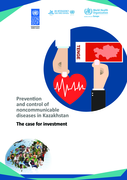
Noncommunicable diseases (NCDs) such as cancer, cardiovascular disease, diabetes and chronic respiratory diseases and their risk factors are an increasing public health and development challenge in Kazakhstan. This report provides evidence through t
...

As part of our commitment to the fight against NCDs, Nigeria was signatory to the political declaration at the UN General Assembly High Level Meeting on NCDs in September 2011. Thus, the purpose of this document is to develop and ensure the implementation of policies and p
...

Since 24 February 2022, the war in Ukraine has caused widespread suffering to its people and serious damage
to the country’s infrastructure. Attacks on the country’s health system and its power network threaten people, compromise the provision of health
...

Noncommunicable diseases (NCDs) – chief among them, cardiovascular diseases (heart disease and stroke), cancer, diabetes and chronic respiratory diseases – along with mental health, cause nearly three quarters of deaths in the world. Their drive
...
Guide for coordinators and data collectors - The WHO Operational Package for Assessing, Monitoring and Evaluating Country Pharmaceutical Situations is intended as a useful tool for researchers, policy-makers, planners and others who need to use standardized measurement tools to gather data and other
...
