
Filter
632
Text search:
convulsions
Featured
109
181
Language
Document type
360
127
42
40
37
12
7
3
2
2
Countries
74
20
17
15
15
14
13
12
11
11
9
9
9
8
7
7
7
7
6
6
6
6
5
5
4
4
4
3
3
3
3
3
2
2
2
2
2
2
2
2
2
2
1
1
1
1
1
1
1
1
1
1
1
1
1
1
1
1
1
1
1
1
1
Authors & Publishers
Publication Years
Category
268
127
96
29
20
12
2
Toolboxes
54
43
32
25
19
17
15
15
13
13
12
11
9
8
6
5
4
3
3
2
2
2
2


Children in Kabwe are especially at risk because they are more likely to ingest lead dust when playing in the soil, their brains and bodies are still developing, and they absorb four to five times as much lead as adults. The consequences for children who are exposed to high levels of lead and are no
...
Children in Kabwe are especially at risk because they are more likely to ingest lead dust when playing in the soil, their brains and bodies are still developing, and they absorb four to five times as much lead as adults. The consequences for children who are exposed to high levels of lead and are no
...
The purpose of this reference manual to support learning of ETAT + principles and to complement your clinical training and practice. The manual is for use before, during, and after an ETAT + course.
This manual contains the necessary information to help you to:
• Triage all sick children when th
...
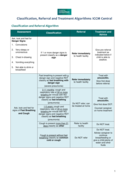
The document "Classification and Referral Algorithm – iCCM Uganda" (2013) by Malaria Consortium provides a practical guide for community health workers to assess, classify, and manage common childhood illnesses in Uganda. It focuses on key symptoms such as fever, cough, diarrhoea, and danger signs
...


Pocket book of hospital care for children
recommended
Guidelines for the Management of common childhood Illness. 2nd edition
These guidelines focus on the management of the major causes of childhood mortality in most developing countries, such as newborn problems, pneumonia, diarrhoea, malaria, meningitis, septicaemia, measles and related conditions,
...


This new edition and fully updated publication replaces the 2012 UCG and is being circulated free of charge to all public and private sector prescribers, pharmacists, and regulatory authorities in the country

Document also available in Arabic, Chinese, Greek, Italian, Korean and Vietnamese. For other language versions go to http://www.schn.health.nsw.gov.au/parents-and-carers/fact-sheets/fever
WHO Factsheet. Updated 02 March 2016

Le présent document vise à fournir des orientations provisoires sur la mesure du périmètre crânien, les normes de croissance, l’évaluation clinique et les examens requis pour établir un diagnostic de microcéphalie et déterminer si elle s’accompagne d’anomalies neurologiques.
WHO Factsheet (French version). Updated 01 March 2016
Basic Paediatric Protocols (Kenya)
recommended


Cette fiche fait partie du Guide de CBM sur la prévention de l’infirmité motrice cérébrale
