
Filter
2333
Text search:
transition
of
care
Featured
203
637
Language
2195
115
50
42
34
18
17
12
4
4
4
4
3
2
2
2
2
2
2
2
2
2
1
1
1
1
1
1
1
1
1
1
1
Document type
1260
457
262
133
117
38
32
16
8
4
3
1
1
Countries
140
83
71
66
61
51
50
45
44
44
41
41
41
36
33
31
28
28
28
27
26
26
25
24
22
20
17
16
16
16
16
14
12
12
12
11
11
11
10
10
9
9
9
8
8
8
6
6
6
6
6
6
5
5
4
4
4
4
4
4
4
4
4
4
4
4
3
3
3
3
3
3
3
3
3
3
2
2
2
2
2
2
2
2
2
2
2
1
1
1
1
1
1
1
1
1
1
1
1
1
1
1
1
1
1
1
1
1
1
1
1
1
1
1
1
1
1
1
1
1
1
Authors & Publishers
286
75
72
69
49
47
40
33
29
27
22
20
19
19
16
15
14
13
11
11
11
11
11
11
10
10
10
10
9
9
8
8
8
8
7
7
7
7
7
7
6
6
6
6
6
6
6
6
6
5
5
5
5
5
5
5
5
5
5
5
5
4
4
4
4
4
4
4
4
4
4
4
4
4
4
4
4
4
4
4
4
4
4
4
4
4
4
4
4
4
4
4
4
3
3
3
3
3
3
3
3
3
3
3
3
3
3
3
3
3
3
3
3
3
3
3
3
3
3
3
3
3
3
3
3
3
3
3
3
3
3
3
3
3
3
3
3
3
3
3
3
3
3
3
3
3
3
2
2
2
2
2
2
2
2
2
2
2
2
2
2
2
2
2
2
2
2
2
2
2
2
2
2
2
2
2
2
2
2
2
2
2
2
2
2
2
2
2
2
2
2
2
2
2
2
2
2
2
2
2
2
2
2
2
2
2
2
2
2
2
2
2
2
2
2
2
2
2
2
2
2
2
2
2
2
2
2
2
2
2
2
2
2
2
2
2
2
2
2
2
2
2
2
2
2
2
2
2
2
2
2
2
2
2
2
2
2
2
2
2
2
2
2
2
2
2
2
2
2
2
2
2
2
2
2
2
2
2
2
2
2
2
2
2
2
2
2
2
2
2
2
2
2
2
2
2
2
2
2
2
2
2
2
2
1
1
1
1
1
1
1
1
1
1
1
1
1
1
1
1
1
1
1
1
1
1
1
1
1
1
1
1
1
1
1
1
1
1
1
1
1
1
1
1
1
1
1
1
1
1
1
1
1
1
1
1
1
1
1
1
1
1
1
1
1
1
1
1
1
1
1
1
1
1
1
1
1
1
1
1
1
1
1
1
1
1
1
1
1
1
1
1
1
1
1
1
1
1
1
1
1
1
1
1
1
1
1
1
1
1
1
1
1
1
1
1
1
1
1
1
1
1
1
1
1
1
1
1
1
1
1
1
1
1
1
1
1
1
1
1
1
1
1
1
1
1
1
1
1
1
1
1
1
1
1
1
1
1
1
1
1
1
1
1
1
1
1
1
1
1
1
1
1
1
1
1
1
1
1
1
1
1
1
1
1
1
1
1
1
1
1
1
1
1
1
1
1
1
1
1
1
1
1
1
1
1
1
1
1
1
1
1
1
1
1
1
1
1
1
1
1
1
1
1
1
1
1
1
1
1
1
1
1
1
1
1
1
1
1
1
1
1
1
1
1
1
1
1
1
1
1
1
1
1
1
1
1
1
1
1
1
1
1
1
1
1
1
1
1
1
1
1
1
1
1
1
1
1
1
1
1
1
1
1
1
1
1
1
1
1
1
1
1
1
1
1
1
1
1
1
1
1
1
1
1
1
1
1
1
1
1
1
1
1
1
1
1
1
1
1
1
1
1
1
1
1
1
1
1
1
1
1
1
1
1
1
1
1
1
1
1
1
1
1
1
1
1
1
1
1
1
1
1
1
1
1
1
1
1
1
1
1
1
1
1
1
1
1
1
1
1
1
1
1
1
1
1
1
1
1
1
1
1
1
1
1
1
1
1
1
1
1
1
1
1
1
1
1
1
1
1
1
1
1
1
1
1
1
1
1
1
1
1
1
1
1
1
1
1
1
1
1
1
1
1
1
1
1
1
1
1
1
1
1
1
1
1
1
1
1
1
1
1
1
1
1
1
1
1
1
1
1
1
1
1
1
1
1
1
1
1
1
1
1
1
1
1
1
1
1
1
1
1
1
1
1
1
1
1
1
1
1
1
1
1
1
1
1
1
1
1
1
1
1
1
1
1
1
1
1
1
1
1
1
1
1
1
1
1
1
1
1
1
1
1
1
1
1
1
1
1
1
1
1
1
1
1
1
1
1
1
1
1
1
1
1
1
1
1
1
1
1
1
1
1
1
1
1
1
1
1
1
1
1
1
1
1
1
1
1
1
1
1
1
1
1
1
1
1
1
1
1
1
1
1
1
1
1
1
1
1
1
1
1
1
1
1
1
1
1
1
1
1
1
1
1
1
1
1
1
1
1
1
1
1
1
1
1
1
1
1
1
1
1
1
1
1
1
1
1
1
1
1
1
1
1
1
1
1
1
1
1
1
1
1
1
1
1
1
1
1
1
1
1
1
1
1
1
1
1
1
1
1
1
1
1
1
1
1
1
1
1
1
1
1
1
1
1
1
1
1
1
1
1
1
1
1
1
1
1
1
1
1
1
1
1
1
1
1
1
1
1
1
1
1
1
1
1
1
1
1
1
1
1
1
1
1
1
1
1
1
1
1
1
1
1
1
1
1
1
1
1
1
1
1
1
1
1
1
1
1
1
1
1
1
1
1
1
1
1
1
1
1
1
1
1
1
1
1
1
1
1
1
1
1
1
1
1
1
1
1
1
1
1
1
1
1
1
1
1
1
1
1
1
1
1
1
1
1
1
1
1
1
1
1
1
1
1
1
1
1
1
1
1
1
1
1
1
1
1
1
1
1
1
1
1
1
1
1
1
1
1
1
1
1
1
1
1
1
1
1
1
1
1
1
1
1
1
1
1
1
1
1
1
1
1
1
1
1
1
1
1
1
1
1
1
1
1
1
1
1
1
1
1
1
1
1
1
1
1
1
1
1
1
1
1
1
1
1
1
1
1
1
1
1
1
1
1
1
1
1
1
1
1
1
1
1
1
1
1
1
1
1
1
1
1
1
1
1
1
1
1
1
1
1
1
1
1
1
1
1
1
1
1
1
1
1
1
1
1
1
1
1
1
1
1
1
1
1
1
1
1
1
1
1
1
1
1
1
1
1
1
1
1
1
1
1
1
1
1
1
1
1
1
1
1
1
1
1
1
1
1
1
1
1
1
1
1
1
1
1
1
1
1
1
1
1
1
1
1
1
1
1
1
1
1
1
1
1
1
1
1
1
1
1
1
1
1
1
1
1
1
1
1
1
1
1
1
1
1
1
1
1
1
1
1
1
1
1
1
1
1
1
1
1
1
1
1
1
1
1
1
1
1
1
1
1
1
1
1
1
1
1
1
1
1
1
1
1
1
1
1
1
1
1
1
1
1
1
1
1
1
1
1
1
1
1
1
1
1
1
1
1
1
1
1
1
1
1
1
1
1
1
1
1
1
1
1
1
1
1
1
1
1
1
1
1
1
1
1
1
1
1
1
1
1
1
1
1
1
1
1
1
1
1
1
1
1
1
1
1
1
1
1
1
1
1
1
1
1
1
1
1
1
1
1
1
1
1
1
1
1
1
1
1
1
1
1
1
1
1
1
1
1
1
1
1
1
1
1
1
1
1
1
1
1
1
1
1
1
1
1
1
1
1
1
1
1
1
1
1
1
1
1
1
1
1
1
1
1
1
1
1
1
1
1
1
1
1
1
1
1
1
1
1
1
1
1
1
1
1
1
1
1
1
1
1
1
1
1
1
1
1
1
1
1
1
1
1
1
1
1
1
1
1
1
1
1
1
1
1
1
1
1
1
1
1
1
1
1
1
1
1
1
1
1
1
1
1
1
1
1
1
1
1
1
1
1
1
1
1
1
1
1
1
1
1
1
1
1
1
1
1
1
1
1
1
1
1
1
1
1
1
1
1
1
1
1
1
1
1
1
1
1
1
1
1
1
1
1
1
1
1
1
1
1
1
1
1
1
1
1
1
1
1
1
1
1
1
1
1
1
1
1
1
1
1
1
1
1
1
1
1
1
1
1
1
1
1
1
1
1
1
1
1
1
1
1
1
1
1
1
1
1
1
1
1
1
1
1
1
1
1
1
1
1
1
1
1
1
1
1
1
1
1
1
1
1
1
1
1
1
1
1
1
1
1
1
1
1
1
1
1
1
1
1
1
1
1
1
1
1
1
1
1
1
1
1
1
1
1
1
1
1
1
1
1
1
1
1
1
1
1
1
1
1
1
1
1
1
1
1
1
1
1
1
1
1
1
1
1
1
1
1
1
1
1
1
1
1
1
1
1
1
1
1
1
1
1
1
1
1
1
1
1
1
1
1
1
1
1
1
1
1
1
1
1
1
1
1
1
1
1
1
1
1
1
1
1
1
1
1
1
1
1
1
1
1
1
1
1
1
1
1
1
1
1
1
1
1
1
1
1
1
1
1
1
1
1
1
1
1
1
1
1
1
1
1
1
1
1
1
1
1
1
1
1
1
1
1
1
1
1
1
1
1
1
1
1
1
1
1
1
1
1
1
1
1
1
1
1
1
1
1
1
1
1
1
1
1
1
1
1
1
1
1
1
1
1
1
1
1
1
1
1
1
1
1
1
1
1
1
1
1
1
1
1
1
1
1
1
1
1
1
1
1
1
1
1
1
1
1
1
1
1
1
1
1
1
1
1
1
1
1
1
1
1
1
1
1
1
1
1
1
1
1
1
1
1
1
1
1
1
1
1
1
1
1
1
1
1
1
1
1
1
1
1
1
1
1
1
1
1
1
1
1
1
1
1
1
1
1
1
1
1
1
1
1
1
1
1
1
1
1
1
1
1
1
1
1
1
1
1
1
1
1
1
1
1
1
1
1
1
1
1
1
1
1
1
1
1
1
1
1
1
1
1
1
1
1
1
1
1
1
1
1
1
1
1
1
1
1
1
1
1
1
1
1
1
1
1
1
1
1
1
1
1
1
1
1
1
1
1
1
1
1
1
1
1
1
1
1
1
1
1
1
1
1
1
1
1
1
1
1
Publication Years
682
1473
169
9
Category
858
173
152
141
109
68
11
Toolboxes
215
118
117
108
107
107
85
75
62
57
56
52
51
35
35
32
27
24
22
19
15
13
10
5
5
2
1

There is a broad consensus nowadays that the Earth is warming up as a result of greenhouse gas emissions caused by anthropogenic activities. It is also clear that current trends in the fields of ene
...
rgy, development and population growth will lead to continuous and ever more dramatic climate change. This is bound to affect the fundamental prerequisites for maintaining good health: clean air and water, sufficient food and adequate housing. The planet will warm up gradually, but the consequences of the extreme weather conditions such as frequent
storms, floods, droughts and heat-waves will have sudden onset and acute repercussions. It is widely accepted that climate change will have an impact on the spread of infectious diseases in Europe, which is likely to bring about new public health risks in the majority of cases. Transmission of infectious diseases depends on a number of factors, including climate and environmental elements. Foodborne and waterborne diseases, for instance, are associated with high temperatures. Disease-transmitting vectors (e.g. mosquitoes, sandflies and ticks) are highly sensitive to climate conditions, including temperature and humidity; their geographical distribution will widen as climate conditions change, potentially allowing them to spread into regions where they are not currently able to live.
The primary purpose of this manual on climate change and infectious diseases is to raise the awareness and the level of knowledge of health workers at national, regional and local levels in the former Yugoslav Republic of Macedonia on the health risks associated with climate change and infectious diseases. This manual was devel-
oped as part of the WHO Regional Office for Europe project, Protecting health from climate change: a seven–country initiative, implemented with financial support from the German Federal Ministry for the Environment, Nature Conservation and Nuclear Safety.
more

The GFF needs an additional US$2.5 billion from 2021 to 2025 to enable countries to protect health gains and accelerate progress toward the 2030 Goals. Of this amount, the GFF urgently needs to secure new pledges
...
of US$1.2 billion by the end of 2021 to help its current 36 partner countries protect and maintain essential health services and implement time-sensitive service delivery and health system improvements to enable a sharp bend of the curve back to a positive trajectory to close the gap to the SDGs.
more

Integrated Outbreak Analytics (IOA) applies a multidisciplinary approach to understanding outbreak dynamics and to inform outbreak response. It aims to drive comprehensive, accountable, and effective public health and clinical strategies by enabling communities, and national and subnational health a
...
uthorities to use data for operational decision-making. IOA embraces a holistic perspective of outbreak dynamics throughout: from the trigger questions to the data that are collected or accessed, to the interpretation of results and the recommendations that follow. In addition, IOA promotes co-development and monitoring of evidence informed actions.
The IOA toolkit aims to provide a clear understanding of IOA and highlight the importance of using an integrated, holistic approach to manage outbreak responses. It provides step-by-step guidance for setting up IOA and putting IOA principles into action. Finally, this toolkit provides guidance on applying IOA in humanitarian and emergency contexts, offering a practical and adaptable approach to informing public health emergency responses.
Developed based on the model from the Democratic Republic of the Congo (DRC), its creation involved extensive consultation with experts experienced in IOA applications. The toolkit was piloted in Tanganyika Province, DRC, as well as Somalia and Sudan, demonstrating its adaptability to diverse emergency scenarios. It builds upon an existing array of tools, templates, reports, case studies, animations, and publications used by stakeholders in diverse contexts.
more

In an effort to improve the capabilities and accountability of humanitarian and economic practitioners, the SEEP (Small Enterprise Education and Promotion) Network's Minimum Economic Recovery Standards focus on minimum industry standards for facilit
...
ating economic recovery in crisis situations.
The handbook sets out strategies and interventions designed to improve income, cash flow, asset management, and growth among crisis-affected households and enterprises. These include financial services, productive assets, employment, and enterprise development. It emphasizes encouraging the re-start of enterprises and livelihoods strategies, and improving market productivity and governance
more
Operational Guidelines and Field Manual on Human Rights Protection in Situations of Natural Disaster
This document was conducted as a desk study and provides useful information and practical examples of responses to HIV and AIDS in the fields of agriculture, rural development, self-help and social
...
protection. It aims to invite Misereor partners and others working in these fields to reflect on their current approaches and to encourage them to respond, in their core business, to the challenges presented by HIV and AIDS.
more
The International Organization for Migration (IOM) is appealing for USD 158.9 million to respond to the urgent humanitarian needs of millions of Afghans and to support recovery and resilience within
...
the country and the region.
IOM’s Comprehensive Action Plan for Afghanistan and Neighbouring Countries aims to help the most vulnerable populations by combining humanitarian, development and peace interventions, known as the HDP nexus.
more
A field guide for accelerating and sustaining open defecation free communities through a Community-Led Total Sanitation approach
Follow-up MANDONA (FUM) is an action-oriented approach for accelerating community-wide sanitation and hygiene behaviour change following the initial triggering session. D
...
irectly based on Community-Led Total Sanitation (CLTS) principles, FUM involves a series of participatory, facilitated sessions that brings the entire community together to analyze their sanitation situation
and collectively undertake small, immediate and doable actions to end open defecation (OD) in the shortest time possible
more
Responding to a poliovirus event and outbreak, Part 1: General (SOPs) describes the general principles and steps to facilitate timely and effective responses to poliovirus events and outbreaks, and incorporate lessons learned from recent previous outbreak response efforts. This document summarizes r
...
oles and responsibilities of national governments and Global Polio Eradication Initiative (GPEI) partners.
Effective 01 November 2017 until 30 April 2018
more
Newsletter No. 15 | Highlighting the gender dimensions of education for children with disabilities
An historic opportunity to end AIDS as a public health threat by 2030 and launch a new era of sustainability
A decade of progress has inspired the once unthinkable—that the AIDS epidemic can ... be ended as a public health threat. The global community has embraced the bold idea to end the AIDS epidemic as a target of the 2030 Agenda for Sustainable Development. Governments from around the world have committed to a Fast-Track agenda and a set of ambitious but attainable milestones to be achieved by 2020 in order to end the AIDS epidemic by 2030, as set out in the United Nations General Assembly Political Declaration on Ending AIDS. Regular reporting through UNAIDS reinforces accountability for results. more
A decade of progress has inspired the once unthinkable—that the AIDS epidemic can ... be ended as a public health threat. The global community has embraced the bold idea to end the AIDS epidemic as a target of the 2030 Agenda for Sustainable Development. Governments from around the world have committed to a Fast-Track agenda and a set of ambitious but attainable milestones to be achieved by 2020 in order to end the AIDS epidemic by 2030, as set out in the United Nations General Assembly Political Declaration on Ending AIDS. Regular reporting through UNAIDS reinforces accountability for results. more
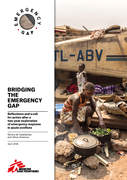
Reflections and a call for action after a two-year exploration of emergency response in acute conflicts
There is general consensus that the humanitarian sector is failing to mount timely and adequate responses in the acute phase ... of conflict-related emergencies, according to the two-year Emergency Gap Project by Médecins Sans Frontières (MSF).
The Project has explored what works for or against effective emergency responses. Its final report, Bridging the emergency gap, draws on the Project’s thematic papers and case studies, and consultations with more than 150 senior-level representatives from 60 key organisations across the humanitarian sector. more
There is general consensus that the humanitarian sector is failing to mount timely and adequate responses in the acute phase ... of conflict-related emergencies, according to the two-year Emergency Gap Project by Médecins Sans Frontières (MSF).
The Project has explored what works for or against effective emergency responses. Its final report, Bridging the emergency gap, draws on the Project’s thematic papers and case studies, and consultations with more than 150 senior-level representatives from 60 key organisations across the humanitarian sector. more
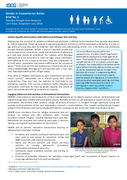
UNHCR and its partners implement interventions focusing on adolescent girls and boys, including:
▪ Formation and capacity building of adolescent girls and boys’ clubs as peer groups for awareness raising, and SGBV prevention and response me ... chanisms.
▪ Community based protection activities and training on child protection
▪ Provision of secondary education for secondary school-aged youth and recruitment of female teachers to encourage adolescent girls to continue education
▪ Introduction of community sharing/ parenting sessions and increasing the number of women support networks
▪ Establishing girls’ friendly spaces, which includes information sharing and psycho-social support
▪ Awareness raising campaigns with all members of the community, including community leaders more
▪ Formation and capacity building of adolescent girls and boys’ clubs as peer groups for awareness raising, and SGBV prevention and response me ... chanisms.
▪ Community based protection activities and training on child protection
▪ Provision of secondary education for secondary school-aged youth and recruitment of female teachers to encourage adolescent girls to continue education
▪ Introduction of community sharing/ parenting sessions and increasing the number of women support networks
▪ Establishing girls’ friendly spaces, which includes information sharing and psycho-social support
▪ Awareness raising campaigns with all members of the community, including community leaders more
This guidance has been developed in line with the WHO corporate risk management framework, the WHO business continuity and contingency plans, as well as the Inter-Agency Emergency Response Preparedness Framework. It is based on a common organiza-tional approach and procedures for managing including
...
emergency response across all hazards and at each level of the Organization. It relates WHO’s responsibilities (1) under the International Health Regulations (2005) and the Sendai Framework for Disaster Risk Reduction 2015-2030, and other international treaties; (2) as the United Nations’ lead agency for health and the health cluster; and (3) as a member of the United Nations or Humanitarian Country Teams
more
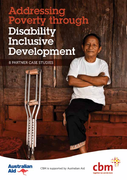
This booklet shows what disability inclusive development for poverty alleviation looks like in a range of settings and with different challenges through eight case studies of projects funded by CBM
...
Australia through the Australian Government NGO Cooperation Program (ANCP).
more
Crisis Group’s Watch List identifies ten countries or regions at risk of deadly conflict or escalation thereof in 2021. In these places, early action, driven or supported by the EU and its member states, could enhance prospects for peace and stabi
...
lity.
Crisis Group’s early-warning Watch List identifies up to ten countries and regions at risk of conflict or escalation of violence. In these situations, early action, driven or supported by the EU and its member states, could generate stronger prospects for peace. The Watch List 2021 includes an Introduction, detailed conflict analyses and EU-targeted recommendations on Central African Republic, Democratic Republic of Congo, Ethiopia, Iran & the Gulf, Libya, Mexico & Central America, Nagorno-Karabakh, Somalia, Thailand and Venezuela.
more

Fighting continues to displace people in Rakhine and Shan States causing displacement of 3,700 people bringing the total displacement in the first two months of the year to approximately 7,500 peopl
...
e.
UNICEF is restarting soap distributions in northern Rakhine State for approximately 100,000 people per month in coordination with food distributions by the World Food Programme. Over 37,400 metric tons has been transferred to the Rakhine office for these activities.
more

The Call to Action on Protection from GBV in Emergencies, formally launched in 2013 by the United Kingdom and Sweden, aims to fundamentally transform the way GBV is addressed in humanitarian operations via the collective action of numerous partners,
...
each bringing our various strengths and capacities to the table. Our goal is to drive change and foster accountability within the humanitarian sphere. The commitment to act and to hold ourselves accountable for action is what binds us together under the Call to Action.
more
Accessed on 21.05.2020
Considering a hotline? This set of tools will help you assess, set up and manage different types of channels to communicate with communities during humanitarian crises.
Children expressed the need for organisations to
support in the delivery of services such as health and
sanitation. The children also emphasized that schools
and the child-friendly spaces (CFSs) were effective
and important spaces to provide the
...
m with what they
need.
more
