Filter
1765
Text search:
ipc
Featured
Recommendations
279
New Publications
410
Language
Document type
No document type
479
Guidelines
469
Studies & Reports
239
Strategic & Response Plan
199
Manuals
101
Fact sheets
65
Situation Updates
59
Training Material
40
Infographics
34
Resource Platforms
32
Online Courses
25
Videos
15
App
4
Brochures
3
Dashboards/Maps
1
Countries / Regions
Global
104
Sierra Leone
87
Liberia
79
Congo, Democratic Republic of
65
Nigeria
50
India
47
Kenya
47
Yemen
44
South Sudan
42
South Africa
40
Uganda
38
Guinea
35
Syria
34
Mozambique
34
Haiti
30
Africa
30
Ethiopia
29
Rwanda
29
West and Central Africa
27
Latin America and the Carribbean
27
Ghana
26
Middle East and North Africa
26
Western and Central Europe
25
Tanzania
24
Russia
21
Senegal
20
East and Southern Africa
20
Malawi
18
Ukraine
17
Burkina Faso
16
Bangladesh
16
Angola
15
Namibia
14
Côte d’Ivoire / Ivory Coast
13
Eastern Europe and Central Asia
13
Nepal
12
Zambia
12
Central African Republic
12
South–East Asia Region
12
Mali
10
Zimbabwe
10
Sudan
10
Brazil
10
Lesotho
10
Myanmar / Burma
10
Somalia
9
Madagascar
9
Guinea-Bissau
8
Afghanistan
8
Cameroon
7
Philippines
7
Pakistan
7
Colombia
7
Togo
6
Chad
6
Cambodia
6
Indonesia
6
Eswatini/ Swaziland
6
Burundi
6
Western Pacific Region
6
Venezuela
6
Iraq
5
Lebanon
5
Eastern Europe
5
Palestine
5
North America
5
China
4
Sri Lanka
4
Laos
4
Vietnam
4
Saudi Arabia
3
Niger
3
Germany
3
Singapore
3
Asia
3
Timor Leste/ East Timor
3
USA
2
Jordan
2
Turkey
2
Honduras
2
Ecuador
2
Botswana
2
Chile
2
Paraguay
2
Italy
2
Djibouti
2
Moldova
2
Iran
2
Mauritius
2
United Kingdom
2
Thailand
1
Malaysia
1
Mauritania
1
Papua New Guinea
1
Vanuatu
1
Peru
1
Serbia
1
Hungary
1
Bolivia
1
Libya
1
Fiji
1
Solomon Islands
1
Poland
1
North Korea
1
Mongolia
1
Congo-Brazzaville
1
Canada
1
Tajikistan
1
Qatar
1
Bulgaria
1
Romania
1
Slovakia
1
Uzbekistan
1
Japan
1
Maldives
1
Tunisia
1
Portugal
1
Spain
1
Oman
1
Authors & Publishers
Publication Years
Category
Countries
703
Key Resources
215
Clinical Guidelines
78
Public Health
47
Women & Child Health
45
Capacity Building
37
Pharmacy & Technologies
19
Annual Report MEDBOX
1
Toolboxes
COVID-19
491
Ebola & Marburg
201
AMR
136
Cholera
125
Malaria
122
Rapid Response
87
Caregiver
69
2.0 Rapid Response
60
Conflict
52
Planetary Health
37
Natural Hazards
34
TB
34
Pharmacy
26
HIV
17
NCDs
13
Global Health Education
10
Refugee
9
NTDs
9
Mental Health
8
Disability
5
Polio
5
Specific Hazards
5
Health Financing Toolbox
3
Typhoon
2
Zika
2
South Sudan
1
Waste Management & Research 39(1) DOI: 10.1177/0734242X211029175
Countries around the world are facing the challenge of increased demand for care of people with COVID-19, compounded by fear, misinformation and limitations on movement that disrupt the delivery of health care for all conditions. Maintaining essential health services: operational guidance for the CO
...
Antimicrobial resistance (AMR) is a multifaceted, international public health problem, which poses a direct threat to the safety of the population of South Africa. A national response is required to complement the development of a global plan, as articulated in the WHO’s draft resolution EB134/37
...
Cholera is a diarrheal disease caused by the bacterium Vibrio cholera. The infection primarily spreads through contaminated water and food. Symptoms include the onset of acute diarrhea and/or vomiting, muscle cramps, and body weakness. If untreated, the infection can result in rapid dehydration and
...
La détection directe des protéines virales du SRAS-CoV-2 (antigènes) dans les écouvillons nasaux et autres sécrétions respiratoires à l'aide de tests immunologiques à flux latéral (également appelés tests de diagnostic rapide, TDR) offre une méthode plus rapide et moins coûteuse pour te
...
This report contains the results of an in-depth Training Needs Assessment (TNA) of Health Workers in the 4 project counties of the republic of Kenya – Nakuru, Kisumu, Nairobi and Bungoma. The assessment, facilitated by the UPOPs Project in close collaboration with the Ministry of Health and Minist
...
procédures : guide méthodologique
Globally, 311,000 women die of cervical cancer every year, 85 percent of them
in resource limited regions of the world. To address this grave threat to women,
the WHO made a call to action in 2018, resulting in accelerated plans to improve
cervical cancer control under the elimination threshold w
...
- Regional analysis of acute food insecurity: Current situation (February-March 2015)
Данное руководство по применению групповой интерперсональной терапии (групповой ИПТ) в лечении депрессии дополняет собой mental health Gap Action Programme Intervention Guide (mhGAP-IG) («Рук
...
Global food insecurity has markedly increased over the last two-years due to conflict, economic and political instability, displacement, environmental degradation and disasters, and major disruptions to global food systems because of the Covid-19 pandemic. In 2021, levels of hunger surpassed all pre
...
Свод методических рекомендаций состоит из нескольких тематически связанных и удобных для пользователя модулей для решения широкого спектра задач и приоритетных
...
Climate change triggers mounting food insecurity, poverty and displacement in Africa
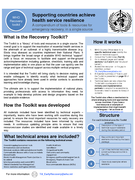
This compendium collates current tools and resources on quality improvement developed by the WHO Service Delivery and Safety Department and provides examples of how the tools and resources have been applied in country settings. The target audience for this document are ministries of health, facility
...
Outline
• Welcome and objectives
• Microbiology, epidemiology and clinical presentation
• Surveillance for imported cases including case definitions
• Laboratory diagnosis • Infection prevention and hospital readiness
• Patient flow and actions required at each step
• Co-ord
...
Antimicrobial resistance (AMR) is a global threat that requires urgent collaborative action within and among countries. AMR makes standard treatments ineffective and facilitates the spread of antimicrobial resistant infections rendering communities vulnerable. The Ministry of Health (MOH) and Minist
...
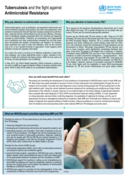
Antimicrobial resistance has become a serious public health threat for effective treatment of an ever increasing range of infections caused by bacteria, parasites, viruses and fungi. When infections can no longer be treated by first-line antibiotics, other antibiotics must be used, which are both mo
...