
Filter
432
Text search:
icrc
Featured
53
143
Language
Document type
267
45
39
38
11
10
10
7
2
1
1
1
Countries
24
18
13
13
11
9
9
8
8
8
7
7
6
6
6
6
6
5
5
4
4
4
3
3
3
3
3
2
2
2
2
2
2
2
2
2
2
2
2
2
2
1
1
1
1
1
1
1
1
1
1
1
1
1
1
1
1
1
1
1
1
1
1
1
1
1
1
1
1
1
1
1
1
1
1
1
1
1
1
1
1
Authors & Publishers
Publication Years
Category
107
100
16
16
16
11
2
Toolboxes
73
47
29
26
24
23
22
14
11
11
10
7
5
5
5
4
3
2
1
1
1
Action on behalf of unaccompanied and separated children should be guided by principles enshrined in international standards. The validity of these principles has been confirmed by experience and lessons learnt from conflicts and natural disasters in recent years. The objective of the present public
...
These ICRC guidelines outline the organization’s approach to mental health and psychosocial support (MHPSS) during and after armed conflict and other situations of violence. They provide a framework for harmonizing MHPSS programmes within the orga
...
With its expert practical advice on security in situations of armed conflict, this updated set of guidelines will prove invaluable to humanitarian personnel working at the operational level. Following on from the success of the first edition, published in 1999, it addresses new and developing threat
...
Working with limited resources in armed conflict and other situations of violence. Vol.2
Medical Waste Management
recommended

Every day, health-care providers are being attacked, patients discriminated against, ambulances held up at checkpoints, hospitals bombed, medical supplies looted and entire communities cut off from critical services around the world.
Between January 2012 and December 2014, the ...
Between January 2012 and December 2014, the ...
Security Survey for Health Facilities
recommended
The purpose of the survey is to identify the level of preparedness required by a health-care facility to be able to continue operating during, or following a conflict-related security event.
The survey method provides a measure of the security and preparedness of a given health facility in it ...
The survey method provides a measure of the security and preparedness of a given health facility in it ...
Doctors, nurses, ambulance drivers and first-aiders are coming under attack while trying to save lives. They are threatened, arrested or beaten, their hospitals looted or bombed. Some are unable to work because medical supplies can’t get through; some are forced to flee for their lives. Some are e
...

A guidance document in simple language for health personnel, setting out their rights and responsibilities in conflict and other situations of violence. It explains how responsibilities and rights for health personnel can be derived from international humanitarian law, human rights law and medical e
...
We have long been working to prevent and end sexual violence in armed conflicts and to ensure that the countless victims – men, women, boys and girls – receive the help they need.
In this document, we examine sexual violence specifically in relation to people deprived of their liberty. We c ...
In this document, we examine sexual violence specifically in relation to people deprived of their liberty. We c ...

Anaesthesia Handbook
recommended
The aim of this handbook is to provide guidance for trained anaesthetists working for the ICRC and to offer advice in areas where practice will differ from that in their home country. It is designed to supplement the practical training given in
...
This guidelines is aimed at humanitarian and human rights actors engaged in protection work, and is intended to act as an easy reference to the minimum standards to be met and the recommended guidelines to be followed in such work.
The 45 standards and 15 guidelines are reproduced in full, together
...

Professional Standards for Protection Work
recommended
Carried out by humanitarian and human rights actors in armed conflict and other situations of violence
This guideline (third edition) constitutes a set of minimum but essential standards aimed at ensuring that protection work is safe and effective. The standards reflect shared thinking and common
...
في النزاعات المسلحة وغيرها من حالات العنفالتي تنفذها الجهات الفاعلة في مجالي العمل الإنساني وحقوق الإنسان
Many migrants find themselves with limited access, if any, to information about risks, prevention measures, health care and other essential services. Migrants in transit, those in need of international protection or without legal status are likely to be particularly vulnerable, as well as those who
...

COVID-19 poses challenges in places of detention, given the specific vulnerabilities of detainees and difficulty of containing outbreaks in such settings. The ICRC's approach to COVID-19 in detention is anchored in support to the authorities who are
...
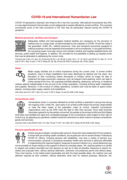
Accessed: 25.04.2020
COVID-19 represents a dramatic new threat to life in war-torn countries. International humanitarian law (IHL) is a key legal framework that provides crucial safeguards to people affected by armed conflicts. This overview summarizes some of the main provisions of IHL that may
...

Estos lineamientos están dirigidos principalmente a las autoridades y/o personal administrativo encargado de la gestión, planificación y adopción de decisiones para una adecuada inhumación de las personas fallecidas. Por ello, otro aspecto importante en el documento es la seguridad y protecció
...

It is targeted towards humanitarian settings and aims to complement other guidance on the management of the dead with a stronger focus on the practical realities faced when dealing with the dead in humanitarian settings. The guidance offers practical recommendations for the management of the bodies
...
