Filter
689
Text search:
Ministry
of
Health
,
World
Health
Organisation
(WHO)
Featured
Recommendations
48
New Publications
199
Language
Document type
No document type
420
Studies & Reports
128
Guidelines
54
Strategic & Response Plan
35
Manuals
28
Training Material
12
Situation Updates
7
Fact sheets
4
Resource Platforms
1
Countries / Regions
India
43
Kenya
29
Nigeria
24
Zambia
23
Malawi
23
Sierra Leone
21
Uganda
21
Nepal
20
Ghana
19
Global
19
Tanzania
15
Namibia
15
Africa
13
Ethiopia
12
Myanmar / Burma
12
Latin America and the Carribbean
11
Rwanda
10
Syria
9
South Africa
9
Lesotho
9
Zimbabwe
8
Western and Central Europe
7
Indonesia
6
Ukraine
6
Haiti
5
South Sudan
5
Botswana
5
Asia
5
Afghanistan
4
Cambodia
4
Mozambique
4
Sri Lanka
4
Congo, Democratic Republic of
3
Cameroon
3
Pakistan
3
East and Southern Africa
3
West and Central Africa
3
South–East Asia Region
3
Guinea
2
Senegal
2
Philippines
2
Jordan
2
Lebanon
2
Chad
2
Bangladesh
2
Benin
2
Eswatini/ Swaziland
2
Brazil
2
Croatia
2
Yemen
2
Middle East and North Africa
2
Eastern Europe
2
Laos
2
Timor Leste/ East Timor
2
Tajikistan
2
Russia
2
Iran
2
Kyrgyzstan
2
Liberia
1
Mali
1
Côte d’Ivoire / Ivory Coast
1
Niger
1
Iraq
1
Turkey
1
Thailand
1
China
1
Malaysia
1
Singapore
1
Central African Republic
1
Serbia
1
Hungary
1
El Salvador
1
Libya
1
Angola
1
Madagascar
1
Chile
1
Fiji
1
Bhutan
1
Venezuela
1
Poland
1
Palestine
1
Albania
1
Lithuania
1
Moldova
1
Uzbekistan
1
Kazakhstan
1
Georgia
1
Vietnam
1
Gabon
1
Turkmenistan
1
Japan
1
Denmark
1
Maldives
1
Mauritius
1
Portugal
1
Spain
1
Azerbaijan
1
Bosnia and Herzegovina
1
Authors & Publishers
Publication Years
Category
Countries
338
Key Resources
38
Clinical Guidelines
37
Public Health
33
Women & Child Health
22
Capacity Building
8
Pharmacy & Technologies
2
Toolboxes
Disability
52
COVID-19
43
Mental Health
40
AMR
37
HIV
35
TB
27
Conflict
23
Planetary Health
20
Ebola & Marburg
18
Caregiver
16
Refugee
14
Rapid Response
13
Global Health Education
12
Health Financing Toolbox
12
Natural Hazards
11
2.0 Rapid Response
11
Pharmacy
10
NTDs
10
Social Ethics
5
NCDs
5
Specific Hazards
4
Cholera
3
Zika
2
Polio
1
Malaria
1

Children continue to be exposed to powerful food marketing, which predominantly promotes foods high in saturated fatty acids, trans-fatty acids, free sugars and/or sodium and uses a wide variety of marketing strategies that are likely to appeal to c
...
The Transformation Agenda (TA) ushered in an ambitious reform process intended to transform the World Health Organization (WHO) into an organizatio
...

Access to safe blood and blood products is recognized as one of the key requirements for delivery of modern health care in the journey towards
...
This strategy defines the World Health Organization (WHO) vision and framework for supporting Member States to accelerate the development, implemen
...
Health in All Policies (HiAP) is not a new concept. While the term “HiAP” has received much attention since the 1990s, the concept
of working across sectors
...
This document sets out the criteria and procedures to be followed by countries in verifying the interruption of yaws transmission. It is intended for use by international verification teams, national yaws eradication programmes and
...
The recurrence of severe climate events combined with economic, social, and institutional fragilities leave El Salvador in an utterly critical humanitarian situation and highly vulnerable. Located in a disaster-prone subregion, El Salvador is among
...

This document provides an overview of strategic purchasing of nutrition services within primary health care. It introduces key terms and payment me
...

Lateral-flow rapid diagnostic tests (RDTs) continue to play a vital role in global health in the management and diagnosis of infectious diseases, including malaria, HIV and COVID-19. Visually interp
...

This sourcebook aims to detail why health needs to be part of urban and territorial planning and how to make this happen. It brings together two vital elements we need to build habitable cities on a
...
Rabies is a global public health problem with important socioeconomic impacts. Human rabies is preventable; almost all cases are transmitted through the bite of a rabid dog. Elimination
...
The World Health Organization Regional Office for Africa (WHO AFRO), in accordance with recommendations from various
...

The key updates include: content update in various sections based on new evidence; design changes for enhanced usability; a streamlined and simplified clinical assessment that includes an algorithm for follow-up; inclusion of two new modules
- Ess
...
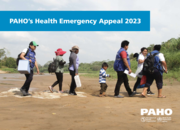
This document outlines PAHO’s regional priorities for the year 2023 to sustain and scale up health emergency and humanitarian assistance in the Americas, with a focus on five priority countries currently facing a prolonged humanitarian crisis and
...

This thematic brief accompanies the Working for Health 2022–2030 Action Plan, serving as a background and rationale to the related actions of the Working for
...

Safe water, sanitation and hygiene (collectively known as WASH) are crucial for human health and well-being. Yet, millions of people globally lack adequate WASH services and consequently suffer from
...

Every day in 2020, approximately 800 women died from preventable causes related to pregnancy and childbirth - meaning that a woman dies around every two minutes.
Sustainable Development Goal (SDG) target 3.1 is to reduce maternal mortality to less than 70 maternal deaths per 100 000 live births by
...

Globally, over two million women live with obstetric fistula with the majority of the cases
being from Africa. In low-resource settings such as Zambia, obstetric fistula (OF) is a visible indicato
...