
Filter
455
Text search:
psychosis
Featured
60
75
Language
Document type
312
43
30
27
23
10
7
2
1
Countries
29
19
11
10
10
8
8
8
7
7
6
6
5
5
4
4
4
3
3
3
3
3
2
2
2
2
2
2
2
2
1
1
1
1
1
1
1
1
1
1
1
1
1
1
1
1
1
1
1
1
1
1
1
1
1
1
1
1
1
Authors & Publishers
Publication Years
Category
123
31
13
8
7
7
1
Toolboxes
269
15
13
12
9
7
6
5
4
3
3
3
2
2
2
1
1
1
1
1
1
This module should always be used together with the
mhGAP Intervention Guide for Mental, Neurological
and Substance Use Disorders in Non-specialized Health
Settings (WHO, 2010), which outlines relevant general
principles of care and management of a range of other
mental, neurological and substa
...

What can you expect?
As a future facilitator your role will be to learn about the structure of mhGAP-IG, how to teach the materials and utilize opportunities to prastice facilitation and supervision skills.
As a supervisor your role will be to serve as a point of reference for non-specialized heal
...
Reduced healthy life expectancy due to the high burden of both mental ill health and noncommunicable diseases (NCDs) is a major public health concern in the European Region. The links between mental disorders and major NCDs are well established.
In clinical practice, however, mental disorders in pa
...
Addressing comorbidity between mental disorders and major noncommunicable diseases (Russian Version)

The European Mental Health Action Plan 2013–2020
recommended
Mental disorders are one of the top public health challenges in the WHO European Region, affecting about 25% of the population every year. In all countries, mental health problems are much more prevalent among the people who are most deprived. The WHO European Region therefore faces diverse challeng
...
Manual for use in primary care

Manual for use in primary care.
There is substantial evidence for the benefits of screening and brief intervention in primary health care for alcohol problems. However, there is a need for screening and brief interventions with cross-cultural relevance for substances other than alcohol or tobacco,
...

This block contains a wide variety of disorders that differ in severity (from uncomplicated intoxication and harmful use to obvious psychotic disorders and dementia), but that are all attributable to the use of one or more psychoactive substances (which may or may not have been medically prescribed)
...
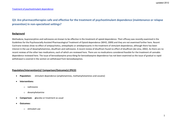
Q3: Are pharmacotherapies safe and effective for the treatment of psychostimulant dependence (maintenance or relapse prevention) in non-specialized settings?
This guide focuses on the evaluation of psychosocial programs that are aligned with two main goals: - To promote psychosocial wellbeing by promoting an environment that provides appropriate care, opportunities for development and protects children from exposure to situations that are harmful to thei
...

Introduction
Chapter A.4
2017 edition
Introduction
Chapter A.9

This publication seeks to describe the best treatments and practices based on the scientific evidence available at the time of writing as evaluated by the authors and may change as a result of new research. Readers need to apply this knowledge to patients in accordance with the guidelines and laws o
...
Developmental disorders
Chapter C.2
2014 Edition

Mood disorders
Chapter E.1
2015 edition
Mood disorders
Chapter E.2
Mood disorders
Chapter E.4
2018 edition


Substance use disorders
Chapter G.3
