
Filter
2524
Text search:
Switzerland
Featured
287
527
Language
2265
127
102
77
45
40
39
18
15
10
9
9
8
8
7
5
5
5
5
5
4
4
4
4
4
4
4
4
3
3
3
3
3
2
2
2
2
2
1
1
1
1
1
1
1
1
1
1
1
1
1
1
1
Document type
1326
469
357
169
59
59
32
19
14
8
4
3
2
1
1
Countries
128
88
40
37
35
35
35
33
29
28
28
27
27
25
24
24
22
20
20
19
18
17
16
15
14
14
13
12
11
11
10
10
10
10
10
9
9
9
9
9
8
8
8
7
7
7
6
6
6
5
5
5
5
5
4
4
4
4
4
4
4
4
4
4
4
4
4
3
3
3
3
3
3
3
3
3
3
3
3
2
2
2
2
2
2
2
2
2
2
2
2
2
2
2
2
2
2
2
2
2
2
2
2
2
2
1
1
1
1
1
1
1
1
1
1
1
1
1
1
1
1
1
1
1
1
1
1
1
1
1
1
1
1
1
1
1
1
1
1
Authors & Publishers
566
302
132
109
66
60
42
37
36
25
24
22
19
18
16
15
15
12
11
10
10
10
10
9
9
8
8
8
8
8
8
7
7
7
7
7
6
6
6
6
6
6
6
6
5
5
5
5
5
5
5
5
5
5
5
5
5
5
5
5
5
4
4
4
4
4
4
4
4
4
4
4
4
4
4
4
4
4
4
4
4
4
3
3
3
3
3
3
3
3
3
3
3
3
3
3
3
3
3
3
3
3
3
3
3
3
3
3
3
3
3
3
3
3
3
3
3
3
3
3
2
2
2
2
2
2
2
2
2
2
2
2
2
2
2
2
2
2
2
2
2
2
2
2
2
2
2
2
2
2
2
2
2
2
2
2
2
2
2
2
2
2
2
2
2
2
2
2
2
2
2
2
2
2
2
2
2
2
2
2
2
2
2
2
2
2
2
2
2
2
2
2
2
2
2
2
2
2
2
2
2
2
2
2
2
2
2
2
2
2
2
2
2
2
2
2
2
2
2
2
2
2
2
2
2
2
2
1
1
1
1
1
1
1
1
1
1
1
1
1
1
1
1
1
1
1
1
1
1
1
1
1
1
1
1
1
1
1
1
1
1
1
1
1
1
1
1
1
1
1
1
1
1
1
1
1
1
1
1
1
1
1
1
1
1
1
1
1
1
1
1
1
1
1
1
1
1
1
1
1
1
1
1
1
1
1
1
1
1
1
1
1
1
1
1
1
1
1
1
1
1
1
1
1
1
1
1
1
1
1
1
1
1
1
1
1
1
1
1
1
1
1
1
1
1
1
1
1
1
1
1
1
1
1
1
1
1
1
1
1
1
1
1
1
1
1
1
1
1
1
1
1
1
1
1
1
1
1
1
1
1
1
1
1
1
1
1
1
1
1
1
1
1
1
1
1
1
1
1
1
1
1
1
1
1
1
1
1
1
1
1
1
1
1
1
1
1
1
1
1
1
1
1
1
1
1
1
1
1
1
1
1
1
1
1
1
1
1
1
1
1
1
1
1
1
1
1
1
1
1
1
1
1
1
1
1
1
1
1
1
1
1
1
1
1
1
1
1
1
1
1
1
1
1
1
1
1
1
1
1
1
1
1
1
1
1
1
1
1
1
1
1
1
1
1
1
1
1
1
1
1
1
1
1
1
1
1
1
1
1
1
1
1
1
1
1
1
1
1
1
1
1
1
1
1
1
1
1
1
1
1
1
1
1
1
1
1
1
1
1
1
1
1
1
1
1
1
1
1
1
1
1
1
1
1
1
1
1
1
1
1
1
1
1
1
1
1
1
1
1
1
1
1
1
1
1
1
1
1
1
1
1
1
1
1
1
1
1
1
1
1
1
1
1
1
1
1
1
1
1
1
1
1
1
1
1
1
1
1
1
1
1
1
1
1
1
1
1
1
1
1
1
1
1
1
1
1
1
1
1
1
1
1
1
1
1
1
1
1
1
1
1
1
1
1
1
1
1
1
1
1
1
1
1
1
1
1
1
1
1
1
1
1
1
1
1
1
1
1
1
1
1
1
1
1
1
1
1
1
1
1
1
1
1
1
1
1
1
1
1
1
1
1
1
1
1
1
1
1
1
1
1
1
1
1
1
1
1
1
1
1
1
1
1
1
1
1
1
1
1
1
1
1
1
1
1
1
1
1
1
1
1
1
1
1
1
1
1
1
1
1
1
1
1
1
1
1
1
1
1
1
1
1
1
1
1
1
1
1
1
1
1
1
1
1
1
1
1
1
1
1
1
1
1
1
1
1
1
1
1
1
1
1
1
1
1
1
1
1
1
1
1
1
1
1
1
1
1
1
1
1
1
1
1
1
1
1
1
1
1
1
1
1
1
1
1
1
1
1
1
1
1
1
1
1
1
1
1
1
1
1
1
1
1
1
1
1
1
1
1
1
1
1
1
1
1
1
1
1
1
1
1
1
1
1
1
1
1
1
1
1
1
1
1
1
1
1
1
1
1
1
1
1
1
1
1
1
1
1
1
1
1
1
1
1
1
1
1
1
1
1
1
1
1
1
1
1
1
1
1
1
1
1
1
1
1
1
1
1
1
1
1
1
1
1
1
1
1
1
1
1
1
1
1
1
1
1
1
1
1
1
1
1
1
1
1
1
1
1
1
1
1
1
1
1
1
1
1
1
1
1
1
1
1
1
1
1
1
1
1
1
1
1
1
1
1
1
1
1
1
1
1
1
1
1
1
1
1
1
1
1
1
1
1
1
1
1
1
1
1
1
1
1
1
1
1
1
1
1
1
1
1
1
1
1
1
1
1
1
1
1
1
1
1
1
1
1
1
1
1
1
1
1
1
1
1
1
1
1
1
1
1
1
1
1
1
1
1
1
1
1
1
1
1
1
1
1
1
1
1
1
1
1
1
1
1
1
1
1
1
1
1
1
1
1
1
1
1
1
1
1
1
1
1
1
1
1
1
1
1
1
1
1
1
1
1
1
1
1
1
1
1
1
1
1
1
1
1
1
1
1
1
1
1
1
1
1
1
1
1
1
1
1
1
1
1
1
1
1
1
1
1
1
1
1
1
1
1
1
1
1
1
1
1
1
1
1
1
1
1
1
1
1
1
1
1
1
1
1
1
1
1
1
1
1
1
1
1
1
1
1
1
1
1
1
1
1
1
1
1
1
1
1
1
1
1
1
1
1
1
1
1
1
1
1
1
1
1
1
1
1
1
1
1
1
1
1
1
1
1
1
1
1
1
1
1
1
1
1
1
1
1
1
1
1
1
1
1
1
1
1
1
1
1
1
1
1
1
1
1
1
1
1
1
1
1
1
1
1
1
1
1
1
1
1
1
1
1
1
1
1
1
1
1
1
1
1
1
1
1
1
1
1
1
1
1
1
1
1
1
1
1
1
1
1
1
1
1
1
1
1
1
1
1
1
1
1
1
1
1
1
1
1
1
1
1
1
1
1
1
1
1
1
1
1
1
1
1
1
1
1
1
1
1
1
1
1
1
1
1
1
1
1
1
1
1
1
1
1
1
1
1
1
1
1
1
1
1
1
1
1
1
1
1
1
1
1
1
1
1
1
1
1
1
1
1
1
1
1
1
1
1
1
1
1
1
1
1
1
1
1
1
1
1
1
1
1
1
1
1
1
1
1
1
1
1
1
1
1
1
1
1
1
1
1
1
1
1
1
1
1
1
1
1
1
1
1
1
1
1
1
1
1
1
1
1
1
1
1
1
1
1
1
1
1
1
1
1
1
1
1
1
1
1
1
1
1
1
1
1
1
1
1
1
1
1
1
1
1
1
1
1
1
1
1
1
1
1
1
1
1
1
1
1
1
1
1
1
1
1
1
1
1
1
1
1
1
1
1
1
1
1
1
1
1
1
1
1
1
1
1
1
1
1
1
1
1
1
1
1
1
1
1
1
1
1
1
1
1
1
1
1
1
1
1
1
1
1
1
1
1
1
1
1
1
1
1
1
1
1
1
1
1
1
1
1
1
1
1
1
1
1
1
1
1
1
1
1
1
1
1
1
1
1
1
1
1
1
1
1
1
1
1
1
1
1
1
1
1
1
1
1
1
1
1
1
1
1
1
1
1
1
1
1
1
1
1
1
1
1
1
1
1
1
1
1
1
1
1
1
1
1
1
1
1
1
1
1
1
1
1
1
1
1
1
1
1
1
1
1
1
1
1
1
1
1
1
1
1
1
1
1
1
1
1
1
1
1
1
1
1
1
1
1
1
1
1
1
1
1
1
1
1
1
1
1
1
1
1
1
1
1
1
1
1
1
1
1
1
1
1
1
1
1
1
1
1
1
1
1
1
1
1
1
1
1
1
1
1
1
1
1
1
1
1
1
1
1
1
1
1
1
1
1
1
1
1
1
1
1
1
1
1
1
1
1
1
1
1
1
1
1
1
1
1
1
1
1
1
1
1
1
1
1
1
1
1
1
1
1
1
1
1
1
1
1
1
1
1
1
1
1
1
1
1
1
1
1
1
1
1
1
1
1
1
1
1
1
1
1
1
1
1
1
1
1
1
1
1
1
1
1
1
1
1
1
1
1
1
1
1
1
1
1
1
1
1
1
1
1
1
1
1
1
1
1
1
1
1
1
1
1
1
1
1
1
1
1
1
1
1
1
1
1
1
1
1
1
1
1
1
1
1
1
1
1
1
1
1
1
1
1
1
1
1
1
1
1
1
1
1
1
1
1
1
1
1
1
1
1
1
1
1
1
1
1
1
1
1
1
1
1
1
1
1
1
1
1
1
1
1
1
1
1
1
1
1
1
1
1
Publication Years
1
651
1542
309
20
1
Category
422
298
223
213
183
76
58
Toolboxes
290
249
137
134
112
110
90
80
68
67
66
63
58
55
53
50
43
38
38
36
31
20
17
15
8
1
1

The objective of Health in the Americas: Overview of the Region of the Americas in the Context of the COVID-19 Pandemic is to respond to the need to address important public health issues in an increasingly timely manner, while serving as a platform with a close focus on specific issues of regional
...
importance. This 2022 edition is the second in its new format, providing an overview of the analysis, as well as an in-depth description of the key issues related to COVID-19 in the Region of the Americas. This overview is supported by the Health in the Americas+ virtual platform, which offers interactive resources for data analysis and allows for the comparison of information disaggregated by subregions and countries.
more

UNAIDS is calling on governments to ensure that the right to health is realized by all by prioritizing public investments in health. At least half of the world’s population cannot access essential health services. Every two minutes a woman dies while giving birth. Among the people being left behin
...
d are women, adolescents, people living with HIV, gay men and other men who have sex with men, sex workers, people who inject drugs, transgender people, migrants, refugees and poor people.
more
These guidelines provide updated evidence-based recommendations on the priority HCV-related topics from the 2018 WHO Guidelines for the care and treatment of persons diagnosed with chronic hepatitis C infection and the 2017 WHO Guidelines on hepatitis B and C testing. These priority areas are:
...
direct-acting antiviral (DAA) treatment of adolescents and children ages ≥3 years of age
simplified HCV service delivery (decentralization, integration and task sharing)
HCV diagnostics – use of point-of-care (POC) HCV ribonucleic acid (RNA) assays and reflex HCV RNA testing.
These guidelines also update existing chapters without new recommendations, such as the inclusion of new manufacturers’ protocols on the use of dried blood spot (DBS) for HCV RNA testing and new data to inform the limit of detection for HCV RNA assays as a test of cure, in addition to their use for diagnosis.
more
Essential health care service disruption due to COVID-19: lessons for sustainability in Nigeria
AHOP National Centre based in Nigeria
World Health Organization WHO, Regional Office Africa
(2022)
C_WHO
The brief concludes that sustaining the continuity of EHS requires policies that ensure a whole-society and systems strengthening approach. This involves increased health care investment, community engagement, disease control regulations, and multisector approaches to improve resilience, EHS quality
...
, and equity.
more

Cities are uniquely positioned to understand local needs and respond rapidly to changing conditions to safeguard health. These changes require strong city leadership to implement multisectoral, health-relevant policies and public services that engage communities. The response to malaria must be an i
...
ntegral part of such policies and processes.
This framework supports the control and elimination of malaria in urban environments. It provides guidance for city leaders, health programmes and urban planners as they respond to the challenges of rapid urbanization in a targeted way. For each urban context, the strategic use of data can inform effective, tailored responses and help build resilience against the threat of malaria and other vector-borne diseases.
more

Current Tropical Medicine Reports (2018) 5:247–256 https://doi.org/10.1007/s40475-018-0166-2 .Purpose of the Review Buruli ulcer (BU) is a necrotizing and disabling cutaneous disease caused by Mycobacterium ulcerans, one of the skin-related neglected tropical diseases (skin NTDs). This article aim
...
s to review the current knowledge of this disease and challenges ahead.
more
1.1 Why this course is needed
The first few hours and days of a newborn baby’s life are a critical window for establishing breastfeeding and for providing mothers with the support they need to breastfeed successfully. Since 1991, the Baby-friendly Hospital Initiative (BFHI) has helped to motivate
...
facilities providing maternity and newborn baby services worldwide to better support breastfeeding. It has been adopted by many countries and organizations. The BFHI aims to provide a health-care environment that supports mothers to acquire the skills necessary to exclusively breastfeed for six months, and to continue breastfeeding for two years or beyond.
more
Available in English, French and Spanish
Policy Brief. More languages available here https://apps.who.int/iris/handle/10665/179517
Joint EUAA, IOM and OECD report provides new insights on displacement from and within Ukraine
The European Union Agency for Asylum (EUAA), the International Organization for Migration (IOM) and the Organisation for Economic Co-operation and Development (OECD) have published a Joint Report on profil
...
es, experiences, and aspirations of forcibly displaced people by the Russian invasion of Ukraine.
The Joint Report provides an in-depth study of the scale of displacement to EU countries and people seeking protection there, by building on initial findings derived from a June EUAA-OECD Survey.
more
La pratique infirmière avancée (PIA), telle qu’évoquée dans le présent document, se réfère aux services et
aux interventions de santé renforcés et étendus, assurés par des infirmières qui, grâce à des compétences avancées, influent sur les résultats des soins de santé cliniques
...
et dispensent des services de santé directs à la personne, aux familles et aux collectivités (CNA, 2019; Hamric et Tracy, 2019). Une infirmière de pratique avancée (IPA) a acquis, grâce à une formation complémentaire, une base de connaissances spécialisées, des capacités perfectionnées en matière de prise de décision et des compétences cliniques pour une pratique infirmière plus étendue, dont les caractéristiques dépendent du contexte dans lequel elle est accréditée
à exercer ses fonctions (CII, 2008a). L’infirmière clinicienne spécialisée (ICS) et l’infirmière praticienne (IP)
sont les deux catégories d’IPA les plus généralement
more

In 1997, the Fiftieth World Health Assembly adopted resolution WHA50.29 on the elimination of
lymphatic filariasis as a public health problem. Preliminary guidance from WHO printed in 2011 referred to “verification” as the official process by which the achievements of the Global Programme to El
...
iminate Lymphatic Filariasis (GPELF) would be confirmed. For the sake of harmonization, the terminology now used for elimination of lymphatic filariasis as a public health problem is “validation”. In 2015, the WHO Strategic and Technical Advisory Group for Neglected Tropical Diseases endorsed standardized processes for confirming and acknowledging success for all neglected tropical diseases targeted for eradication, elimination of transmission, or elimination as a public health problem.
more
Many countries have made significant progress in the implementation of World Health Organization recommended preventive chemotherapy strategy, to eliminate lymphatic filariasis (LF). However, pertinent challenges such as the existence of areas of residual infections in disease endemic districts pose
...
potential threats to the achievements made. Thus, this study was undertaken to assess the importance of these areas in implementation units (districts) where microfilaria (MF) positive individuals could not be found during the mid-term assessment after three rounds of mass drug administration.
more

Women have less access to the development services and support – such as adequate healthcare, education and
modern technology – that make people more resilient to climate change and other shocks and stressors.2
Women’s unequal access to resources, their disproportionate responsibility for ca
...
re of dependents (typically unpaid),
and the insecurity and precariousness of their paid labour all contribute to the feminisation of poverty and women’s
heightened vulnerability to climate hazards. Climate change is a multiplier of existing vulnerabilities and threatens to
reverse hard-earned development gains for all people, and particularly for women.
more

An estimated 1.3 billion people – or 16% of global population worldwide – experience a significant disability today. Persons with disabilities have the right to the highest attainable standard of health as those without disabilities. However, the WHO Global report on health equity for persons w
...
ith disabilities demonstrates that while some progress has been made in recent years, the world is still far from realizing this right for many persons with disabilities who continue to die earlier, have poorer health, and experience more limitations in everyday functioning than others. These poor health outcomes are due to unfair conditions faced by persons with disabilities in all facets of life, including in the health system itself. Countries have an obligation under international human rights law to address the health inequities faced by persons with disabilities. Furthermore, the Sustainable Development Goals and global health priorities will not progress without ensuring health for all.
more
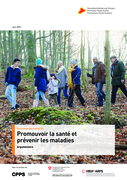
La promotion de la santé et la prévention des maladies nécessitent une action multisectorielle qui renforce les environnements favorables à la santé et oriente les comportements. Au niveau des cantons et des communes, de nombreuses politiques, telles
la protection de la jeunesse, la promotion
...
de la santé à l’école, la promotion de la santé et de la sécurité au travail, l’action sociale, le soutien au logement, la promotion de l’intégration, l’aménagement du territoire, la gestion de la mobilité ou la protection
de l’environnement sont des leviers très efficaces pour améliorer l’état de santé de la population.
L’argumentaire «Promouvoir la santé et prévenir les maladies» a pour objectif d’expliquer les enjeux et
d’inciter les personnes actives dans ces divers domaines à intégrer la promotion de la santé dans leurs activités et projets. Cela exige de leur mettre à disposition des informations actuelles et facilement compréhensibles
more

The results of the report clearly show that in 2020, a year dominated by the emergence of COVID-19 and its associated health and economic crises, governments around the world rose to the challenge. Sharp increases in government spending on health at all country income levels underpinned the rise in
...
health spending to a new high of US $9 trillion (approximately 11% of global GDP). Government health spending generally increased and offset declines in out-of-pocket spending. Importantly, the rise in government health spending was part of a much broader fiscal response to the pandemic. In high income and upper-middle income countries social protection spending also increased sharply in as governments attempted to cushion populations from the economic impacts of COVID-19. In contrast to health and social protection, growth in education spending was relatively subdued. Countries face the further challenge of sustaining increased public spending on health and other social sectors in the face of deteriorating macroeconomic conditions and rising debt servicing. This also includes the challenge of sustaining external support for low income countries, which is essential for reducing ensuring poverty, ensuring access to health services and strengthening pandemic preparedness.
more
Although Shiga toxin-producing Escherichia coli (STEC) have been isolated from a variety of food production animals, they are most commonly associated with ruminants from which we derive meat and milk. Because of the widespread and diverse nature of ruminant-derived food production, coupled with the
...
near ubiquity of STEC worldwide, there is no single definitive solution for controlling STEC that will work alone or in all situations. Instead, the introduction of multiple interventions applied in sequence, as a “multiple-hurdle scheme” at several points throughout the food chain (including processing, transport and handling) will be most effective.
This report summarizes the review and evaluation of interventions applied for the control of STEC in cattle, raw beef and raw milk and raw milk cheese manufactured from cows’ milk, and also evaluates available evidence for other small ruminants, swine and other animals. The information is presented from primary production, to the end of processing, providing the reader with information on the currently available interventions based on the latest scientific evidence.
This work was undertaken to support the development of guidelines for the control of STEC in beef, raw milk and cheese produced from raw milk by the Codex Committee on Food Hygiene (CCFH).
more
Obesity and diet-related noncommunicable diseases (NCDs) have been steadily increasing globally, and with them, a pressing need to implement effective responses to address the contributing factors. Among the available evidence-based policy options that enable healthier choices and improved diets is
...
the implementation of taxes on sugar-sweetened beverages (SSBs).
This tax manual is a practical guide for policy-makers and others involved in SSB tax policy development to promote healthy diets and populations. It features summaries and case studies of SSB global taxation evidence, and provides support on the policy-cycle development process to implement SSB taxation — from problem identification and situation analysis through policy design, development and implementation to the monitoring and evaluation phase. Additionally, the manual identifies and debunks industry tactics designed to dissuade policy-makers from implementing these taxes.
SSB taxes can be a win-win-win strategy: a win for public health (and averted health-care costs), a win for government revenue, and a win for health equity.
more

International commitment to eliminate trachoma as a public health problem worldwide is supported by resolution WHA51.11 of the World Health Assembly .1 Important progress towards this goal has been made by harnessing the mostly informal relationships that exist between partners including Member Stat
...
es, the World Health Organization (WHO), academic institutions, donors and nongovernmental organizations. Recognizing that work remains to be done and that the 2020 target2 for elimination is rapidly approaching, in February 2015 the WHO Department of Control of Neglected Tropical Diseases convened a group of academic institutions that had for many years helped WHO to implement its mandate on trachoma and to work towards establishing a Network of WHO collaborating centres (WHOCCs) for Trachoma. The report of that meeting has been published.
more
