
Filter
79
Featured
5
1
Language
Document type
41
12
9
5
4
2
1
1
1
1
1
1
Countries
9
2
1
1
1
1
1
1
1
1
Authors & Publishers
Publication Years
Category
10
7
1
1
Monitoring air quality (for example collecting continuous and quality data) is integral and critical to detecting air pollutants and to ensuring information sharing with the public, policy-makers, and regulatory compliance. Air quality monitoring is also one of the first and necessary steps for quan
...
La Hoja de Ruta del Grupo Regional de Expertos en AirQ+ representa un hito para la región de las Américas en la integración de la evidencia científica en la toma de decisiones sobre calidad del aire y salud pública. Fruto de un proceso de construcción colectiva que reunió a más de 100 especi
...

os pacientes y el personal de atención de salud permanecen en los establecimientos de salud durante largos períodos. Por lo tanto, asegurar una calidad del ambiente en espacios
interiores (CAEI) en relación con la salud es esencial para proteger a los pacientes, visitantes y trabajadores de salu
...
More than a quarter of the global population still cook meals over open fires and/or on simple stoves fuelled by firewood, agricultural waste, dried dung, charcoal, and coal. This practice results in the emission of harmful and dangerously high levels of household air pollution.
Exposure to this h
...

Exposure to air pollution has significant adverse health effects, leading to nearly 1 in every 8 deaths globally. Air pollution affects all age groups, from unborn children to older people, in both high- and low-income nations.

WHO, as the coordinating authority on international health, supports countries in protecting public health through evidence-based policies and actions. Considering the significant health burden and the multiple potential benefits of interventions, the WHO Air Quality, Energy and Health Unit aims to
...
A escala mundial, unos 2100 millones de personas siguen cocinando con combustibles sólidos (como leña, desechos agrícolas, carbón vegetal y mineral y excrementos de animales) y queroseno, en fuegos abiertos y fogones poco eficientes (1). En su mayor parte, se trata de personas en situación de p
...
La contaminación atmosférica proviene principalmente de cinco actividades humanas que emiten una gama de sustancias, tales como monóxido de carbono, dióxido de carbono, óxido de nitrógeno, dióxido de nitrógeno, dióxido de azufre, ozono troposférico o a nivel del suelo, material particulado
...
La contaminación atmosférica es una de las mayores amenazas para la salud infantil. El 99% de la población mundial vive en lugares donde el aire se considera nocivo. Respirar aire contaminado perjudica la salud de los niños y las niñas y pone en peligro su futuro.


Clean Household Energy Solutions Toolkit
recommended
A systematic review of the evidence has demonstrated the key role of clean household energy in improving global health, reaffirming the importance of United Nations’ Sustainable Development Goal (SDG) 7, to achieve worldwide access to affordable, modern and clean energy by 2030.
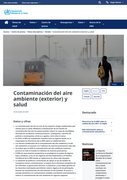
La contaminación del aire exterior representa un importante riesgo medioambiental para la salud que afecta a todas las personas en los países de ingreso bajo, mediano y alto.
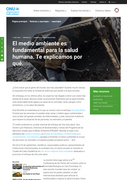
¿Por qué es tan importante incluir la dimensión ambiental en el enfoque Una sola salud?

Use estas herramientas para ayudar a los pacientes a manejar su salud los días de calor o de mala calidad de aire.
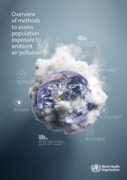
This document summarizes several air quality measurement and modelling methods that can be used to estimate ground-level air pollutant concentrations and presents multiple approaches to monitoring ambient air pollution at different spatial and temporal scales. These methods are crucial for estimatin
...
In 2019, WHO estimated that 6.7 million premature deaths could be attributed to ambient and household air pollution from particulate matter (particles with a diameter less than 2.5 μm, PM2.5. Of the 4.2 million deaths attributed specifically to ambient air pollution exposures.
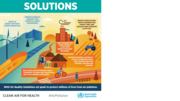
WHO Air Quality Guidelines set goals to protect millions of lives from air pollution
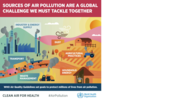
This report describes the “Building health workers capacity on air pollution and health” pilot workshop held in Ghana in 2022 which aimed at testing the training material of the first WHO Air Pollution and Health Training toolkit (APHT) targeting health professionals. APHT aims at strengthening
...

Almost the entire Rwandan population (98.5%) relies on polluting fuels, particularly firewood and charcoal, for cooking. Access to clean energy such as electricity is still limited. In 2022, 70% of the population lived in towns and villages that have electricity – 49% from the national grid and 21
...
