
Filter
982
Featured
48
21
Language
Document type
516
89
81
52
45
43
37
37
29
21
11
10
4
3
Countries
88
22
13
10
9
9
8
8
8
6
6
6
6
5
5
5
4
4
4
3
3
3
3
3
3
3
2
2
2
2
2
2
2
2
2
2
1
1
1
1
1
1
1
1
1
1
1
1
1
1
1
1
1
1
1
1
1
1
1
1
1
1
1
1
1
Authors & Publishers
Publication Years
Category
116
61
27
15
15
7
4
An overview on the health equity impact of policy and action: Is it making a difference? Why or why not?
Dieses Kurzdossier konzentriert sich besonders auf den Zusammenhang zwischen zwei übertragbaren
tropischen Armutserkrankungen – dem Wurmbefall des Darms durch Geohelminthen wie Spul-,
Peitschen- und Hakenwürmer sowie der Schistosomiasis (Bilharziose). Es zeigt Möglichkeiten zu
deren Bekämpf
...
Der Klimawandel und seine Folgen bedrohen schon heute Millionen von Menschen weltweit. Wissenschaftler/-innen warnen seit Jahren davor, dass ein ungebremster Klimawandel die Welt ins Chaos führen wird. Obwohl der Klimaschutz seit Jahren im Zentrum der öffentlichen Debatte steht und auch weltweit i
...
Kaum ein Jahr vergeht inzwischen, ohne dass von neuen Rekorden bei Extremwetterereignissen berichtet wird. Naturkatastrophen und Wetterextreme werden insgesamt immer häufiger und nehmen an Stärke zu – und der Klimawandel spielt dabei eine immer größere und zerstörerische Rolle. Wie schlimm di
...
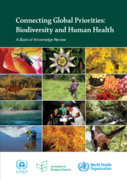
Healthy communities rely on well-functioning ecosystems. They provide clean air, fresh water, medicines and food security. They also limit disease and stabilize the climate. But biodiversity loss is happening at unprecedented rates, impacting human health worldwide, according to a new state of knowl
...
Training Modules for climate change and Health - WHO
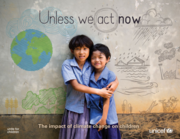
Today’s children, and their children, are the ones who will live with the consequences of climate change.
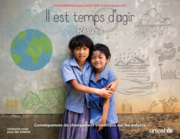
Today’s children, and their children, are the ones who will live with the consequences of climate change.
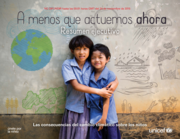
Los niños de hoy, y sus hijos, son los que vivirán las consecuencias del cambio climático.
Connecting global priorities: biodiversity and human health: a state of knowledge review
By almost any measure, human health is better now than at any time in history. Life expectancy has soared from 47 years in 1950–1955, to 69 years in 2005–2010, and death rates in children younger than 5 years of age have decreased substantially, from 214 per thousand live births in 1950–1955,
...
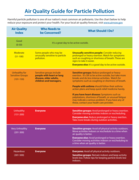
Harmful particle pollution is one of our nation’s most common air pollutants. Use the chart below to help reduce your exposure and protect your health. For your local air quality forecast, visit www.airnow.gov
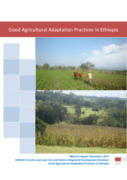
Ethiopia is one of the most vulnerable countries to climate change in East Africa. The future climate change projections suggest that temperature will rise and rainfall variability will increase with high unpredictability. Agriculture is extremely vulnerable to these
changes, with concerns that the
...
Bioethics 519 (online) doi:10.1111/bioe.12145 Volume 29 Number 8 2015 pp. 488–596;
Pandemic plans recommend phases of response to an emergent infectious disease (EID) outbreak, and are primarily aimed at preventing and mitigating human-to-human transmission. These plans carry presumptive weight
...

Clinical Microbiology and Infection Volume 21, Issue 5, May 2015, Pages 433-443;
The neglected zoonotic diseases (NZDs) have been all but eradicated in wealthier countries, but remain major causes of ill-health and mortality across Africa, Asia, and Latin America. This neglect is, in part, a conse
...

011 - Biogeochemical Cycles
In this video Paul Andersen explains how biogeochemical cycles move required nutrients through the abiotic and biotic spheres on our planet. Matter on the Earth is conserved so producers must receive required nutrients through the water cycle, carbon cycle, nitrogen c
...

Environmental Research Letters
Microplastic debris floating at the ocean surface can harm marine life. Understanding the severity of this harm requires knowledge of plastic abundance and distributions. Dozens of expeditions measuring microplastics have been carried out since the 1970s, but they ha
...

Briefing Note no. 80 November 2015
