Filter
236
Text search:
visually
impaired
Featured
10
58
Language
Document type
191
17
14
7
3
2
1
1
Countries
9
9
9
9
8
7
6
6
6
5
5
4
4
4
4
4
4
3
3
3
3
3
3
2
2
2
2
2
2
2
1
1
1
1
1
1
1
1
1
1
1
1
1
1
1
Authors & Publishers
Publication Years
Category
107
13
8
6
3
3
1
Toolboxes
110
9
9
8
5
3
3
2
2
2
2
2
1
1
1

Accessed online March 2018

The aim of this pamphlet is to inform parents and guardians of supports and services available for children and young people who are blind or have a visual impairment.
The WHO estimates that 19 million children aged 15 years or younger are visually impaired. Of these, 1.4 million are irreversibly blind and need visual rehabilitation interventions for full psycholo
...

On 31 May 2022, the Konrad-Adenauer-Stiftung (KAS) Namibia – Angola Office handed over equipment to the Namibian Federation of the Visually Impaired (NFVI), at their head office in Windhoek. The m
...
This monograph presents 12 reports of successful programs serving children with special needs in various nations. The program locations and the program report titles and authors are as follows: (1) Austria: "Integration Models for Elementary and Secondary Schools in Austria" (Volker Rutte)
...

Preventing Physical Impairment in Childhood CBM Strategy Overview | Laminated flip charts | These are the main implementing tools in the prevention program, developed as A4 sized booklets which can be carried easily. They constitute the basic information a community rehabilitation worker needs to co
...



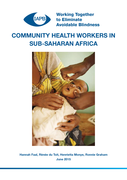
Community Health Workers in Sub Saharan Africa
recommended
A booklet on how CHWs were addressing eye health across Africa based on desk research and a survey in 23 countries

Samuel P. Hayes Research Library | hayeslibrary@perkins.org | 617-972-7250 | http://www.perkins.org/researchlibrary

Recommendations on the inclusion of people with disabilities in eye care made by CBM's Medical Eye Care Advisory Group as a result of
a meeting in Hydrabad, India, in 2012.

Trachoma is the world’s leading infectious cause of blindness. It is one of 18 neglected
tropical diseases (NTDs) that affect over one billion of the world’s poorest people.