
Filter
256
Text search:
l'aide
Featured
45
70
Language
Document type
131
37
34
31
5
5
4
3
2
1
1
1
1
Countries
15
11
9
8
7
7
6
6
5
5
5
4
4
4
3
3
3
3
3
2
2
2
2
2
2
1
1
1
1
1
1
1
1
1
1
1
1
1
1
1
1
1
1
1
1
1
1
1
1
1
1
1
1
Authors & Publishers
Publication Years
Category
211
31
16
10
7
5
Toolboxes
43
25
15
13
10
8
8
5
5
4
3
3
3
3
2
2
1
1
1
1
Sphere Essentials
recommended
A number of tools and resources have been developed to support humanitarian professionals working with the Sphere Handbook and the Core Humanitarian Standard.
You will find “Sphere unpacked” guides, training resources, videos and promotional materials in several languages to download at http://
...
Sphere unpacked
Sphere for Monitoring and Evaluation
recommended
Sphere Unpacked
The CHS is a voluntary and measurable standard, which means its application can be objectively assessed. The CHS Verification Scheme allows organisations to measure the extent to which they have successfully applied the CHS requirements, and allows them, to demonstrate that they have done so. The Sc
...
The Minimum Standards for Age and Disability Inclusion in Humanitarian Action inform the design, implementation, monitoring and evaluation of humanitarian programmes across all sectors and phases of response, and in all emergency contexts, ensuring older people and people with disabilities are not e
...
Currently there is no publicly available source of consolidated information on attacks on health care in emergencies. This report is a first attempt to consolidate and analyse the data that is available from open sources. While the data are not comprehensive, the findings shed light on the severity
...
Despite the stated centrality of protection in humanitarian action and a growing attention to protection activities, the evaluation of protection has received relatively little attention. This pilot guide seeks to fill this gap, providing insights and guidance to those evaluating protection in the c
...
Section One
summarizes UNHCR’s mandate of international protecdtion and the aim and principles of emergency
response;
Section Two
deals with emergency management;
Section Three
covers the vital sectors and problem areas in refugee emergencies, including health, food, sanitation
and water, a
...

Ce guide sera particulièrement utile pour les gestionnaires de programme qui concoivent, gèrent et évaluent les systèmes logistique pour les programmes de santé. En outre, décideurs, intervenants du système et toute personne travaillant dans la logistique trouveront dans ce guide une utile a
...

Conceived as part of the CWS-A/P project on regional security and risk management, this book presents a
collection of testimonies from aid workers in some of the most insecure and volatile environments in the world.
The participants recount a broad array of security incidents, such as kidnappings,
...

This EISF report provides an analysis of the issues surrounding the relationship between NGO’s and their local partners. It includes a section on the topic and its background, responsabilities towards the partner organisation and particularly in terms of security, how to enable and help the partne
...
The Cost of Security Risk Management for NGOs explores the costs related to safety and security management for aid programmes. It aims to assist all aid practitioners to determine their risk management expenditure more accurately, and demonstrate an evidence-based approach when presenting this infor
...
The transformation of the humanitarian landscape has already made a significant impact on the operational security of INGOs and other humanitarian actors. This report serves to inform strategic policy priorities and approaches to security planning and coordination, and addresses three main questions
...
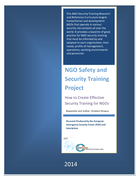
The NGO Safety and Security Training Report provides a narrative of the research findings, an updated curriculum, and guidance tools for training. It is based on extensive research and interviews with members of the NGO community. The report draws upon existing training materials, community consulta
...
The report offers an analysis of the broader challenges to securing humanitarian action and recommends areas for improvement. This study will contribute to improving the way humanitarians ‘do business’ in complex
security environments. Document also available in French, Arabic and Spanish.

The report offers an analysis of the broader challenges to securing humanitarian action and recommends areas for improvement. This study will contribute to improving the way humanitarians ‘do business’ in complex security environments.
El informe ofrece un análisis de los mayores retos para asegurar la acción humanitaria y da recomendaciones sobre aspectos que mejorar. Este estudio ayudará a mejorar la manera en que el personal humanitario hace su trabajo en entornos de seguridad complejos.
Manual de Normas Mínimas para la Protección de la Infancia en la Acción Humanitaria (CPMS) - Resumen
El Grupo de Trabajo para la Protección de la Infancia define a la protección de la infancia como “la prevención y la respuesta al abuso, negligencia, explotación y violencia contra los niños, niñas y adolescentes”. Complemento al Manual Esfera.
