
Filter
994
Text search:
World
Health
Organization,
Regional
Office
for
Africa
Featured
Recommendations
105
New Publications
245
Language
Document type
No document type
490
Studies & Reports
203
Guidelines
132
Strategic & Response Plan
60
Manuals
53
Training Material
19
Situation Updates
16
Fact sheets
15
Resource Platforms
4
App
1
Online Courses
1
Countries / Regions
Global
56
Kenya
38
Ethiopia
30
Sierra Leone
29
Africa
27
Uganda
23
Liberia
22
Tanzania
20
Malawi
19
Zambia
17
India
16
South Africa
15
South Sudan
13
West and Central Africa
13
Western and Central Europe
13
Ghana
12
Guinea
11
Nigeria
11
Congo, Democratic Republic of
11
Syria
11
Senegal
10
Rwanda
10
East and Southern Africa
10
Middle East and North Africa
10
Asia
10
Latin America and the Carribbean
9
Zimbabwe
7
Yemen
7
South–East Asia Region
7
Cameroon
6
Ukraine
6
Somalia
5
Mozambique
5
Namibia
5
Lesotho
5
Mali
4
Nepal
4
Sudan
4
Brazil
4
Myanmar / Burma
4
Russia
4
Togo
3
Philippines
3
Bangladesh
3
Central African Republic
3
Eswatini/ Swaziland
3
Botswana
3
Eastern Europe
3
Côte d’Ivoire / Ivory Coast
2
Haiti
2
Pakistan
2
Afghanistan
2
Lebanon
2
Chad
2
Thailand
2
Benin
2
North Macedonia
2
Colombia
2
Madagascar
2
Sri Lanka
2
Eastern Europe and Central Asia
2
Venezuela
2
Kazakhstan
2
Burkina Faso
1
Guinea-Bissau
1
Morocco
1
Niger
1
Jordan
1
Cambodia
1
China
1
Indonesia
1
Argentina
1
Peru
1
Hungary
1
Burundi
1
Angola
1
Mexico
1
Western Pacific Region
1
Southern Africa
1
Laos
1
Tajikistan
1
Estonia
1
Moldova
1
Iran
1
Kyrgyzstan
1
Georgia
1
Jamaica
1
Mauritius
1
Norway
1
Portugal
1
Authors & Publishers
Publication Years
Category
Countries
298
Clinical Guidelines
87
Key Resources
69
Public Health
65
Women & Child Health
63
Capacity Building
18
Pharmacy & Technologies
14
Toolboxes
HIV
108
COVID-19
84
Planetary Health
60
Mental Health
53
TB
44
Ebola & Marburg
43
AMR
38
Disability
35
Rapid Response
34
Caregiver
28
Conflict
27
NTDs
25
2.0 Rapid Response
25
Refugee
20
Global Health Education
20
Pharmacy
15
NCDs
14
Health Financing Toolbox
13
Natural Hazards
9
Polio
7
Zika
7
Cholera
6
Malaria
5
Typhoon
3
Specific Hazards
2
Social Ethics
2
2016 data
The report was coordinated by Anastasia Pharris and Annemarie Stengaard.
Report review and production support were provided by Andrew J. Amato-Gauci, Mike Catchpole, Denis Coulombier, Masoud Dara, Nedret Emiroglu, Rachel Katterl, Shahin Khasiyev, Valentina Lazdina, Teymur Noori, Marc
...
Accessed December 2017
The introduction of vaccines for coronavirus disease 2019 (COVID-19) added another measure to the existing set of
recommended preventive measures (wearing a mask in public, keeping a distance from other people and regular handwashing). The roll-out
...

Rehabilitation in health systems provides recommendations for Member States and other relevant stakeholders to strengthen and expand the availability of quality rehabilitation services. Currently, t
...

While there has been real progress in addressing the burden of disease in the WHO African region, the COVID-19 pandemic has highlighted the link between health, economics and security, as the region saw decades of progress threatened, including posi
...
Intended for use primarily by those responsible for developing policies and directing the working practices of nurses, midwives and other frontline health
...
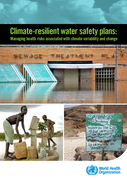
Long-term planning for an adequate and safe supply of drinking-water should be set in the context of growing external uncertainties arising from changes in the climate and environment. The water safety plan (WSP) process offers a systematic framewo
...
Resource Guide for Advanced Learning
A WHO-UNICEF joint statement encouraging greater health commodity supply chain integration for temperature-sensitive pharmaceuticals where appropriate, 19 November 2020
Advising principles. The purpose of this document is to support competent authorities in charge of IHR implementation to improve national capacities for the prevention, detection and control of events, by strengthening communications and coordinatio
...
This report presents, for the first time, a global assessment of the extent to which health care facilities provide essential water, sanitation and hygiene (WASH) services. Drawing on data from 54 l
...
Policy brief, 24 July 2020
The COVID-19 pandemic has affected older people disproportionately, especially those living in long-term care facilities. In many countries, evidence shows that more than 40% of COVID-19 related deaths have been linked to long-term care facilities, with figures being as h
...
Interim guidance. 12 May 2021. The Continuity of essential health services: Facility Assessment Tool can be used by countries to rapidly assess the capacity of health facilities to maintain the prov
...

Every year, an estimated 15 million babies are born preterm – before 37 weeks of pregnancy. That is more than 1 in 10 live births. Approximately 1 million children die each year worldwide due to complications from their early birth. Those that survive often face a lifetime of ill-
...

The rapid assessment tool (RAT) is meant to assess health facilities within mpox-affected areas that have at least one inpatient bed. Depending on time and resources available, certain facilities may be prioritized during an mpox outbreak. The RAT e
...
To assess national-level responses to NCDs, WHO has implemented NCD country capacity surveys periodically since 2001. This report is the latest in that series. Since the first survey round, the NCD Country Capacity Survey (NCD CCS) has been conducted a further seven times, most recently in 2021. In
...

This fourth WHO report on neglected tropical diseases (NTDs) reviews the progress made towards achieving the Roadmap targets for 2020, noting the remaining challenges, then looks beyond 2020 to evaluate the changing global
...
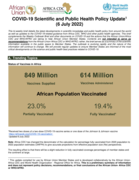
This bi-weekly brief details the latest developments in scientific knowledge and public health policy from around the world as well as updates to the COVID-19-related guidance from
...
