
Filter
3302
Text search:
Child
Poverty
Featured
199
1011
Language
3197
75
68
39
37
22
16
12
5
4
4
4
3
2
2
2
2
2
2
2
2
2
2
2
2
1
1
1
1
1
1
1
1
1
1
1
1
1
1
1
1
1
1
1
1
Document type
2112
632
195
136
114
39
37
18
7
5
4
2
Countries / Regions
160
144
120
97
94
84
84
80
75
74
72
69
68
66
55
55
52
47
44
43
42
40
37
34
33
30
30
26
25
22
22
20
20
19
18
17
15
15
14
14
14
14
14
13
13
13
13
12
11
11
10
10
10
8
8
8
7
7
7
7
6
6
6
5
5
5
5
5
5
4
4
4
4
4
4
4
3
3
3
3
3
2
2
2
2
2
2
2
2
2
1
1
1
1
1
1
1
1
1
1
1
1
1
1
1
1
1
1
1
1
1
1
1
1
1
1
1
Authors & Publishers
234
122
113
89
73
64
59
52
42
35
33
33
23
20
20
18
18
18
16
16
16
15
14
14
14
14
13
12
12
12
12
12
12
12
12
11
11
11
10
10
10
10
10
10
10
10
9
9
9
9
9
9
9
9
9
9
9
8
8
8
8
7
7
7
7
7
7
7
7
7
7
6
6
6
6
6
6
6
6
6
6
6
6
6
6
6
6
5
5
5
5
5
5
5
5
5
5
5
5
5
5
5
5
5
5
5
4
4
4
4
4
4
4
4
4
4
4
4
4
4
4
4
4
4
4
4
4
4
4
4
4
4
4
4
4
4
4
4
3
3
3
3
3
3
3
3
3
3
3
3
3
3
3
3
3
3
3
3
3
3
3
3
3
3
3
3
3
3
3
3
3
3
3
3
3
3
3
3
3
3
3
3
3
3
3
3
3
3
3
3
3
3
3
3
3
3
3
3
3
3
3
3
3
3
3
3
3
3
3
3
2
2
2
2
2
2
2
2
2
2
2
2
2
2
2
2
2
2
2
2
2
2
2
2
2
2
2
2
2
2
2
2
2
2
2
2
2
2
2
2
2
2
2
2
2
2
2
2
2
2
2
2
2
2
2
2
2
2
2
2
2
2
2
2
2
2
2
2
2
2
2
2
2
2
2
2
2
2
2
2
2
2
2
2
2
2
2
2
2
2
2
2
2
2
2
2
2
2
2
2
2
2
2
2
2
2
2
2
2
2
2
2
2
2
2
2
2
2
2
2
2
2
2
2
2
2
2
2
2
2
2
2
2
2
2
2
2
2
2
2
2
2
2
2
2
2
2
2
2
2
2
2
2
2
2
2
2
2
2
2
2
2
2
2
2
2
2
2
2
2
2
2
2
2
2
2
2
2
2
2
2
2
2
2
2
2
2
2
2
2
2
2
2
2
2
2
2
2
2
2
2
2
2
2
2
2
2
2
2
2
2
2
2
2
2
2
2
2
2
2
2
2
2
2
2
2
2
2
2
2
2
2
2
2
1
1
1
1
1
1
1
1
1
1
1
1
1
1
1
1
1
1
1
1
1
1
1
1
1
1
1
1
1
1
1
1
1
1
1
1
1
1
1
1
1
1
1
1
1
1
1
1
1
1
1
1
1
1
1
1
1
1
1
1
1
1
1
1
1
1
1
1
1
1
1
1
1
1
1
1
1
1
1
1
1
1
1
1
1
1
1
1
1
1
1
1
1
1
1
1
1
1
1
1
1
1
1
1
1
1
1
1
1
1
1
1
1
1
1
1
1
1
1
1
1
1
1
1
1
1
1
1
1
1
1
1
1
1
1
1
1
1
1
1
1
1
1
1
1
1
1
1
1
1
1
1
1
1
1
1
1
1
1
1
1
1
1
1
1
1
1
1
1
1
1
1
1
1
1
1
1
1
1
1
1
1
1
1
1
1
1
1
1
1
1
1
1
1
1
1
1
1
1
1
1
1
1
1
1
1
1
1
1
1
1
1
1
1
1
1
1
1
1
1
1
1
1
1
1
1
1
1
1
1
1
1
1
1
1
1
1
1
1
1
1
1
1
1
1
1
1
1
1
1
1
1
1
1
1
1
1
1
1
1
1
1
1
1
1
1
1
1
1
1
1
1
1
1
1
1
1
1
1
1
1
1
1
1
1
1
1
1
1
1
1
1
1
1
1
1
1
1
1
1
1
1
1
1
1
1
1
1
1
1
1
1
1
1
1
1
1
1
1
1
1
1
1
1
1
1
1
1
1
1
1
1
1
1
1
1
1
1
1
1
1
1
1
1
1
1
1
1
1
1
1
1
1
1
1
1
1
1
1
1
1
1
1
1
1
1
1
1
1
1
1
1
1
1
1
1
1
1
1
1
1
1
1
1
1
1
1
1
1
1
1
1
1
1
1
1
1
1
1
1
1
1
1
1
1
1
1
1
1
1
1
1
1
1
1
1
1
1
1
1
1
1
1
1
1
1
1
1
1
1
1
1
1
1
1
1
1
1
1
1
1
1
1
1
1
1
1
1
1
1
1
1
1
1
1
1
1
1
1
1
1
1
1
1
1
1
1
1
1
1
1
1
1
1
1
1
1
1
1
1
1
1
1
1
1
1
1
1
1
1
1
1
1
1
1
1
1
1
1
1
1
1
1
1
1
1
1
1
1
1
1
1
1
1
1
1
1
1
1
1
1
1
1
1
1
1
1
1
1
1
1
1
1
1
1
1
1
1
1
1
1
1
1
1
1
1
1
1
1
1
1
1
1
1
1
1
1
1
1
1
1
1
1
1
1
1
1
1
1
1
1
1
1
1
1
1
1
1
1
1
1
1
1
1
1
1
1
1
1
1
1
1
1
1
1
1
1
1
1
1
1
1
1
1
1
1
1
1
1
1
1
1
1
1
1
1
1
1
1
1
1
1
1
1
1
1
1
1
1
1
1
1
1
1
1
1
1
1
1
1
1
1
1
1
1
1
1
1
1
1
1
1
1
1
1
1
1
1
1
1
1
1
1
1
1
1
1
1
1
1
1
1
1
1
1
1
1
1
1
1
1
1
1
1
1
1
1
1
1
1
1
1
1
1
1
1
1
1
1
1
1
1
1
1
1
1
1
1
1
1
1
1
1
1
1
1
1
1
1
1
1
1
1
1
1
1
1
1
1
1
1
1
1
1
1
1
1
1
1
1
1
1
1
1
1
1
1
1
1
1
1
1
1
1
1
1
1
1
1
1
1
1
1
1
1
1
1
1
1
1
1
1
1
1
1
1
1
1
1
1
1
1
1
1
1
1
1
1
1
1
1
1
1
1
1
1
1
1
1
1
1
1
1
1
1
1
1
1
1
1
1
1
1
1
1
1
1
1
1
1
1
1
1
1
1
1
1
1
1
1
1
1
1
1
1
1
1
1
1
1
1
1
1
1
1
1
1
1
1
1
1
1
1
1
1
1
1
1
1
1
1
1
1
1
1
1
1
1
1
1
1
1
1
1
1
1
1
1
1
1
1
1
1
1
1
1
1
1
1
1
1
1
1
1
1
1
1
1
1
1
1
1
1
1
1
1
1
1
1
1
1
1
1
1
1
1
1
1
1
1
1
1
1
1
1
1
1
1
1
1
1
1
1
1
1
1
1
1
1
1
1
1
1
1
1
1
1
1
1
1
1
1
1
1
1
1
1
1
1
1
1
1
1
1
1
1
1
1
1
1
1
1
1
1
1
1
1
1
1
1
1
1
1
1
1
1
1
1
1
1
1
1
1
1
1
1
1
1
1
1
1
1
1
1
1
1
1
1
1
1
1
1
1
1
1
1
1
1
1
1
1
1
1
1
1
1
1
1
1
1
1
1
1
1
1
1
1
1
1
1
1
1
1
1
1
1
1
1
1
1
1
1
1
1
1
1
1
1
1
1
1
1
1
1
1
1
1
1
1
1
1
1
1
1
1
1
1
1
1
1
1
1
1
1
1
1
1
1
1
1
1
1
1
1
1
1
1
1
1
1
1
1
1
1
1
1
1
1
1
1
1
1
1
1
1
1
1
1
1
1
1
1
1
1
1
1
1
1
1
1
1
1
1
1
1
1
1
1
1
1
1
1
1
1
1
1
1
1
1
1
1
1
1
1
1
1
1
1
1
1
1
1
1
1
1
1
1
1
1
1
1
1
1
1
1
1
1
1
1
1
1
1
1
1
1
1
1
1
1
1
1
1
1
1
1
1
1
1
1
1
1
1
1
1
1
1
1
1
1
1
1
1
1
1
1
1
1
1
1
1
1
1
1
1
1
1
1
1
1
1
1
1
1
1
1
1
1
1
1
1
1
1
1
1
1
1
1
1
1
1
1
1
1
1
1
1
1
1
1
1
1
1
1
1
1
1
1
1
1
1
1
1
1
1
1
1
1
1
1
1
1
1
1
1
1
1
1
1
1
1
1
1
1
1
1
1
1
1
1
1
1
1
1
1
1
1
1
1
1
1
1
1
1
1
1
1
1
1
1
1
1
1
1
1
1
1
1
1
1
1
1
1
1
1
1
1
1
1
1
1
1
1
1
1
1
1
1
1
1
1
1
1
1
1
1
1
1
1
1
1
1
1
1
1
1
1
1
1
1
1
1
1
1
1
1
1
1
1
1
1
1
1
1
1
1
1
1
1
1
1
1
1
1
1
1
1
1
1
1
1
1
1
1
1
1
1
1
1
1
1
1
1
1
1
1
1
1
1
1
1
1
1
1
1
1
1
1
1
1
1
1
1
1
1
1
1
1
1
1
1
1
1
1
1
1
1
1
1
1
1
1
1
1
1
1
1
1
1
1
1
1
1
1
1
1
1
1
1
1
1
1
1
1
1
1
1
1
1
1
1
1
1
1
1
1
1
1
1
1
1
1
1
1
1
1
1
1
1
1
1
1
1
1
1
1
1
1
1
1
1
1
1
1
1
1
1
1
1
1
1
1
1
1
1
1
1
1
1
1
1
1
1
1
1
1
1
1
1
1
1
1
1
1
1
1
1
1
1
1
1
1
1
1
1
1
1
1
1
1
1
1
1
1
1
1
1
1
1
1
1
1
1
1
1
1
1
1
1
1
1
1
1
1
1
1
1
1
1
1
1
1
1
1
1
1
1
1
1
1
1
1
1
1
1
1
1
1
1
1
1
1
1
1
1
1
1
1
1
1
1
1
1
1
1
1
1
1
1
1
1
1
1
1
1
1
1
1
1
1
1
1
1
1
1
1
1
1
1
1
1
1
1
1
1
1
1
1
1
1
1
1
1
1
1
1
1
1
1
1
1
1
1
1
1
1
1
1
1
1
1
1
1
1
1
1
1
1
1
1
1
1
1
1
1
1
1
1
1
1
1
1
1
1
1
1
1
1
1
1
1
1
1
1
1
1
1
1
1
1
1
1
1
1
1
1
1
1
1
1
1
1
1
1
1
1
1
1
1
1
1
1
1
1
1
1
1
1
1
1
1
1
1
1
1
1
1
1
1
1
1
1
1
1
1
1
1
1
1
1
1
1
1
1
1
1
1
1
1
1
1
1
1
1
1
1
1
1
1
1
1
1
1
1
1
1
1
1
1
1
1
1
1
1
1
1
1
1
1
1
1
1
1
1
1
1
1
1
1
1
1
1
1
1
1
1
1
1
1
1
1
1
1
1
1
1
1
1
1
1
1
1
1
1
1
1
1
1
1
1
1
1
1
1
1
1
1
1
1
1
1
1
1
1
1
1
1
1
1
1
1
1
1
1
1
1
1
1
1
1
1
1
1
1
1
1
1
1
1
1
1
1
1
1
1
1
1
1
1
1
1
1
1
1
1
1
1
1
1
1
1
1
1
1
1
1
1
1
1
1
1
1
1
1
1
1
1
1
1
1
1
1
1
1
1
1
1
1
1
1
1
1
1
1
1
1
1
1
1
1
1
1
1
1
1
1
1
1
1
1
1
1
1
1
1
1
1
1
1
1
1
1
1
1
1
1
1
1
1
1
1
1
1
1
1
1
1
1
1
1
1
1
1
1
1
1
1
1
1
1
1
1
1
1
1
1
1
1
1
1
1
1
1
1
1
1
1
1
1
1
1
1
1
1
1
1
1
1
1
1
1
1
1
1
1
1
1
1
1
1
1
1
1
1
1
1
1
1
1
1
1
1
1
1
1
1
1
1
1
1
1
1
1
1
1
1
1
1
1
1
1
1
1
1
1
1
1
1
1
1
1
1
1
1
1
1
1
1
1
1
1
1
1
1
1
1
1
1
1
1
1
1
1
1
1
1
1
1
1
1
1
1
1
1
1
1
1
1
1
1
1
1
1
1
1
1
1
1
1
1
1
1
1
1
1
1
1
1
1
1
1
1
1
1
1
1
1
1
1
1
1
1
1
1
1
1
1
1
1
1
1
1
1
1
1
1
1
1
1
1
1
1
1
1
1
1
1
1
1
1
1
1
1
1
1
1
1
1
1
1
1
1
1
1
1
1
1
1
1
1
1
1
1
1
1
1
1
1
1
1
1
1
1
1
1
1
1
1
1
1
1
1
1
1
1
1
1
1
1
1
1
1
1
1
1
1
1
1
1
1
1
1
1
1
1
1
1
1
1
1
1
1
1
1
1
1
1
1
1
1
1
1
1
1
1
1
1
1
1
1
1
1
1
1
1
1
1
1
1
1
1
1
1
1
1
1
1
1
1
1
1
1
1
1
1
1
1
1
1
1
1
1
1
1
1
1
1
1
1
1
1
1
1
1
1
1
1
1
1
1
1
1
1
1
1
1
1
1
1
1
1
1
1
1
1
1
1
1
1
1
1
1
1
1
1
1
1
1
1
1
1
1
1
1
1
1
1
1
1
1
1
1
1
1
1
1
1
1
1
1
1
1
1
1
1
1
1
1
1
1
1
1
1
1
1
1
1
1
1
1
1
1
1
1
1
1
1
1
1
1
1
1
1
1
1
1
1
1
1
1
1
1
1
1
1
1
1
1
1
1
1
1
1
1
1
1
1
1
1
1
1
1
1
1
1
1
1
1
1
1
1
1
1
1
1
1
1
1
1
1
1
1
1
1
1
1
1
1
1
1
1
1
1
1
1
1
1
1
1
1
1
1
1
1
1
1
1
1
1
1
1
1
1
1
1
1
1
1
1
1
1
1
1
1
1
1
1
1
1
1
1
1
1
1
1
1
1
1
1
1
1
1
1
1
1
1
1
1
1
1
1
1
1
1
1
1
1
1
1
1
1
1
1
1
1
1
1
1
1
1
1
1
1
1
1
1
1
1
1
1
1
1
1
1
1
1
1
1
1
1
1
1
1
1
1
1
1
1
1
1
1
1
1
1
1
1
1
1
1
1
1
1
1
1
1
1
1
1
1
1
1
1
1
1
1
1
1
1
1
1
1
1
1
1
1
1
1
1
1
1
1
1
1
1
1
1
1
1
1
1
1
1
1
1
1
1
1
1
1
1
1
1
1
1
1
1
1
1
1
1
1
1
1
1
1
1
1
1
1
1
1
1
1
1
1
1
1
1
Publication Years
780
2183
334
5
Category
1549
203
159
153
92
58
5
2
Toolboxes
291
277
166
166
127
118
115
96
84
78
61
57
49
43
33
32
23
19
11
11
10
9
7
6
5
2
1
Follow up to the so called Abuja Declaration ten years later: In April 2001, heads of state of African Union countries met and pledged to set a target of allocating at least 15% of their annual budget to improve the health sector. At the same time, they urged donor countries to "fulfil the yet to be
...
met target of 0.7% of their GNP as official Development Assistance (ODA) to developing countries". This drew attention to the shortage of resources necessary to improve health in low income settings.
more

I examine the effectiveness of donors in targeting the highest burden of malaria in the Democratic Republic of Congo when health information structure is fragmented. I exploit local variations in the burden of malaria induced by mining activities as well as financial and epidemiological data from he
...
alth facilities to estimate how local aid is matching local health needs. Using a regression discontinuity design, I find significant but quantitatively small variations in aid to health facilities located within mining areas. Comparing local aid with the additional cost of treatment and prevention associated with the increased risk of malaria transmission, I find suggestive evidence that local populations with the highest burden of the disease receive a proportionately lower share of aid compared to neighbouring areas with reduced exposure to malaria infection. The evidence of disparities in the allocation of aid for malaria supports the view that donors may have inaccurate information about local population needs.
more
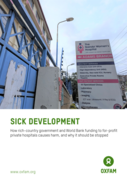
Development finance institutions owned by European governments and the World Bank Group are spending hundreds of millions of dollars on expensive for-profit hospitals in the Global South that block patients from getting care, or bankrupt them, with some even imprisoning patients who cannot afford th
...
eir bills. At the height of the COVID-19 pandemic, some of these same hospitals denied entry to patients suffering from the virus or sold intensive care beds at eyewatering prices to the highest bidder. These development institutions have woefully inadequate safeguards, invest via a complex web of tax-avoiding financial intermediaries, and offer little to zero evidence on the impacts their investments are having. Oxfam is calling on rich-country governments and the World Bank Group to immediately halt their spending on for-profit private healthcare, and for an urgent independent investigation to be conducted into all active and historic investments.
more
Background: A recent report by the Institute for Health Metrics and Evaluation (IHME) highlights that mental health receives little attention despite being a major cause of disease burden. This paper extends previous assessments of development assistance for mental health (DAMH) in two significant w
...
ays; first by contrasting DAMH against that for other disease categories, and second by benchmarking allocated development assistance against the core disease burden metric (disability-adjusted life year) as estimated by the Global Burden of Disease Studies. Methods: In order to track DAH, IHME collates information from audited financial records, project level data, and budget information from the primary global health channels. The diverse set of data were standardised and put into a single inflation adjusted currency (2015 US dollars) and each dollar disbursed was assigned up to one health focus areas from 1990 through 2015. We tied these health financing estimates to disease burden estimates (DALYs) produced by the Global Burden of Disease 2015 Study to calculated a standardised measure across health focus areas—development assistance for health (in US Dollars) per DALY.
more
Financing Global Health 2014 is the sixth edition of this annually produced report on global health financing. As in previous years, this report captures trends in development assistance for health (DAH) and government health expenditure (GHE). Health financing is one of IHME’s core research areas
...
, and the aim of the series is to provide much-needed information to global health stakeholders. Updated GHE and DAH estimates allow decision-makers to pinpoint funding gaps and investment opportunities vital to improving population health. This year, IHME made a number of improvements to the data collection and methods implemented to produce Financing Global Health estimates. Both government health expenditure and development assistance for health estimates were updated and enhanced in 2013.
more

Developmental disabilities are common. Yet, children with developmental disabilities have been neglected in health systems planning and policy provisions for health and continue to experience stigmatization, institutionalization, barriers to access health care and inequalities in health and educatio
...
n outcomes.
Using findings from research and practice and guided by the tenets of international human rights conventions, this WHO-UNICEF Global Report on children with developmental disabilities provides principles and approaches to intentionally include the needs and aspirations of children and young people with developmental disabilities in policy, programming and public health monitoring. It makes the case for greater accountability and proposes 10 priority actions to accelerate changes towards inclusive environments and responsive multisectoral care systems for children with developmental disabilities.
more

The world is off track to make significant progress towards universal health coverage (UHC) (SDG target 3.8) by 2030 as improvements to health services coverage have stagnated since 2015, and the proportion of the population that faced catastrophic levels of out-of-pocket (OOP) health spending has i
...
ncreased.
more

Reproductive health needs are particularly acute in countries affected by armed conflict. Reliable information
on aid investment for reproductive health in these countries is essential for improving the efficiency and effectiveness of
aid. The purpose of this study was to analyse official developm
...
ent assistance (ODA) for reproductive health activities in
conflict-affected countries from 2003 to 2006.
Methods and Findings: The Creditor Reporting Syst
more

Zimbabwe has, over the years, grappled with the repercussions of the climate crisis, which have led to erratic rainfall patterns characterized by either severe floods or prolonged periods of drought. The nation has experienced a concerning trend of numerous regions reporting rainfall levels below th
...
e usual during what should be "normal" years. The upcoming El Niño event forecasted for 2023-2024, which is associated with drier-than-average rainfall, is poised to exacerbate this predicament. It is expected to intensify aridity, significantly impacting food and animal production across many areas, including those typically classified as "dry regions."
more

This report shows that increased domestic revenues can and will cover only part of the necessary SDG budget spending of the LIDCs. Achieving the SDGs in the LIDCs will also require increases of both Official Development Assistance (ODA) and Private Development Assistance (PDA) to reach aggregate lev
...
els of SDG-directed development aid on the order of US$300-400 billion USD per year
more

A major problem facing the world is how to build peace following the ravages of increasingly protracted armed conflict. Armed conflicts leave behind shattered, divided societies that are at risk of repeating cycles of violence, and therefore need concerted peacebuilding efforts. Conflicts also take
...
a heavy toll on people’s mental health and psychosocial well-being. One in five people who live in a war zone will likely develop a mental disorder, and many others suffer from painful everyday stresses associated with multiple losses, family separation, gender-based violence (GBV), disability, climate change and ongoing insecurity, among other issues.
more

Humanitarian crises exacerbate nutritional risks and often lead to an increase in acute malnutrition. Emergencies include both manmade (conflict) and natural disasters (floods, drought, cyclones, typhoons, earthquakes, volcanic eruptions, etc.). Complex emergencies are combinations of both manmade a
...
nd natural disasters, often of a protracted nature. Millions of people are affected by humanitarian crises every year. The increasing frequency and scale of emergencies requires nutrition to be addressed in all phases of a response.
Crisis situations, whether acute or protracted, impact on a range of factors that can increase the risk of undernutrition, morbidity, and mortality. They may involve: the large-scale destruction of property and infrastructure; the erosion of livelihood strategies and purchasing power; a breakdown of and reduced access to essential services, including health services, water supply, and sanitation; and the displacement of large numbers of people. Emergencies can also disrupt social systems and the quality of care/feeding practices. Household access to food may be negatively affected and people may find themselves in overcrowded settlements with their families divided. As a result, at the individual level, there is often an increased risk of deteriorating health and nutritional status, resulting in a greater likelihood of death.
more

Comprehensive Primary Health Care has an important role in the primary and secondary prevention of several disease conditions, including non-communicable diseases which today contribute to over 60% of the mortality in India. The provision of Comprehensive primary health care reduces morbidity, disab
...
ility and mortality at much lower costs and significantly reduces the need for secondary and tertiary care. Estimates suggest that almost 52% of all conditions can be managed at the
primary care level.
In order to ensure comprehensive primary health care, close to where people live, Sub- Centres should be strengthened as Health and Wellness Centres (H&WC), staffed by appropriately trained primary health care team. The Medical officer of the Primary Health Centre would oversee the functioning of the SC/HWC that falls in that area.
Services include those that (i) can be delivered at the level of the household and outreach sites in the community by suitably trained frontline workers, (ii) those that are delivered by a team headed by a mid-level health provider, at the level of the Sub-Centre/Health and Wellness Centre and (iii) the referral support and continuity of care within the district health system in rural and urban areas. The package of services is in Box. States would need to either phase in these services or add on additional services based on state specific and local context.
more

Ahead of World Malaria Day, the WHO Global Malaria Programme published a new operational strategy outlining its priorities and key activities up to 2030 to help change the trajectory of malaria trends, with a view to achieving the global malaria targets. The strategy outlines 4 strategic objectives
...
where WHO will focus its efforts, including developing norms and standards, introducing new tools and innovation, promoting strategic information for impact, and providing technical leadership of the global malaria response.
I
more

This MHPSS in Emergencies training aims to prepare MHPSS responders, disaster managers, and emergency team leaders for work in the field by building understanding of basic concepts of MHPSS in emergencies as well as planning and implementing PSS activities. It is for MHPSS focal points from the Red
...
Cross and Red Crescent Societies Movement and humanitarian organizations responsible for initiating or supporting the overall mental health and psychosocial activities and interventions during emergencies. The training modules in this guide have been developed to be flexible and adapted to different contexts and training needs. The guide and accompanying materials include the information and materials you will need to design and facilitate MHPSS in Emergencies training.
more
This policy brief explores the impact of air pollution on health and address the air quality issue in the response to noncommunicable diseases (NCDs). It also provides key actions that policy makers, NGOs and health professionals can take to ensure that every one can breathe clean air.
This review examines high-quality research evidence that synthesises the efects of extreme heat on human health in tropical
Africa. Web of Science (WoS) was used to identify research articles on the efects extreme heat, humidity, Wet-bulb Globe
Temperature (WBGT), apparent temperature, wind, Heat
...
Index, Humidex, Universal Thermal Climate Index (UTCI), heatwave, high temperature and hot climate on human health, human comfort, heat stress, heat rashes, and heat-related morbidity
and mortality
more

The epidemiology of wheeze in children, when assessed by questionnaires, is dependent on parents' understanding of the term “wheeze”.
In a questionnaire survey of a random population sample of 4,236 children aged 6–10 yrs, parents' definition of wheeze was assessed. Predictors of a correct
...
definition were determined and the potential impact of incorrect answers on prevalence estimates from the survey was assessed.
Current wheeze was reported by 13.2% of children. Overall, 83.5% of parents correctly identified “whistling or squeaking” as the definition of wheeze; the proportion was higher for parents reporting wheezy children (90.4%). Frequent attacks of reported wheeze (adjusted odds ratio (OR) 3.0), maternal history of asthma (OR 1.5) and maternal education (OR 1.5) were significantly associated with a correct answer, while the converse was found for South Asian ethnicity (OR 0.6), first language not English (OR 0.6) and living in a deprived neighbourhood (OR 0.6).
In summary, the present study showed that misunderstanding could lead to an important bias in assessing the prevalence of wheeze, resulting in an underestimation in children from South Asian and deprived family backgrounds. Prevalence estimates for the most severe categories of wheeze might be less affected by this bias and questionnaire surveys on wheeze should incorporate measures of parents' understanding of the term wheeze.
more

The 2023 meeting of the WHO Clinical Consortium on Healthy Ageing (CCHA) was the group’s ninth gathering and took place in Geneva 5–7 December 2023. The meeting was structured around seven panels, with a series of technical presentations, plenary discussions and group work, and a final session o
...
utlining the work programme for 2024.
more

Health Statistics in the Western Pacific Region 2023: Monitoring health for the SDGs is the third biennial report providing an overview of the progress of the World Health Organization (WHO) Western Pacific Region towards the health-related Sustainable Development Goal (SDG) targets. Thi
...
s edition also serves as a baseline assessment for the implementation of the global WHO Fourteenth General Programme of Work 2025–2028 (GPW14) within the Western Pacific Region and the for the Regional Vision “Weaving Health for Families, Communities, and Societies of the Western Pacific Region: Working Together to Improve Health, Well-Being and Save Lives”.
more
