Filter
330
Text search:
rectal
dose
Featured
59
91
Language
Document type
168
92
24
18
16
6
5
1
Countries
36
13
12
12
12
10
10
6
5
5
5
5
5
4
4
4
4
3
3
3
3
3
3
2
2
2
2
2
1
1
1
1
1
1
1
1
1
1
1
1
1
1
1
1
1
1
1
Authors & Publishers
Publication Years
Category
152
74
48
13
12
9
3
Toolboxes
31
18
18
13
13
13
7
6
6
5
5
4
2
2
2
2
1
1
1
1
1
1

Prompt, effective antimalarial treatment, and supportive care can substantially reduce the rate of mortality from severe malaria. However, many children in malaria-endemic countries do not have access to health facilities or a qualified health care provider and do not receive the necessary care in a
...
Information note. In 2021, preliminary results of observational studies from the Community Access to Rectal Artesunate for Malaria (CARAMAL) project did not confirm the mortality impact observed in the controlled trial in 2009. Consequently, in Janu
...
Update, 2023. En 2021, les résultats préliminaires des études d’observation du projet CARAMAL (Community Access to Rectal Artesunate for Malaria) n’ont pas confirmé l’impact sur la mortalité observé dans l’essai contrôlé de 2009. Par
...
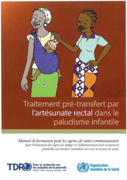
Manuel de formation pour les agents de santé communautaire pour l'évaluation des signes de danger et l'administration d'un traitement préalable au transfert immédiat vers une structure de santé.
Ce manuel a été développé par le Programme Spécial de Recherche et de Formation concernant l
...
Actualización de 2023. Nota informativa. En 2021, los resultados preliminares de los estudios observacionales del proyecto de Acceso Comunitario al Artesunato Rectal para el Paludismo (CARAMAL, por sus siglas en inglés) no confirmaron el impacto e
...
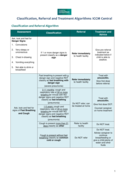
The document "Classification and Referral Algorithm – iCCM Uganda" (2013) by Malaria Consortium provides a practical guide for community health workers to assess, classify, and manage common childhood illnesses in Uganda. It focuses on key symptoms such as fever, cough, diarrhoea, and danger signs
...
WHO Model Formulary for Children
recommended
WHO Model Formulary for children based on the Second Model List of Essential Medicines for Children 2009.
In 2007, the World Health Assembly passed a Resolution titled ‘Better Medicines for Children’. This resolution recognized the need for research and development into medicines for children,
...

The objective of this book is to provide health workers with easily accessible information on important aspects of the medicines commonly used at primary care level in Zimbabwe. Medicines are a crucial part of the management of most of our patients, yet many medicines are potentially dangerous if no
...
Pocket book of hospital care for children
recommended
Guidelines for the Management of common childhood Illness. 2nd edition
These guidelines focus on the management of the major causes of childhood mortality in most developing countries, such as newborn problems, pneumonia, diarrhoea, malaria, meningitis, septicaemia, measles and related conditions,
...

Government of Nepal has an obligation to ensure availability of affordable and high quality basic health care services to its population
Basic Paediatric Protocols (Kenya)
recommended
Caring for the Sick Child age 2 months up to 5 years. Chart Booklet

Standard treatment guidelines
recommended

Handout presentations in PDF for illustrating lectures
Accessed May 2014
The Priority medicines for mothers and children 2011 list was updated following the 18th Expert Committee Meeting
on Selection and Use of Medicines, the release of new treatment guidelines and feedback from partners following
the 2011 version. In alignment with the UN Global strategy f
...