
Filter
24
Featured
2
1
Language
Document type
6
6
5
3
2
1
Countries / Regions
1
1
1
Authors & Publishers
Publication Years
Category
2
2
1
1
1
1
1
Toolboxes
10
3
3
3
3
3
2
2
2
1
1
1
1
WHO, with the United Nations Office on Drugs and Crime (UNODC) and other partners, supports the implementation of comprehensive HIV and HCV services for people who live in prisons and other closed settings.

The Best Buys for Disease Elimination is a practical, evidence-based guide to the most effective actions for countries to implement in order to eliminate communicable diseases. The guide highlights the efficient use of resources and prioritizing populations in vulnerable situations.
“The Region
...
BMC Public Health. 2025 Jan 8;25(1):87. doi: 10.1186/s12889-024-21208-y. PMID: 39780111; PMCID: PMC11708247.
These findings provide an insight into the types of psychosocial support interventions provided by Community-based organisations to orphans and vulnerable children. Conversely, the study als
...

International Journal of Integrated Care, 2025; 25(2): 5, 1–12. DOI: https://doi.org/10.5334/ijic.8920. Community-based intervention support plays a crucial role in enhancing
the lives of orphans and vulnerable children in Africa. Community-based intervention
support needs to be integrated into
...
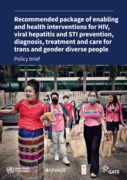
Policy brief. In this policy brief, we give an update on those parts of the guidelines which are relevant for trans and gender diverse people.
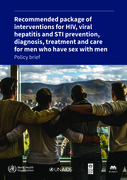
Polic brief. In this policy brief, we give an update on those parts of the guidelines which are relevant for men who have sex with men.
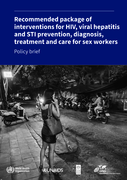
Policy brief. In this policy brief, we give an update on those parts of the guidelines which are relevant for sex workers
In 2022, WHO published the Consolidated guidelines on HIV, viral hepatitis and STI prevention, diagnosis, treatment and care for key populations. These guidelines outline a public health response to HIV, viral hepatitis and sexually transmitted infections (STIs) for 5 key populations (men who have s
...
Polic brief. In this policy brief, we give an update on those parts of the guidelines which are relevant for people in prisons and other closed setting

Speaking at a special session on promoting prison health reform in Africa, Doreen Namyalo, the sub-Saharan Africa Director at Penal Reform International, told the conference that the HIV burden in Zambian prisons was 27%, 37% in Malawi, 17% in Lesotho, 15% in Uganda and 8% in Kenyan prisons.
Guidance for Orphans and Vulnerable Children Programs
The guidelines present and discuss new recommendations and consolidate a range of recommendations and guidance from current WHO guidelines which are summarised here in this policy brief.
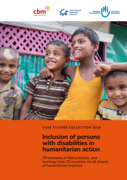
39 examples of field practices, and learnings from 20 countries, for all phases of humanitarian response. The report shows that deliberate and proactive action is required to ensure that persons with disabilities from all constituencies are systematically included and meaningfully participate in DRR
...

This facilitator manual is aimed at trainers of a three-day
‘Integrating VAC prevention and response into HIV settings’
course. It is for use by all facilitators who are delivering the
training.

This training seeks to equip health workers who have contact with children in HIV settings with the knowledge and skills to better integrate violence against children (VAC) services into their work. It seeks to transmit information and skills to make them: feel comfortable talking with, providing se
...
PowerPoint slides for Integrating Violence Against Children Prevention and Response into HIV Service
Slides for use with the facilitator manual.
This three-day training package includes ten modules to be delivered to groups of 25-30 health workers. The training is aimed at different cadres of health workers, including: nurses and midwives; clinicians; HIV counselors; medical social workers; pharm
...

In disaster preparedness, the participation of women, children, older people, persons with disabilities (PWDs), and other minority groups and sectors is important because they are the most vulnerable against disasters. Inclusive disaster preparedness provides technical and logical frameworks that as
...
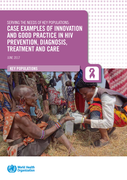
This WHO guidelines highlight innovative, community-led, and peer-driven approaches to reduce HIV risks among key populations—sex workers, trans people, MSM, people who inject drugs, and prisoners. Effective practices integrate services, utilize trained peers for testing (HTS), and provide stigma-
...

These guidelines were developed through an interagency process with participation by United Nations (UN) organiza-
tions, nongovernmental organizations, the International Red Cross and Red Crescent Movement and the International
Organization for Migration.
