Filter
235
Text search:
laboratory
blood
transfusion
Featured
Recommendations
30
New Publications
83
Language
Document type
No document type
153
Guidelines
33
Studies & Reports
18
Manuals
17
Strategic & Response Plan
6
Training Material
3
Situation Updates
2
Fact sheets
2
App
1
Countries / Regions
India
25
Sierra Leone
13
Nigeria
9
Kenya
9
Rwanda
8
Liberia
7
Uganda
7
Philippines
5
Nepal
5
Tanzania
5
South Africa
5
Bangladesh
5
Ethiopia
4
Ghana
4
Zambia
4
Malawi
4
Namibia
4
Latin America and the Carribbean
4
Global
4
Ukraine
3
Western and Central Europe
3
Guinea
2
Congo, Democratic Republic of
2
Papua New Guinea
2
Brazil
2
Lesotho
2
Bhutan
2
Eastern Europe
2
Russia
2
Burkina Faso
1
Senegal
1
Mali
1
Côte d’Ivoire / Ivory Coast
1
Togo
1
Somalia
1
Pakistan
1
South Sudan
1
Afghanistan
1
Syria
1
Chad
1
Cambodia
1
Indonesia
1
Benin
1
North Macedonia
1
Botswana
1
Myanmar / Burma
1
Sri Lanka
1
Venezuela
1
Albania
1
Tajikistan
1
Moldova
1
Japan
1
Authors & Publishers
Publication Years
Category
Countries
115
Clinical Guidelines
34
Women & Child Health
16
Key Resources
13
Capacity Building
6
Pharmacy & Technologies
6
Public Health
3
Toolboxes
HIV
20
COVID-19
13
Ebola & Marburg
11
Caregiver
11
NTDs
10
Conflict
8
Zika
7
Rapid Response
6
TB
5
Pharmacy
5
Refugee
4
Mental Health
3
Malaria
2
Natural Hazards
1
Specific Hazards
1
Global Health Education
1
Health Financing Toolbox
1
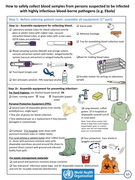
This interim guidance to national health authorities and blood transfusion services outlines the steps required to collect convalescent whole blood
...
External quality assessment (EQA) is an important component of quality systems for blood transfusion services. Establishing external quality assessment programmes for screening of donated
...

Access to safe blood and blood products is recognized as one of the key requirements for delivery of modern health care in the journey towards health for all. The foundation of safe and sustainable
...

2nd edition
Improve identification, verification, communication and coordination.
Inerim Guidance. These guidelines have been developed in recognition that infection with Zika virus may present a risk to blood safety, and in consideration of the declaration on 1 February 2016 by the WHO Director-General of a Public Health Emergen
...
Guidelines for Good Clinical Laboratory Practices (GCLP) outlines the principles and procedures to be followed by medical laboratories involved in clinical research and/or patient care so as to provide quality data which can be used for health resea
...
The BBV/STI Glossary is a resource for interpreters, translators and others who work in a health setting. It offers an extensive list of English terms related to sexual health and blood-borne viruses (such as hepatitis), with easy to understand defi
...
: interim guidance, 17 February 2021
This document provides interim guidance on the management of the blood supply in response to the pandemic outbreak of coronavirus disease (COVID-19). It emphasizes the importance of being prepared and responding
...
The WHO guidelines provide recommended steps for safe phlebotomy and reiterate accepted principles for drawing, collecting blood and transporting blood to laboratories/
...
Epidemiology
Chagas disease (American trypanosomiasis) is caused by the protozoan parasite Trypanosoma cruzi, and transmitted to humans by infected triatomine bugs, and less commonly by transfusion, organ transplant, from mother to infant, and in r
...
It is Zika virus (ZIKV) that most often causes these neurological effects it appears to be the only arbovirus than can cause congenital malformations such as microcephaly. In any case, more scientific tests are needed to establish the causal relationship between the virus and this malformation (7-10
...
The waves of yellow fever transmission in the Region of the Americas in 2016–2018 involved the largest number of human and epizootic cases to be reported in several decades. Yellow fever is a serious viral hemorrhagic disease that poses a challenge for health professionals. It requires early recog
...