
Filter
965
Text search:
antibiotic
resistance
Featured
126
212
Language
Document type
286
231
224
57
51
43
17
12
10
9
9
8
6
1
Countries
60
35
33
28
26
22
16
15
13
13
11
10
10
10
9
8
8
7
6
6
6
6
5
5
5
4
4
4
4
3
3
3
3
3
3
3
3
3
3
2
2
2
2
2
2
2
2
2
2
2
2
2
2
2
2
2
2
2
2
2
2
2
2
1
1
1
1
1
1
1
1
1
1
1
1
1
1
1
1
1
1
1
1
1
1
1
1
1
1
1
1
1
1
1
1
1
1
1
1
1
1
1
1
1
1
Authors & Publishers
Publication Years
Category
287
114
46
43
25
16
13
Toolboxes
392
68
41
41
37
34
20
18
17
16
14
11
10
10
9
9
8
6
4
4
2
2
2

You Tube Video
Accessed February 4, 2020

WHO commissioned a survey, carried out in September/October 2015, among some 10 000 members of the public in 12 countries (2 per WHO Region: Barbados, China, Egypt, India, Indonesia, Mexico, Nigeria, the Russian Federation, Serbia, South Africa, Sudan and Viet Nam) on their use of antibiotics, knowl
...
This policy brief has been developed in response to the contemporary challenge of antibiotic resistance (ABR). ABR poses a formidable threat to global health and sustainable development. It is
...
Antibiotic resistant bacteria are spreading at an alarming rate and some bacterial infections may once again be untreatable. Antibiotic resistance
...
Each year, 33000 people die from an infection due to bacteria resistant to antibiotics. The burden of infections with bacteria resistant to antibiotics on the European population is comparable to that of influenza, tuberculosis and HIV/AIDS combined.

Carbapenems are a major last-line class of antibiotics to treat bacterial infections.The spread of carbapenem-resistant infections is a threat to healthcare andpatient safety in Europe as it seriously curtails the ability to cure infections. The spread of carbapenem-resistant infections is a threat
...

Antibiotic resistance is a natural occurrence caused by mutations in bacteria’s genes. However, inappropriate use of antibiotics accelerates the emergence and spread of
...

Antimicrobial resistance (AMR) is an important public health concern shared by developed and developing countries. In developing countries the burden of infectious diseases is greater and exacerbated by limited access to, and availability and afford
...

MICROBIAL DRUG RESISTANCEVolume 24, Number 5, 2018ªMary Ann Liebert, Inc.DOI: 10.1089/mdr.2017.0383
Antibiotic resistance (ABR) is a worldwide publichealth concern, with serious health, economic
...

Antibiotic resistance has been recognized as a major global health threat and optimizing prescribing is one of the most effective measures to preserve the effectiveness of antibiotics. The
...
Antibiotic resistance is no longer a concern for the distant future but is a pressing issue, both globally and in Nepal. As part of global effort to preserve the effectiveness of a
...
Antibiotic resistant bacteria are spreading at an alarming rate and some bacterial infections may once again be untreatable. Antibiotic resistance
...

Antimicrobial resistance and antibiotic resistance are a major threat to public health. How can we tackle them? Get answers with a range of cour
...
Book for Communities

This course is designed for anyone with an interest in antibiotic resistance, no matter if you are a member of the public, a student, a health professional or any other expert.
Our focus is to prov
...

Antibiotics and other antimicrobial agents are invaluable life savers, particularly in resource-limited countries where infectious diseases are abundant. Both uncomplicated and severe infections are potentially curable as long as the aetiological agents are susceptible to the
...

In Kenya, the bacterial infections that contribute most to human disease are often those in which re-‐sistance is most evident. Examples are multidrug-‐resistant enteric bacterial pathogens such as typhoid,
...
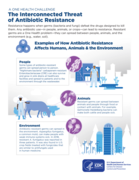
Resistance happens when germs (bacteria and fungi) defeat the drugs designed to kill them. Any antibiotic use—in people, animals, or crops—can lead to
...

A patient leaflet for primary care prescribers to hand out to patients: it explains to patients what antibiotic resistance is and why appropriate use of antibiotics is important.
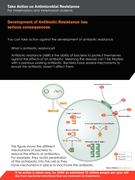
Take Action on Antimicrobial Resistance. For Veterinarians and Veterinarian students
