
Filter
2285
Text search:
resource
platform
Featured
238
587
Language
Document type
944
452
275
196
168
148
37
26
25
9
3
1
Countries
126
96
63
50
49
48
47
47
46
46
45
38
34
33
33
32
28
27
27
27
26
25
23
19
19
17
15
15
14
13
13
12
12
12
11
11
10
9
9
9
9
9
9
9
9
8
8
8
7
7
7
7
7
6
6
6
6
5
5
5
5
5
4
4
4
4
4
4
4
4
4
3
3
3
3
3
3
3
2
2
2
2
2
2
2
2
2
2
1
1
1
1
1
1
1
1
1
1
1
1
1
1
1
1
1
1
1
1
1
1
1
1
1
1
1
1
1
1
1
1
1
1
1
1
1
Authors & Publishers
Publication Years
Category
827
172
125
112
109
39
22
2
Toolboxes
318
149
103
94
80
78
77
71
71
64
63
63
59
58
52
41
39
38
35
21
14
13
11
10
7
2
Update, 23 de junio de 2022

This document is a guide defining requirements for quality and safety for malaria rapid diagnostic testing services to safeguard the quality of the results, the safety of the operators and patients and that of the environment for use by national malaria control programmes, regulators, implementers a
...

Cities are uniquely positioned to understand local needs and respond rapidly to changing conditions to safeguard health. These changes require strong city leadership to implement multisectoral, health-relevant policies and public services that engage communities. The response to malaria must be an i
...

This collection of case studies on risk communication and community engagement (RCCE) from 18 different country/area level public health partners in the WHO European Region provides evidence of numerous results achieved and lessons learned since the start of the COVID-19 pandemic. RCCE has not
...

The World Health Organization (WHO) convened a meeting of the Technical Advisory Group on Buruli ulcer at its headquarters in Geneva, Switzerland on 25 to 27 March 2019

The guidance notes describe key actions that policy-makers at national and subnational levels can take in relation to: diagnostic testing for COVID-19, clinical management of COVID-19, meeting targets for vaccination against COVID-19, maintaining infection control measures for COVID-19 in health-car
...
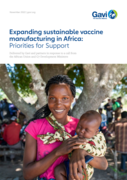
Despite high regional demand for vaccines valued at over US$ 1 billion annually, Africa’s vaccine industry provides only 0.1% of global supply. Vaccine inequity and hoarding at the start of the pandemic, which resulted in delays in obtaining COVID-19 doses, stimulated new resolve to address future
...

SAMS team rose to meet these challenges, delivering world class COVID treatment with four newly established COVID hospitals complete with 100 ICU beds and state of the art equipment like ventilators, monitors, and oxygen generators. By using innovative technologies, SAMS’ physicians were able to s
...
Ensuring mental health and well-being has become a worldwide imperative and an important target
of the Sustainable Development Goals.
But in all countries around the world, our response has been woefully insufficient, and we have made
little progress to advance mental health as a fundamental huma
...
Guidance module.
The QualityRights training and orientation modules have been developed to enhance the knowledge, skills and understanding of key stakeholders on how to promote the rights of people with psychosocial, intellectual or cognitive disabilities, improve the quality of services and suppo
...
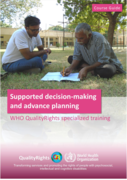
Supported decision-making and advance planning: WHO QualityRights Specialized training: course guide
Les modules de formation et d’orientation QualityRights ont été élaborés pour renforcer les connaissances, les compétences et la compréhension des principales parties prenantes sur la manière de promouvoir les droits des personnes en situation de handicap psychosocial, intellectuel ou cogni
...
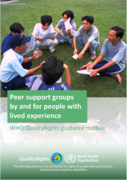

The QualityRights training and orientation modules have been developed to enhance the knowledge, skills and understanding of key stakeholders on how to promote the rights of people with psychosocial, intellectual or cognitive disabilities, improve the quality of services and support provided in the
...
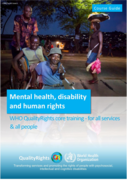
Les modules de formation et d’orientation QualityRights ont été élaborés pour renforcer les connaissances, les compétences et la compréhension des principales parties prenantes sur la manière de promouvoir les droits des personnes en situation de handicap psychosocial, intellectuel ou cogni
...

Comment reconnaître les maladies tropicales négligées selon les altérations de la peau : guide de formation à l’usage du
personnel sanitaire de première lignes [Recognizing neglected tropical diseases through changes on the skin: a training
guide for front-line health workers]

This policy brief aims to provide a review of the current progress on implementing the Kenya national action plan on AMR, identifies critical gaps, and highlights findings to accelerate further progress in the human health sector. The target audience includes all those concerned with implementing ac
...

January 2020 to December 2021

The World Health Organization Regional Office for Africa (WHO AFRO), in accordance with recommendations from various WHO committees, has developed three flagship programmes to support Member States in the African region to prepare for, detect and respond to public health emergencies. They are the re
...
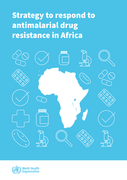
The Strategy to respond to antimalarial drug resistance in Africa is a technical and advocacy document, grounded in the best available evidence to date and aimed at minimizing the threat and impact of antimalarial drug resistance of Plasmodium falciparum parasites in Africa. Its objectives are to: i
...
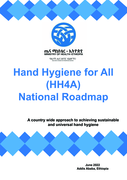
In collaboration with partners, the government of Ethiopia has successfully developed 10 years Hand Hygiene for All (HH4A) costed national roadmap- a country-wide approach to achieving sustainable and universal hand hygiene. On the occasion of the 2022 Global Hand Washing Day event ( Ethiopia is cel
...
