
Filter
1834
Text search:
first-line
Featured
Recommendations
230
New Publications
547
Language
Document type
No document type
1131
Guidelines
242
Studies & Reports
229
Manuals
81
Strategic & Response Plan
52
Training Material
34
Fact sheets
31
Situation Updates
14
Infographics
10
Brochures
4
Resource Platforms
4
Videos
1
Countries / Regions
India
125
Kenya
63
Global
56
South Africa
46
Uganda
44
Ethiopia
41
Tanzania
39
Western and Central Europe
37
Sierra Leone
35
Malawi
35
Namibia
31
Nepal
26
Nigeria
25
Bangladesh
24
Zambia
23
Latin America and the Carribbean
23
Liberia
22
Rwanda
21
Africa
21
Myanmar / Burma
18
Eastern Europe
18
Ghana
17
Philippines
16
Zimbabwe
15
South–East Asia Region
15
Cambodia
13
Lesotho
12
Mozambique
11
Syria
10
Eswatini/ Swaziland
10
Congo, Democratic Republic of
9
Ukraine
9
Botswana
9
Senegal
8
Cameroon
8
Asia
8
East and Southern Africa
7
Burkina Faso
6
Indonesia
6
Georgia
6
Vietnam
6
Guinea
5
South Sudan
5
Jordan
5
Benin
5
Haiti
4
Lebanon
4
Thailand
4
Yemen
4
West and Central Africa
4
USA
3
Germany
3
Brazil
3
Colombia
3
Sri Lanka
3
Middle East and North Africa
3
Venezuela
3
Albania
3
Tajikistan
3
Russia
3
Somalia
2
Pakistan
2
Iraq
2
Afghanistan
2
Turkey
2
China
2
Sudan
2
Argentina
2
North Macedonia
2
Armenia
2
Laos
2
Turkmenistan
2
Jamaica
2
Morocco
1
Saudi Arabia
1
Gambia
1
Papua New Guinea
1
Central African Republic
1
El Salvador
1
Bolivia
1
Greece
1
Angola
1
Madagascar
1
Chile
1
Western Pacific Region
1
Eastern Europe and Central Asia
1
Paraguay
1
Fiji
1
Bhutan
1
Canada
1
Timor Leste/ East Timor
1
Estonia
1
Iran
1
North America
1
France
1
Mauritius
1
Tunisia
1
United Kingdom
1
Portugal
1
Spain
1
Authors & Publishers
Publication Years
Category
Countries
748
Clinical Guidelines
216
Women & Child Health
79
Public Health
73
Key Resources
38
Capacity Building
28
Pharmacy & Technologies
18
Toolboxes
TB
269
HIV
242
Mental Health
130
AMR
93
COVID-19
62
NTDs
51
Malaria
44
Pharmacy
43
NCDs
38
Caregiver
27
Ebola & Marburg
20
Refugee
19
Conflict
17
Rapid Response
15
Planetary Health
15
Global Health Education
11
Disability
8
Polio
8
Cholera
7
Natural Hazards
6
Health Financing Toolbox
6
2.0 Rapid Response
5
Specific Hazards
3
Zika
2
Social Ethics
2
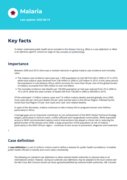
The document provides a comprehensive overview of malaria, covering its global impact, transmission, symptoms, diagnosis, treatment, prevention strategies, and the role of public health interventions—especially in high-risk regions like sub-Saharan Africa—to reduce its incidence and mortality.

The "Regional Action Plan 2017–2030: Towards a Malaria-Free South-East Asia Region" by the World Health Organization (WHO) outlines a strategic framework to eliminate malaria in the 11 countries of the WHO South-East Asia Region by 2030. It focuses on reducing transmission, particularly of Plasmod
...

World malaria report 2024
recommended
New data from the WHO reveal that an estimated 2.2 billion cases of malaria and 12.7 million deaths have been averted since 2000, but the disease remains a serious global health threat, particularly in the WHO African Region. According to WHO’s latest World malaria report, there were an estimated
...

To meet our Strategy objectives and get within reach
of the 2030 SDG 3 target related to the three diseases,
the Global Fund needs to raise US$18 billion for the
Eighth Replenishment. That sum is essential to drive the
required pace of progress in the fight against HIV, TB
and malaria, and to m
...

To deliver on the Global Fund Strategy milestones
for 2028 and ensure we keep the SDG 3 target
within reach, we need to raise US$18 billion to
fund the Global Fund’s next three-year grant cycle.

The document outlines essential steps and provides guidance to countries on the adoption and deployment of c-IPTp so that it is integrated into the existing health system. It draws upon best practices and lessons learned from pilot implementation experiences in eight African countries and targets st
...

This malaria case management training manual was developed by the Federal Ministry of Health (FMOH) of Ethiopia, in collaboration with several national and international partners. Primarily based on WHO guidelines and training materials, as well as the 2022 national malaria guidelines and various te
...

This Implementation Kit (I-Kit), developed by the Health Communication Capacity Collaborative (HC3), helps national and local stakeholders to design country-specific social and behavioural change communication (SBCC) campaigns that address the threat posed by substandard, spurious, falsified and fal
...

Social and Behaviour Change Communication (SBCC) is essential for the effective control, prevention and elimination of malaria. The 2018–2030 Strategic Framework for Malaria SBCC guides countries and partners in strengthening capacities, refining strategies and sharing best practices, all of which
...
WHO recommends artemisinin-based combination therapies for treating uncomplicated malaria, alongside studies to monitor treatment effectiveness. Given the threat of antimalarial resistance, including partial resistance in several African countries, molecular tools are vital for tracking resistance.
...

The purpose of this guide is to provide updated clinical guidance on TB/HIV, with an emphasis on diagnostic aspects—including new techniques—as well as current treatment, while maintaining a public health approach. By compiling and consolidating the latest World Health Organization recommendatio
...

Community led-monitoring is based on the principle that «Nothing that is done for us should
be done without us”. The combination of this principle with evidence shows that community-led
monitoring is an important driver of improved service delivery and health outcomes that needs to
be re-empha
...

The National Strategic Plan for Malaria Elimination 2021–2025 outlines Bangladesh’s roadmap to achieve zero indigenous malaria cases by 2030, with an interim goal to reduce transmission to near-zero levels by 2025. The strategy builds upon earlier successes in malaria control and shifts focus to
...

According to the WHO, there were an estimated 251 million malaria cases (95% of global cases) and 579,414 malaria deaths (97% of global deaths) in African Union Member States in 2023. 76% of these deaths were children under the age of five.

The document “Malaria Prophylaxis for Travellers: Guideline for Healthcare Workers” (2019) from Sri Lanka provides guidance for healthcare providers on preventing malaria among travelers to endemic areas.
It explains that since Sri Lanka was certified malaria-free in 2016, the main risk comes f
...

The National Strategic Plan on Malaria Prevention and Elimination Period 2021 – 2025 seeks to build on the previous national successes of the National Institute of Malariology, Parasitology, and Entomology (NIMPE) while addressing current challenges to reduce the overall burden of malaria in the S
...
This document highlights the latest WHO recommendations designed to optimize health outcomes, streamline delivery and address persistent barriers to prevention and care. It especially focuses on people often left behind in service delivery, including adolescents and young people, key populations and
...

Noncommunicable diseases (NCDs) (e.g., cardiovascular diseases, cancers, diabetes, and chronic respiratory diseases) and mental health conditions (e.g., Alzheimer’s disease and related dementias, depression, anxiety, autism spectrum disorders) are the world’s leading cause of preventable illness
...
