
Filter
2110
Text search:
Disposal
Featured
269
606
Language
Document type
1094
401
233
172
89
46
38
15
10
4
4
3
1
Countries
133
89
83
82
65
62
59
55
53
42
40
38
33
31
28
25
24
24
23
21
20
20
19
17
15
14
14
14
14
13
13
12
11
11
10
9
9
9
8
8
8
8
8
8
7
7
7
7
6
6
5
5
5
5
4
4
4
4
4
3
3
3
3
3
2
2
2
2
2
2
2
2
2
2
2
2
2
2
2
2
2
1
1
1
1
1
1
1
1
1
1
1
1
1
1
1
1
1
1
1
1
1
1
1
1
1
1
1
1
1
1
1
1
1
1
Authors & Publishers
Publication Years
Category
875
299
152
87
83
50
47
Toolboxes
200
138
104
94
91
79
61
59
49
48
46
46
41
39
37
36
25
19
18
17
17
11
9
8
8
1
This guideline aims to improve the quality of donations and the management thereof and serve as the basis for policies of the State and other organizations in the giving and receiving of donations of medicines, medical devices and IVDs.
Over the last three or four decades, there has been an enorm
...

J Pharm Pharm Sci (www.cspsCanada.org) 16(3) 441 - 455, 2013
Revision Bulletin ESPNF
5 April 2022, Addendum. This policy brief confirms WHO guidance and policy on injection safety in the context of the extraordinary increase in global injections resulting from COVID-19 immunization campaigns. It also calls attention to information on specialized syringes for COVID-19 vaccines and br
...
This publication is a companion document to the NDVP National Deployment and Vaccination Plans guidance, which provides a framework for countries to develop their national strategies. As countries face challenges with erratic vaccine supplies, use of multiple vaccine products with different charact
...

The report identifies major global gaps in WASH services: one third of health care facilities do not have what is needed to clean hands where care is provided; one in four facilities have no water services, and 10% have no sanitation services. This means that 1.8 billion people use facilities that l
...

Using Epidemiology to Support Primary Health Care. Updated version of the WHO handbook published in the early 1990's entitled: Manual of Epidemiology for District Health Management or those with an interest in applied epidemiology in primary health care and district health systems

This version of the glossary is substantially changed from the original. Some terms have been omitted, many have been modified in light of practical experiences and the evolution in concepts, and new terms have been added. The list of terms is not intended to be either exhaustive or exclusive, and d
...
2nd edition. The purpose of the WHO human health risk assessment toolkit: chemical hazards is to provide its users with guidance to identify, acquire and use the information needed to assess chemical hazards, exposures and the corresponding health risks in their given health risk assessment contexts
...
Key questions
What is already known?
Critical illness is common throughout the world and COVID-19 has caused a global surge of critically ill patients.
There are large gaps in the quality of care for critically ill patients, especially in low-staffed and low-resourced settings, and mortal
...

3rd edition. In 2001, Uganda adapted the Integrated Disease Surveillance and Response (IDSR) developed by World Health Organization (WHO) for member states in African region. The Ministry of Health has been implementing the IDSR strategy since then with success across the country. This strategy prov
...

This document is the national level companion to a broader document on health care facility level developed by the WHO Health Emergencies Programme for national level stakeholders

English Manual and Guideline on World about Food and Nutrition, Health and Epidemic; published on 30 Nov 2021 by USAID

This Global Competency Standards sets the benchmark for the health workforce in providing equality of care to refugees and migrants. Refugee and migrant populations are highly diverse, with significant variation in life experiences, health needs and access to health care. The standards described out
...
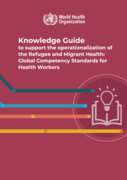
The Knowledge Guide provides guidance on how health workers can apply the Standards to their own practice. For each of the nine competencies and their specific behaviours in the Standards, the Knowledge Guide examines in detail how a health worker's knowledge, skills and attitudes can reach the stat
...
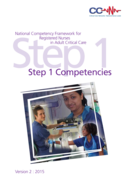
tep 1 Competencies have been designed to provide staff with the core skills required to care for a critically ill patient safely, whilst under supervision. It is expected that Step 1 competencies will be completed prior to commencing an academic critical care programme.
Steps 2 & 3 Competencies hav
...
