
Filter
1191
Text search:
Sexual
empowerment
Featured
82
386
Language
Document type
760
195
92
50
49
25
11
3
2
2
1
1
Countries
72
46
42
41
37
34
32
32
30
30
27
26
25
24
23
22
22
21
20
19
19
14
13
13
12
11
9
9
8
8
7
7
7
7
7
6
6
5
5
5
4
4
4
3
3
3
3
3
3
3
3
3
2
2
2
2
2
2
2
2
2
1
1
1
1
1
1
1
1
1
1
1
1
1
1
1
1
1
1
Authors & Publishers
Publication Years
Category
597
124
58
50
23
21
Toolboxes
111
109
92
50
45
39
30
24
18
16
14
14
8
7
7
6
5
3
3
3
2
1
1

This framework has been developed with the aim of providing standard procedures, assessment and planning tools, and guidance in the delivery of case management services. As Malawi moves forward to build a holistic child protection system, case management will serve as a core anchor and a mobilizing
...

The WHO Toolkit for the care and support of people affected by complications associated with Zika virus has been developed to serve as a model guide, with the goal of enhancing country preparedness for Zika virus outbreaks. The toolkit is intended to provide a systems approach involving public heal
...

Regional situation analysis, practices, experiences, lessons learned and ways forward.

As of June 2019, the number of Venezuelans leaving their country reached 4 million, with Colombia, Peru, Chile, Ecuador and Brazil hosting the vast majority of Venezuelans in Latin America. The end of the first half of the year was marked by the announcement of tighter immigration measures in Peru
...

This paper was commissioned by the German Federal Ministry for Economic Cooperation and Development (BMZ) in 2015, and produced by the Deutsche Gesellschaft für Internationale Zusammenarbeit (GIZ) GmbH, in cooperation with German civil society actors and freelance psychologists working in the field
...

The Call to Action on Protection from GBV in Emergencies, formally launched in 2013 by the United Kingdom and Sweden, aims to fundamentally transform the way GBV is addressed in humanitarian operations via the collective action of numerous partners, each bringing our various strengths and capacities
...
Teaching the Sustainable Development Goals” provides information about the SDGs, their background, the global reality and offers assistance and suggestions on how to teach and support learning for sustainable development.

Primary care - Putting people first: This chapter describes how primary care brings promotion and prevention, cure and care together in a safe, effective and socially productive way at the interface between the population and the health system.

Stronger collaboration, better health: global action plan for healthy lives and well-being for all
recommended
The overall objective of the Global Action Plan is to enhance collaboration among 12 global organizations engaged in health, development and humanitarian responses to accelerate country progress on the health-related SDG targets. The Plan presents a new approach to strengthening collaboration among
...
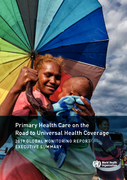
Countries must invest at least 1% more of GDP on primary health care to eliminate glaring coverage gaps
At current rates of progress up to 5 billion people will miss out on health care in 2030
Countries must increase spending on primary healthcare by at least 1% of their gross domestic product (
...

he refugee flow to Ethiopia continued during 2018, with 36,1351 persons seeking safety and protection within the country’s borders. At the start of 2019, the nation hosted 905,8312 thousand refugees who were forced to flee their homes as a result of insecurity, political instability, military cons
...
For children orphaned or made vulnerable by HIV (OVC)
Accessed: 26.10.2019
Case Study on Improving HIV Testing and Services for Children Orphaned or made Vulnerable by HIV (OVC)
Minimum standards of home care for older people in Red Cross Red Crescent volunteer-based programming in the Europe Zone
This publication integrates human rights principles into measuring HIV service effectiveness, ensuring accountability for equity and health. It focuses on reducing stigma, removing punitive laws, and ensuring access to care for key populations, aiming to achieve 2030 targets.

UNAIDS 2018 / Guidance
Guidance for policy-makers, and people living with, at risk of or affected by HIV
