
Filter
2720
Text search:
declaration
Featured
247
719
Language
2562
139
76
65
44
34
25
21
12
5
4
4
4
4
4
4
3
3
3
3
3
3
3
3
2
2
2
2
2
2
2
2
2
2
2
2
2
2
2
1
1
1
1
1
1
1
1
1
1
1
1
1
1
1
Document type
1393
516
370
164
141
51
41
24
9
4
2
1
Countries
144
66
63
62
61
59
57
47
46
42
41
40
38
35
35
35
30
30
30
28
28
26
25
25
25
25
24
24
23
20
17
16
16
16
15
15
13
13
13
13
12
12
12
12
10
10
9
9
9
8
8
8
7
7
6
6
6
6
5
5
5
5
5
5
4
4
4
4
4
4
3
3
3
3
3
3
3
2
2
2
2
2
2
2
2
2
2
2
2
2
2
2
1
1
1
1
1
1
1
1
1
1
1
1
1
1
1
1
1
1
1
1
1
1
1
1
1
1
1
1
1
1
1
1
1
1
1
Authors & Publishers
474
149
88
84
71
63
42
30
29
22
18
14
14
12
12
12
12
12
12
11
11
11
10
10
10
10
10
10
9
9
9
9
8
8
8
8
8
8
8
8
8
7
7
7
7
7
7
7
7
7
7
7
6
6
6
6
6
6
6
6
6
6
6
5
5
5
5
5
5
5
5
5
5
5
5
4
4
4
4
4
4
4
4
4
4
4
4
4
4
4
4
4
4
4
4
4
4
4
4
4
4
4
4
4
4
4
3
3
3
3
3
3
3
3
3
3
3
3
3
3
3
3
3
3
3
3
3
3
3
3
3
3
3
3
3
3
3
3
3
3
3
3
3
3
3
3
3
3
3
3
3
3
3
3
3
3
3
3
3
3
3
3
3
3
2
2
2
2
2
2
2
2
2
2
2
2
2
2
2
2
2
2
2
2
2
2
2
2
2
2
2
2
2
2
2
2
2
2
2
2
2
2
2
2
2
2
2
2
2
2
2
2
2
2
2
2
2
2
2
2
2
2
2
2
2
2
2
2
2
2
2
2
2
2
2
2
2
2
2
2
2
2
2
2
2
2
2
2
2
2
2
2
2
2
2
2
2
2
2
2
2
2
2
2
2
2
2
2
2
2
2
2
2
2
2
2
2
2
2
2
2
2
2
2
2
2
2
2
2
2
2
2
2
2
2
2
2
2
2
2
2
1
1
1
1
1
1
1
1
1
1
1
1
1
1
1
1
1
1
1
1
1
1
1
1
1
1
1
1
1
1
1
1
1
1
1
1
1
1
1
1
1
1
1
1
1
1
1
1
1
1
1
1
1
1
1
1
1
1
1
1
1
1
1
1
1
1
1
1
1
1
1
1
1
1
1
1
1
1
1
1
1
1
1
1
1
1
1
1
1
1
1
1
1
1
1
1
1
1
1
1
1
1
1
1
1
1
1
1
1
1
1
1
1
1
1
1
1
1
1
1
1
1
1
1
1
1
1
1
1
1
1
1
1
1
1
1
1
1
1
1
1
1
1
1
1
1
1
1
1
1
1
1
1
1
1
1
1
1
1
1
1
1
1
1
1
1
1
1
1
1
1
1
1
1
1
1
1
1
1
1
1
1
1
1
1
1
1
1
1
1
1
1
1
1
1
1
1
1
1
1
1
1
1
1
1
1
1
1
1
1
1
1
1
1
1
1
1
1
1
1
1
1
1
1
1
1
1
1
1
1
1
1
1
1
1
1
1
1
1
1
1
1
1
1
1
1
1
1
1
1
1
1
1
1
1
1
1
1
1
1
1
1
1
1
1
1
1
1
1
1
1
1
1
1
1
1
1
1
1
1
1
1
1
1
1
1
1
1
1
1
1
1
1
1
1
1
1
1
1
1
1
1
1
1
1
1
1
1
1
1
1
1
1
1
1
1
1
1
1
1
1
1
1
1
1
1
1
1
1
1
1
1
1
1
1
1
1
1
1
1
1
1
1
1
1
1
1
1
1
1
1
1
1
1
1
1
1
1
1
1
1
1
1
1
1
1
1
1
1
1
1
1
1
1
1
1
1
1
1
1
1
1
1
1
1
1
1
1
1
1
1
1
1
1
1
1
1
1
1
1
1
1
1
1
1
1
1
1
1
1
1
1
1
1
1
1
1
1
1
1
1
1
1
1
1
1
1
1
1
1
1
1
1
1
1
1
1
1
1
1
1
1
1
1
1
1
1
1
1
1
1
1
1
1
1
1
1
1
1
1
1
1
1
1
1
1
1
1
1
1
1
1
1
1
1
1
1
1
1
1
1
1
1
1
1
1
1
1
1
1
1
1
1
1
1
1
1
1
1
1
1
1
1
1
1
1
1
1
1
1
1
1
1
1
1
1
1
1
1
1
1
1
1
1
1
1
1
1
1
1
1
1
1
1
1
1
1
1
1
1
1
1
1
1
1
1
1
1
1
1
1
1
1
1
1
1
1
1
1
1
1
1
1
1
1
1
1
1
1
1
1
1
1
1
1
1
1
1
1
1
1
1
1
1
1
1
1
1
1
1
1
1
1
1
1
1
1
1
1
1
1
1
1
1
1
1
1
1
1
1
1
1
1
1
1
1
1
1
1
1
1
1
1
1
1
1
1
1
1
1
1
1
1
1
1
1
1
1
1
1
1
1
1
1
1
1
1
1
1
1
1
1
1
1
1
1
1
1
1
1
1
1
1
1
1
1
1
1
1
1
1
1
1
1
1
1
1
1
1
1
1
1
1
1
1
1
1
1
1
1
1
1
1
1
1
1
1
1
1
1
1
1
1
1
1
1
1
1
1
1
1
1
1
1
1
1
1
1
1
1
1
1
1
1
1
1
1
1
1
1
1
1
1
1
1
1
1
1
1
1
1
1
1
1
1
1
1
1
1
1
1
1
1
1
1
1
1
1
1
1
1
1
1
1
1
1
1
1
1
1
1
1
1
1
1
1
1
1
1
1
1
1
1
1
1
1
1
1
1
1
1
1
1
1
1
1
1
1
1
1
1
1
1
1
1
1
1
1
1
1
1
1
1
1
1
1
1
1
1
1
1
1
1
1
1
1
1
1
1
1
1
1
1
1
1
1
1
1
1
1
1
1
1
1
1
1
1
1
1
1
1
1
1
1
1
1
1
1
1
1
1
1
1
1
1
1
1
1
1
1
1
1
1
1
1
1
1
1
1
1
1
1
1
1
1
1
1
1
1
1
1
1
1
1
1
1
1
1
1
1
1
1
1
1
1
1
1
1
1
1
1
1
1
1
1
1
1
1
1
1
1
1
1
1
1
1
1
1
1
1
1
1
1
1
1
1
1
1
1
1
1
1
1
1
1
1
1
1
1
1
1
1
1
1
1
1
1
1
1
1
1
1
1
1
1
1
1
1
1
1
1
1
1
1
1
1
1
1
1
1
1
1
1
1
1
1
1
1
1
1
1
1
1
1
1
1
1
1
1
1
1
1
1
1
1
1
1
1
1
1
1
1
1
1
1
1
1
1
1
1
1
1
1
1
1
1
1
1
1
1
1
1
1
1
1
1
1
1
1
1
1
1
1
1
1
1
1
1
1
1
1
1
1
1
1
1
1
1
1
1
1
1
1
1
1
1
1
1
1
1
1
1
1
1
1
1
1
1
1
1
1
1
1
1
1
1
1
1
1
1
1
1
1
1
1
1
1
1
1
1
1
1
1
1
1
1
1
1
1
1
1
1
1
1
1
1
1
1
1
1
1
1
1
1
1
1
1
1
1
1
1
1
1
1
1
1
1
1
1
1
1
1
1
1
1
1
1
1
1
1
1
1
1
1
1
1
1
1
1
1
1
1
1
1
1
1
1
1
1
1
1
1
1
1
1
1
1
1
1
1
1
1
1
1
1
1
1
1
1
1
1
1
1
1
1
1
1
1
1
1
1
1
1
1
1
1
1
1
1
1
1
1
1
1
1
1
1
1
1
1
1
1
1
1
1
1
1
1
1
1
1
1
1
1
1
1
1
1
1
1
1
1
1
1
1
1
1
1
1
1
1
1
1
1
1
1
1
1
1
1
1
1
1
1
1
1
1
1
1
1
1
1
1
1
1
1
1
1
1
1
1
1
1
1
1
1
1
1
1
1
1
1
1
1
1
1
1
1
1
1
1
1
1
1
1
1
1
1
1
1
1
1
1
1
1
1
1
1
1
1
1
1
1
1
1
1
1
1
1
1
1
1
1
1
1
1
1
1
1
1
1
1
1
1
1
1
1
1
1
1
1
1
1
1
1
1
1
1
1
1
1
1
1
1
1
1
1
1
1
1
1
1
1
1
1
1
1
1
1
1
1
1
1
1
1
1
1
1
1
1
1
1
1
1
1
1
1
1
1
1
1
1
1
1
1
1
1
1
1
1
1
1
1
1
1
1
1
1
1
1
1
1
1
1
1
1
1
1
1
1
1
1
1
1
1
1
1
1
1
1
1
1
1
1
1
1
1
1
1
1
1
1
1
1
1
1
1
1
1
1
1
1
1
1
1
1
1
1
1
1
1
1
1
1
1
1
1
1
1
1
1
1
1
1
1
1
1
1
1
1
1
1
1
1
1
1
1
1
1
1
1
1
1
1
1
1
1
1
1
1
1
1
1
1
1
1
1
1
1
1
1
1
1
1
1
1
1
1
1
1
1
1
1
1
1
1
1
1
1
1
1
1
1
1
1
1
1
1
1
1
1
1
1
1
1
1
1
1
1
1
1
1
1
1
1
1
1
1
1
1
1
1
1
1
1
1
1
1
1
1
1
1
1
1
1
1
1
1
1
1
1
1
1
1
1
1
1
1
1
1
1
1
1
1
1
1
1
1
1
1
1
1
1
1
1
1
1
1
1
1
1
1
1
1
1
1
1
1
1
1
1
1
1
1
1
1
1
1
1
1
1
1
1
1
1
1
1
1
1
1
1
1
1
1
1
1
1
1
1
1
1
1
1
1
1
1
1
1
1
1
1
1
1
1
1
1
1
1
1
1
1
1
1
1
1
1
1
1
1
1
1
1
Publication Years
1
884
1620
199
12
1
1
2
Category
914
188
177
164
153
33
30
1
Toolboxes
201
172
165
129
104
103
93
87
87
84
81
79
69
65
63
52
38
36
29
28
26
24
18
17
10
3
Promoting and protecting health is essential to human welfare and sustained economic and social development. This was recognized more than 30 years ago by the Alma-Ata Declaration signatories, who noted that Health for All would contribute both to a
...
better quality of life and also to global peace and security.
more
On May 17, 2026, the World Health Organization (WHO) declared the Ebola outbreak in the Democratic Republic of Congo (DRC) and Uganda as a Public Health Emergency of International Concern (PHEIC). This was followed by Africa Centres for Disease Control and Prevention (Africa CDC)
...
declaration on 18 May 2026 as a Public Health Emergency of Continental Security (PHECS) signalling the seriousness of the situation and calling for immediate actions. Unlike previous outbreaks of Ebola Virus Disease (EVD) caused by zaire strain for which validated countermeasures have been available, there is currently lack of vaccines and therapeutics for the Bundibugyo ebolavirus strain that is driving the current outbreak. In addition, only a limited number of clinical diagnostics tests have been approved or validated for use. These gaps in effective medical countermeasures are constraining the outbreak response efforts.
more

Social protection, a component of the World Health Organization (WHO)’s End TB strategy, has been upheld by Member States as an essential part of the response to tuberculosis in several political declarations, including the 2017 Moscow Declaration
...
to End TB, and both the political declarations of both the 2018 and 2023 United Nations General Assembly (UNGA) high-level meetings on the fight against TB. Furthermore, during the 2023 high-level meeting, member states agreed on a new target to ensure that all people with TB have access to a comprehensive package of health and social benefits by 2027.
more
The burden of mental health conditions in the Region is high and actions are being taken by WHO to address this issue. These include the PARO Declaration (1) by the health ministers of Member States at the Seventy-fifth Session of the WHO Regional C
...
ommittee for South-East Asia on universal access to people-centred mental health care and services.
more
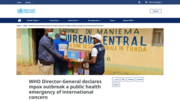
WHO Director-General Dr Tedros Adhanom Ghebreyesus has determined that the upsurge of mpox in the Democratic Republic of the Congo (DRC) and a growing number of countries in Africa constitutes a public health emergency of international concern (PHEIC) under the International Health Regulations (2005
...
) (IHR). Dr Tedros’s declaration came on the advice of an IHR Emergency Committee of independent experts who met earlier in the day to review data presented by experts from WHO and affected countries. The Committee informed the Director-General that it considers the upsurge of mpox to be a PHEIC, with potential to spread further across countries in Africa and possibly outside the continent.
more
Why we need Targets for 2025.
1.2020 Fast Track targets will soon elapse; 2. Current UNAIDS strategy concludes in 2021; 3. Informs possible UN General Assembly Special Session on AIDS in 2021; where a new Political Declaration on AIDS would be adop
...
ted; 4. Informs the strategies of other organisations (Global Fund, PEPFAR); . An updated set of programmatic targets for 2025 in needed to keep us on
track for 2030
more

Sustaining HIV Community-led Responses: Technical guidelines for costing and budgeting
UNAIDS
(2026)
Community-led responses (CLRs) are a vital pillar of the HIV response and central to achieving national and global targets, including the 30-80-60 commitments outlined in the 2021 Political Declaration on HIV and AIDS. These guidelines provide pract
...
ical, step-by-step methods for costing and budgeting community-led responses (CLRs), tailored to the unique features of CLRs. They are designed for use by community-led organizations (CLOs), their partners, national governments, policy-makers, donors, and researchers involved in planning, implementing, financing or evaluating CLRs that address HIV.
more
Claims for refugee status related to situations of armed conflict and violence under Article 1A(2) of the 1951 Convention and/or 1967 Protocol relating to the Status of Refugees and the regional refugee definitions
UNHCR issues these Guidelines on International Protection pursuant to its mandate,
...
as contained in, inter alia, the Statute of the Office of the United Nations High Commissioner for Refugees, namely paragraph 8(a), in conjunction with Article 35 of the 1951 Convention relating to the Status of Refugees, Article II of its 1967 Protocol, Article VIII(1) of the 1969 OAU Convention Governing the Specific Aspects of Refugee Problems in Africa, and Commitment II(e) of the 1984 Cartagena Declaration on Refugees.
These Guidelines clarify paragraph 164 of the UNHCR Handbook on Procedures and Criteria for Determining Refugee Status under the 1951 Convention and otherwise complement the Handbook. They are to be read in conjunction with UNHCR’s other Guidelines on International Protection.
more
An historic opportunity to end AIDS as a public health threat by 2030 and launch a new era of sustainability
A decade of progress has inspired the once unthinkable—that the AIDS epidemic can be ended as a public health threat. The global community has embraced the bold idea to end the AIDS ep ... idemic as a target of the 2030 Agenda for Sustainable Development. Governments from around the world have committed to a Fast-Track agenda and a set of ambitious but attainable milestones to be achieved by 2020 in order to end the AIDS epidemic by 2030, as set out in the United Nations General Assembly Political Declaration on Ending AIDS. Regular reporting through UNAIDS reinforces accountability for results. more
A decade of progress has inspired the once unthinkable—that the AIDS epidemic can be ended as a public health threat. The global community has embraced the bold idea to end the AIDS ep ... idemic as a target of the 2030 Agenda for Sustainable Development. Governments from around the world have committed to a Fast-Track agenda and a set of ambitious but attainable milestones to be achieved by 2020 in order to end the AIDS epidemic by 2030, as set out in the United Nations General Assembly Political Declaration on Ending AIDS. Regular reporting through UNAIDS reinforces accountability for results. more
The Global Vaccine Action Plan (GVAP) 2011-2020, endorsed by Member States during the May 2012 World Health Assembly, has set ambitious targets to improve access to immunization and tackle vaccine-preventable diseases. This responsibility has been translated into firm commitments in February 2016, t
...
hrough the signature of the Addis Declaration on Immunization (ADI) by African Ministers and subsequently endorsed by the Heads of States from across Africa at the 28th African Union Summit held in January 2017. This commitment from the highest level of government comes as a catalyst to immunization efforts on the continent to deliver on the promise of universal immunization
more

Regional Network for Equity in Health in east and southern Africa (EQUINET): Disussion Paper 110
This report compiles evidence from published, grey literature and key informants on the UNMHCP since its introduction in Uganda’s health system, and findings were further validated during a oneda ... y national stakeholder meeting.
Three main factors motivated introduction of the UNMHCP. First, Uganda, along with other lowincome countries, was unable to implement holistically the primary healthcare (PHC) concepts as set out in the Alma Ata Declaration. Second, the macro-economic restructuring carried out in the 1990s, which was an international conditionality for low-income countries to access development financing, influenced the trend towards more stringent prioritisation of health interventions as a means of rationing and targeting use of resources. Third, the government sought to achieve equity with a service package that would be universally available for all people. more
This report compiles evidence from published, grey literature and key informants on the UNMHCP since its introduction in Uganda’s health system, and findings were further validated during a oneda ... y national stakeholder meeting.
Three main factors motivated introduction of the UNMHCP. First, Uganda, along with other lowincome countries, was unable to implement holistically the primary healthcare (PHC) concepts as set out in the Alma Ata Declaration. Second, the macro-economic restructuring carried out in the 1990s, which was an international conditionality for low-income countries to access development financing, influenced the trend towards more stringent prioritisation of health interventions as a means of rationing and targeting use of resources. Third, the government sought to achieve equity with a service package that would be universally available for all people. more
This report brings attention to achieving gender equality in the context of women, girls, and the HIV response. This six-month consultation in 2016 with adolescent women and young girls found that #WhatWomenWant is: collaboration and joint action by all to invest in women's HIV and Sexual and Reprod
...
uctive Health and Rights (SRHR), to be leaders and articulate the priorities of women and girls in all their diversity, and to speak to the new Political Declaration on AIDS and the SDG framework as a tool for civil society to meet their agenda to achieve gender equality in the HIV and SRHR response.
more
The notion of dignity can simply be defined as the inherent and inalienable worth of all human beings irrespective of social status such as race, gender, physical or mental state1. Dignity is deeply embedded in international human rights instruments.
In fact the very first article of the Universal
...
Declaration of Human Rights states that “All human beings are born free and equal in dignity and rights”2, 3. Protection and respect of human rights are the necessary prerequisites to ensure that people are not stripped of their dignity.
more
The drugs issue cuts across the 2030 Agenda for Sustainable Development and multiple Sustainable Development Goals, including ending poverty, reducing inequalities, and, of course, improving health, with its targets on drug use, HIV, and other communicable diseases. Goal 16 on peace, justice, and st
...
rong institutions is particularly important, requiring attention to human rights across the Sustainable Development Goals. Since the late 1990s, United Nations (UN) General Assembly resolutions have acknowledged that ‘countering the world drug problem’ must be carried out ‘in full conformity’ with ‘all human rights and fundamental freedoms’.1 This has been reaffirmed in every major UN political declaration on drug control since, and in multiple resolutions adopted by the Commission on Narcotic Drugs.2 The reality, however, has not always lived up to this important commitment.
more
Planetary health is a transdisciplinary approach that aims to advance the understanding of the links between human-driven changes to the planet and their consequences, and to develop appropriate solutions to the challenges identified. This emerging movement has not yet agreed upon a code of ethics t
...
o underpin the rapidly expanding body of research being carried out in its
name. However, a code of ethics might support the principles for planetary health set out in the Canmore Declaration of 2018. Phrases such as “Public Health 2.0”, “Human Health in an Era of Global Environmental Change”, or “A safe and just operating space for humanity” are often used in planetary health discussions, but are not always clearly defined and so far, the field lacks a strong guiding ethical framework. In this paper, we propose a starting point towards a code of ethics for planetary health that builds on the Canmore Declaration.
more
La prise en charge de la tuberculose représente un véritable défi en milieu carcéral et l’organisation de la continuité des soins à la sortie un enjeu majeur. Comme tout être humain, les détenus ont le droit de jouir du meilleur état de santé physique et mental possible. Ce droit est gar
...
anti par l’article 25 de la Déclaration universelle des droits de l’homme adoptée par l’Organisation des Nations Unies, et par l’article 12 du Pacte international relatif aux droits économiques, sociaux et culturels. Ce travail fait un état des lieux sur la prise en charge de la tuberculose en milieu carcéral au Sénégal, depuis les stratégies de dépistage jusqu’à la continuité des soins après la sortie de prison.
more
La prise en charge de la tuberculose représente un véritable défi en milieu carcéral et l’organisation de la continuité des soins à la sortie un enjeu majeur. Comme tout être humain, les détenus ont le droit de jouir du meilleur état de santé physique et mental possible. Ce droit est gar
...
anti par l’article 25 de la Déclaration universelle des droits de l’homme adoptée par l’Organisation des Nations Unies, et par l’article 12 du Pacte international relatif aux droits économiques, sociaux et culturels. Ce travail fait un état des lieux sur la prise en charge de la tuberculose en milieu carcéral au Sénégal, depuis les stratégies de dépistage jusqu’à la continuité des soins après la sortie de prison.
more
Depuis son apparition début décembre 2019 en Chine, la pandémie de coronavirus (CoViD19), une nouvelle forme de syndrome respiratoire aigu sévère, s'est propagée dans le monde entier avec une rapidité sans précédent. Le 30 janvier 2020, l'Organisation mondiale de la santé (OMS) a déclaré
...
l'épidémie comme une urgence sanitaire internationale, suivie par la déclaration de la pandémie le 11 mars 2020, rendant obligatoire pour tous les pays de surveiller en permanence la situation et de mettre en œuvre des mesures de prévention et de réponse.
more

Accessed: 27.04.2020
Selon les données partagées par CONASUR dans le mois de mars de 2020, le Burkina Faso compte avec près de 840 000 personnes déplacées internes à cause de la crise d’insécurité. Les régions du CentreNord, le Sahel et le Nord, enregistrent les chiffres des population
...
s déplacées internes plus hautes. À cette situation assez complexe en termes de besoins humanitaires, s’ajoute la déclaration d’urgence sanitaire à cause de la pandémie du COVID-19.
more
Orientations provisoires
26 mars 2020
Plusieurs pays ont montré qu’il était possible de ralentir voire de stopper la transmission interpersonnelle de la COVID-19. Les principales mesures pour arrêter la transmission sont le dépistage actif des cas, les soins et l’isolement, la recherche
...
des contacts et la quarantaine. L’OMS a publié des recommandations pour la surveillance mondiale de la COVID-19, qui donnent la définition des cas et des contacts pour la déclaration à l’OMS. En plus de la recherche active des cas et du dépistage, il est essentiel d’intensifier les activités de surveillance pour déterminer si la COVID-19 se transmet au sein de la communauté et pour suivre l’évolution de la transmission communautaire.
more
