
Filter
693
Text search:
Dengue
fever
Featured
71
231
Language
Document type
320
110
101
33
30
23
22
20
13
12
4
3
1
1
Countries
59
33
20
17
17
15
14
13
9
9
9
8
8
7
7
6
6
6
6
5
5
5
5
5
4
4
4
4
4
4
3
3
3
3
3
3
3
3
2
2
2
2
2
2
2
1
1
1
1
1
1
1
1
1
1
1
1
1
1
1
1
1
1
1
1
1
1
Authors & Publishers
Publication Years
Category
195
80
51
46
22
11
6
Toolboxes
127
104
49
38
37
28
28
26
19
17
10
8
8
5
4
4
4
4
3
3
3
1
1
The EYE strategy is a comprehensive and long-term strategy built on lessons learned that aims at ending yellow fever epidemics by 2026, and consists of three strategic objectives:
protect at-risk populations;
prevent international spread;
...
July 2019
National Malaria Elimination & Aedes Transmitted Disease Control Program
Disease Control Division
Derectorate General of Health Services
This country profile presents a summary and analysis of Argentina's status with yellow fever. It is part of a series of profiles on this topic, each focusing on a different country in the Region of the Americas. Argentina's geographical location pre
...

Methodological field approaches for scientists with a basic background in entomology to prepare and implement a yellow fever entomological assessment during outbreaks
2nd edition.This updated publication provides programme managers with a user-friendly tool that can: (i) analyse and draw conclusions from historic dengue datasets; (ii) identify appropriate alarm indicators that can predict forthcoming outbreaks at
...
Dengue is a mosquito-borne viral disease that occurs mainly in the tropics and subtropics but has a high potential to spread to new areas. Dengue infections are climate sensitive, so it is important
...
The socioeconomic factors and public health inadequacies that facilitated the rapid spread of this infection continue to exist. As it is a new and emerging disease it has not received sufficient coverage yet in the medical curricula of Member States. Specific treatment is not available, and there is
...

This guidance synthesizes current evidence on dengue laboratory testing and diagnostics and provides practical recommendations for laboratories, clinicians, public health officials, and programme managers involved in
...

The aim of this toolkit is to guide countries on how to best estimate their current burden of dengue by combining existing data from dengue surveillance systems with on-going research efforts to mea
...

The waves of yellow fever transmission in the Region of the Americas in 2016–2018 involved the largest number of human and epizootic cases to be reported in several decades. Yellow fever is a seri
...
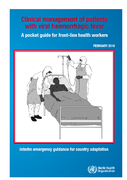
The purpose of this pocketbook is to provide clear guidance on current best management practices for VHF across health-care facilities
WHO Secretariat Information paper July 2016

In the Region of the Americas, between epidemiological week (EW) 1 and EW 52 of 2018, a total of 560,586 cases of dengue were reported (incidence rate of 57.3 cases per 100,000 population), including 336 deaths. Of the total cases, 209,192 (37.3%) w
...

This publication aims to provide updated guidance on the specific use of yellow fever laboratory assays in the context of surveillance to be used across the Global Yellow Fever Laboratory Network fo
...

Laboratory manual for yellow fever
recommended
This WHO laboratory manual provides the most up to date methods and procedures for the laboratory identification of yellow fever virus infection in humans. It provides guidance on the establishment and maintenance of an effective laboratory providin
...

This toolkit is a comprehensive set of practical tools and resources designed to support country-level risk communication and community engagement (RCCE) practitioners, decision-makers, and partners to plan and implement readiness and response activities for yellow
...

Disease Control Division, Standard Management Guideline;Directorate General of Health Services, Ministry of Health & Family Welfare: First Published: 15th May 2017
Zika and dengue viruses remain significant public health threats. These viruses share the same Aedes (Stegomyia) mosquito vectors and geographic distributions but infections cannot be readily distinguished clinically and need to be differentiated fr
...
