
Filter
1113
Text search:
HIV
infected
infants
Featured
145
355
Language
Document type
685
193
110
44
36
24
11
6
2
1
1
Countries
83
48
38
36
35
33
32
32
25
23
20
18
17
16
16
15
15
14
14
13
11
11
9
7
7
7
6
6
5
5
5
4
4
4
3
3
3
3
3
3
3
3
2
2
2
2
2
2
2
1
1
1
1
1
1
1
1
1
1
1
1
1
1
1
1
1
1
1
Authors & Publishers
Publication Years
Category
552
154
105
40
37
31
5
Toolboxes
114
112
35
31
28
21
18
17
16
15
14
14
13
11
10
9
9
7
6
4
4
3
2
1


This manual aims to provide practical guidance to field workers in order to maximise the nutritional impact of food security & livelihoods (FSL) interventions. This requires the systematic use of a ‘nutrition lens’ at each step of the project cycle and a close collaboration between sectors.
Nosocomial or health-facility-acquired infections are a serious issue, representing one of the most significant causes of morbidity and mortality in healthcare systems and consuming many scarce resources, especially in developing countries. Although much has been done, particularly in the hospital s
...
Infection Control Assessment Tool
recommended
Strengthening Parmaceutical Systems. 2nd edition

Case Manangement Training Modules
The WHO Cholera Vaccine Position Paper (August 2017) highlights the importance of oral cholera vaccines (OCVs) as a key tool in outbreak response and prevention, alongside water, sanitation, and hygiene (WASH) measures. It recommends OCVs for high-risk populations, endemic areas, and humanitarian cr
...
NEMLIST | Sixth Edition | February 2016


Joining efforts to control two trelated global epidemics.
Weekly epidemiological record/ Relevé épidémiologique hebdomadaire 4 AUGUST 2017, 92th YEAR / 4 AOÛT 2017, 417-436

These standards for the quality of paediatric care in health facilities form part of normative
guidance for improving the quality of maternal, newborn, child and adolescent health care.
In view of the importance of the continuum of both the life-course and service delivery (1),
these standards bu
...
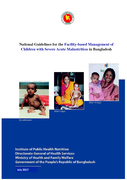
Level of stunting among Bangladeshi children <5years declined from 51% in 2004 to 36% and underweight from 41% in 2007 to 33% (BDHS 2014). But the decrease in wasting rate is not as expected, which is only from 17% to 14.3 % over last decade. Approximately 3.1 % (BDHS 2014) of under-5 children suffering from SAM only b
...
No publication year indicated
The specific objectives of the plan are to:
- Scale up evidence-based, cost effective interventions through effective strategies within a HSS approach and provide equitable coverage with quality.
- Reduce neonatal mortality by improved home-based newborn ...
The specific objectives of the plan are to:
- Scale up evidence-based, cost effective interventions through effective strategies within a HSS approach and provide equitable coverage with quality.
- Reduce neonatal mortality by improved home-based newborn ...
