
Filter
402
Text search:
portuguese
Featured
51
74
Language
Document type
165
92
40
32
20
13
8
6
5
5
5
4
3
3
Countries
27
23
21
17
17
16
12
5
5
5
4
4
4
4
3
3
3
3
3
3
3
3
3
2
2
2
2
2
2
2
2
2
2
2
1
1
1
1
1
1
1
1
1
1
1
1
1
1
1
1
1
1
1
1
1
1
1
1
1
1
1
1
1
1
1
1
1
1
1
1
1
1
1
1
1
Authors & Publishers
Publication Years
Category
90
38
24
18
17
13
2
1
Toolboxes
85
37
28
21
20
20
16
15
15
14
13
11
9
8
8
7
7
6
6
5
5
2
1
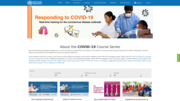
OpenWHO is an interactive, web-based, knowledge-transfer platform offering free online courses to improve the response to health emergencies. In summary, OpenWHO currently offers courses covering the following topics and languages to support the response to COVID-19:
A general introduction to
...

Hesperian released a Coronavirus (COVID-19) Fact Sheet specifically for people like you, individuals and organizations seeking credible resources. Thanks to the incredible skill and participation of many partners on short notice, it is available now in English, Spanish, French, Chinese, Urdu, Bangla
...
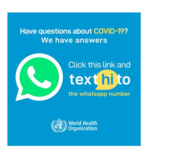
WHO is launching a messaging service with partners WhatsApp and Facebook to keep people safe from coronavirus.
WHO has launched a dedicated messaging services in Arabic, English, French, Hindi, Italian, Spanish and Portuguese with partners WhatsA
...

This document, produced by IFRC, UNICEF and WHO, suggests key actions on how people and communities can stay safe and slow down the spread of COVID-19, particularly for contexts where you might have been asked by your local authorities to maintain physical distance or stay home.
Available in: Arabi
...

This topic last updated: Apr 28, 2020.
The content on the UpToDate website is not intended nor recommended as a substitute for medical advice, diagnosis, or treatment. Always seek the advice of your own physician or other qualified health care professional regarding any medical questions or condi
...

This topic last updated: Apr 28, 2020.
The content on the UpToDate website is not intended nor recommended as a substitute for medical advice, diagnosis, or treatment. Always seek the advice of your own physician or other qualified health care professional regarding any medical questions or condi
...

This topic last updated: Apr 28, 2020.
The content on the UpToDate website is not intended nor recommended as a substitute for medical advice, diagnosis, or treatment. Always seek the advice of your own physician or other qualified health care professional regarding any medical questions or conditi
...

This initiative produced over 55 infographics designs in over 60 languages in order to empower many communities in Africa and beyond.
The infographics are available in over 60 languages, including: Amhari, Bemba, Chinchewa, English, Hausa, Igbo, Luganda, Lumasaba, Madinka, Pidgin,
...

To help increase continental testing efforts and reduce COVID-19 transmission in Africa, Africa CDC has launched the Partnership to Accelerate COVID-19 Testing (PACT): Test, Trace, Treat. PACT will mobilize experts, community workers, supplies and other resources to TEST, TRACE and TREAT COVID-19 c
...

A guide on how to prevent and address social stigma surrounding coronavirus disease (COVID-19) for Government, media and local organisations working on the disease.
Available in different languages: Arabic, English, French, Indonesia, Hindi, Korean, Japanese, Thai, Vientmese, Bengali, Malay,
...
Science in 5
recommended
Coronavirus disease (COVID-19) science conversation
In this video and audio series WHO experts explain the science related to COVID-19. This series is available every week on WHO's YouTube, Instagram, Facebook, Twitter, and LinkedIn channels and on all major podcasts platforms.
Download all epis
...
WHO Academy’s mobile learning app
recommended
The WHO Academy’s mobile learning app was developed specifically for health workers and is designed to enable them to expand their life-saving skills to battle COVID-19. It delivers mobile access to a wealth of COVID-19 knowledge resources developed by WHO, including up-to-the-minute guidance, to
...
COVID-19 Recommended Interventions in Mental Health and Psychosocial Support (MHPSS) during the Pandemic
recommended
This document describes the essential interventions in mental health and psychosocial support (MHPSS) that should be developed on an intersectoral basis in countries and communities. Its frame of reference is the Inter-Agency Standing Committee (IASC) intervention pyramid for MHPSS services. The pyr
...
Augmented reality PPE course
recommended
he app has a new feature that deploys augmented reality (AR) technology to help health workers address a critical challenge that many face every day during the pandemic – staying free of infection while they care for patients. This 20-minute course demonstrates the proper techniques and sequence
...
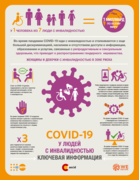
Во время пандемии COVID-19 юди с инвалидностью и сталкиваются с еще
большей дискриминацией, насилием и отсутствием доступа к информации,
образованию и услугам, связаÐ
...
Вспышки заболеваний по-разному затрагивают женщин и мужчин, а пандемии усугубляют существующее неравенство в отношении женщин и девочек и дискриминацию других ма
...
The WHO SAGE values framework for the allocation and prioritization of COVID-19 vaccination is intended to offer guidance on the prioritization of groups for vaccination when vaccine supply is limited. It provides a values foundation for the objectives of COVID-19 vaccination programmes and links t
...
MEDBOX – The Aid Library is an open-access online library aiming to increase the quality of health care worldwide. Quality assurance and accountability are important values in humanitarian action as well as healthcare settings, which receive growing attention by affected populations, health care w
...
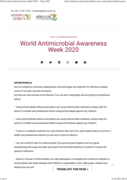
Such as antibiotics, antivirals, antiparasitics, and antifungals are important for infectious disease control in humans, animals and plants,
but they can only continue to be effective if we use them responsibly and according to professional advice.
Available in English, French and
...
28 Dec 2020. The main objective of these guidelines is to provide tools for staff working in the field of immunization to support effective communication between health personnel and the general population, with the aim of strengthening, maintaining or recovering trust in vaccines and the immunizati
...
