
Filter
2723
Text search:
COVID-19
response
Featured
348
37
Language
Document type
945
712
277
225
224
122
59
54
41
27
24
9
3
1
Countries
255
84
82
72
70
61
60
60
60
56
54
50
44
43
42
36
33
32
31
28
28
28
27
26
23
23
22
18
17
16
16
16
16
15
14
14
13
13
12
12
12
12
12
10
10
9
9
9
9
8
8
8
8
8
8
7
7
7
7
7
7
7
7
7
7
7
6
6
6
6
6
6
6
5
5
5
5
5
5
5
5
5
4
4
4
4
4
4
4
3
3
3
3
3
3
3
3
3
2
2
2
2
2
2
2
2
2
2
2
2
2
2
2
1
1
1
1
1
1
1
1
1
1
1
1
1
1
1
1
1
1
1
1
1
1
1
Authors & Publishers
Publication Years
Category
1072
142
131
85
82
35
26
2
Toolboxes
1462
145
123
90
88
78
77
76
66
52
45
44
41
41
37
35
33
17
14
8
8
6
5
3
3

The strategy recommends that AU Member States should enhance, where feasible, existing COVID-19 surveillance to include:
Community-based surveillance to detect symptomatic cases early for tre
...

A study conducted by the World Health Organisation Regional Office for Africa. The COVID-19 pandemic has had a significant impact on older persons both globally and in the African region. Although o
...

The COVID-19 pandemic has disproportionately impacted the informal women workers due to lockdowns, curfews, school closures, and all other containment measures- most of which missed the feminist len
...

access free courses in more than 60 languages
This guidance addresses rationale, risk-based scenarios, practical considerations prior to adoption of the self-testing products, quality assurance, safety and ethical considerations, and data management considerations for COVID-
...

WHY THIS GUIDE?
Because, in the face of crises and emergencies, it is vital to include a human rights perspective in responses. Vulnerable groups face major obstacles to accessing and benefiting from prevention, mitigation, and health care policies due to structural barriers of inequality. To offer
...

Ethnic disparities in COVID-19 persist, with increased rates of infection, severe disease, and death among people from minority ethnic groups. COVID
...
The Lancet Regional health Americas, vol.10 (2022) June 1, March 04, 2022DOI:https://doi.org/10.1016/j.lana.2022.100222

This collection of case studies on risk communication and community engagement (RCCE) from 18 different country/area level public health partners in the WHO European Region provides evidence of numerous results achieved and lessons learned since the start of the
...

Nearly 260 000 people died in parts of Somalia between October 2010 and April 2012, including
133 000 children under five during the famine and food crisis in Somalia making it the worst famine in history.
A study commissioned and funded by the Food and Agriculture Organization of the United Natio
...

The COVID-19 pandemic has resulted in a double shock - health and economic. As of March 1, 2021, COVID-
...

The WHO COVID-19 Clinical management: living guidance contains the most up-to-date recommendations for the clinical management of people with COVID
...

Be willing to talk. They will already have heard something. Silence and secrets do not protect our children. Honesty and openness do. Think about how much they will understand. You know them best.
Updated 8 June 2020

This is a stressful time. Take care of yourself, so you can support your children.
Updated 8 June 2020

All children misbehave. It is normal when children are tired, hungry, afraid, or learning independence. And they can drive us crazy when stuck at home.
Updated 8 June 2020

COVID-19 has taken away our daily work, home and school routines. This is hard for children, teenagers and for you. Making new routines can help.
Updated 8 June 2020
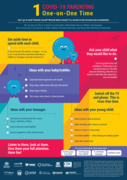
Can’t go to work? Schools closed? Worried about money? It is normal to feel stressed and overwhelmed. School shutdown is also a chance to make better relationships with our children and teenagers. One-on-One time is free and fun. It makes children feel loved and secure, and shows them that they a
...

