
Filter
650
Text search:
UN
High
Commissioner
for
Refugees
Featured
74
225
Language
Document type
333
147
54
38
33
16
11
10
3
2
1
1
1
Countries
69
39
37
27
27
24
21
20
19
15
13
11
11
10
10
9
9
8
8
7
7
7
6
6
5
5
5
4
4
4
3
3
2
2
2
2
2
2
2
2
2
2
2
2
2
2
2
2
2
2
2
2
2
2
2
2
2
1
1
1
1
1
1
1
1
1
1
1
1
1
1
1
1
1
Authors & Publishers
Publication Years
Category
188
108
48
15
14
11
Toolboxes
130
104
68
67
32
18
16
11
10
9
9
5
5
5
5
3
3
2
2
1
1
1
1
This report serves the specific purpose of collating legally relevant information on conditions in countries of origin pertinent to the assessment of claims for asylum. It is not intended to be a general report on human rights conditions. The report
...


Revision for Field Review
Online version of the manual: https://iawgfieldmanual.com/manual
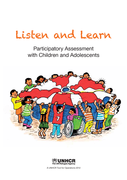
Participatory Assessment with Children and Adolescents. An UNHCR Tool for Operations

“Because we struggle to survive” Child Labour among Refugees of the Syrian Conflict | This study provides pertinent first-hand information on the reality facing Syrian children who are working either in their homeland, the neighbouring countries
...

This document contains guidance for strengthening the disability inclusiveness of MHPSS responses and programmes in emergency settings. It is intended to supplement the IASC Guidelines on Mental Health and Psychosocial Support in Emergency Settings
...
Action on behalf of unaccompanied and separated children should be guided by principles enshrined in international standards. The validity of these principles has been confirmed by experience and lessons learnt from conflicts and natural disasters in recent years. The objective of the present public
...
The present report is based on a longitudinal analysis of assessments on mixed migration routes and dynamics, conducted over the course of 2018. It is based on six rapid thematic studies, conducted over the course of 2018, as well as a longitudinal analysis of changes in mixed migration routes and d
...
Refugees and migrants face unacceptable and extreme forms of violence on mixed migration routes from East and West Africa to and through North Africa. This report provides clear and strong findings based on almost 16,000 interviews with
...
According to the United Nations, Yemen has been the "Worst humanitarian crisis in the world," for the past two years. Despite the Hudaydah Agreement signed in December 2018, the fighting continued in many areas of the country, such as Hajjah in the
...
New research published today shows that older, disabled and injured Syrian refugees are paying a double toll as a result of the conflict. The report, released by Handicap International and HelpAge International, provides new data showing how much th
...
At the World Humanitarian Summit in Istanbul in May 2016, leaders made over 3,700 commitments to advance the Agenda for Humanity. In their first self-reports against these commitments, 142 stakeholders described the efforts they made from June to De
...
Background paper for the Oslo Summit on Education for Development
Background paper for the Oslo Summit on Education for Development.
This paper covers the four topics of the Oslo Summit: investment in education, quality of learning, education in emergencies and
...
For applying the new operational guidance on CB-MHPSS in the field, UNICEF country offices and partners will need ready access to tools and resources that can be used to implement the programs. By bringing together resources from different contexts,
...

Background paper 11
The Independent Panel for Pandemic Preparedness and Response
May 2021

A Guide for UNICEF Staff
The Interagency Emergency Health Kit 2017
recommended
Interagency Guidelines; Medicines and medical devices for 10 000 people for approximately three month.
This manual is for the beginner/intermediate and advanced EHA courses run by Channel Research on behalf of ALNAP. It is supported by a course specific set of case studies and exercises and by a bibliography of evaluation references

This report found that fewer than 15 percent of more than 3,000 school-age asylum-seeking children on the islands were enrolled in public school at the end of the 2017-2018 school year, and that in government-run camps on the islands, only about 100 children, all preschoolers, had access to formal e
...
