
Filter
2858
Text search:
transition
Featured
223
778
Language
2508
332
69
63
51
31
24
17
5
5
4
4
4
3
3
2
2
2
2
2
2
2
2
2
2
2
2
1
1
1
1
1
1
1
1
1
1
1
Document type
1504
613
304
155
144
46
43
22
12
8
4
1
1
Countries
177
91
81
69
68
53
53
51
50
49
48
47
45
44
40
37
34
33
33
32
32
32
29
28
27
27
26
24
23
22
21
20
19
18
18
17
15
14
13
13
13
12
12
12
11
11
9
9
9
9
9
9
8
7
7
6
6
6
5
5
5
5
5
5
5
4
4
4
4
4
3
3
3
3
3
3
3
3
3
3
3
3
2
2
2
2
2
2
2
2
2
2
2
2
2
2
2
1
1
1
1
1
1
1
1
1
1
1
1
1
1
1
1
1
1
1
1
1
1
1
1
1
1
1
1
1
Authors & Publishers
315
98
84
75
62
58
55
42
33
30
30
22
20
20
18
16
16
14
14
14
13
13
12
12
12
12
11
11
11
11
10
10
10
9
9
9
9
8
8
8
8
8
8
7
7
7
7
7
7
6
6
6
6
6
6
6
6
6
6
6
6
5
5
5
5
5
5
5
5
5
5
5
5
5
5
5
5
5
5
4
4
4
4
4
4
4
4
4
4
4
4
4
4
4
4
4
4
4
4
4
4
4
4
4
4
4
4
4
4
4
4
4
4
4
3
3
3
3
3
3
3
3
3
3
3
3
3
3
3
3
3
3
3
3
3
3
3
3
3
3
3
3
3
3
3
3
3
3
3
3
3
3
3
3
3
3
3
3
3
3
3
3
3
3
3
3
3
3
3
3
3
3
3
3
3
3
3
3
3
3
3
3
3
2
2
2
2
2
2
2
2
2
2
2
2
2
2
2
2
2
2
2
2
2
2
2
2
2
2
2
2
2
2
2
2
2
2
2
2
2
2
2
2
2
2
2
2
2
2
2
2
2
2
2
2
2
2
2
2
2
2
2
2
2
2
2
2
2
2
2
2
2
2
2
2
2
2
2
2
2
2
2
2
2
2
2
2
2
2
2
2
2
2
2
2
2
2
2
2
2
2
2
2
2
2
2
2
2
2
2
2
2
2
2
2
2
2
2
2
2
2
2
2
2
2
2
2
2
2
2
2
2
2
2
2
2
2
2
2
2
2
2
2
2
2
2
2
2
2
2
2
2
2
2
2
2
2
2
2
2
2
2
2
2
2
2
2
2
2
2
2
2
2
2
2
2
2
2
2
2
2
2
2
2
2
2
2
2
2
2
2
2
2
2
2
2
2
2
2
2
2
2
2
2
2
2
2
1
1
1
1
1
1
1
1
1
1
1
1
1
1
1
1
1
1
1
1
1
1
1
1
1
1
1
1
1
1
1
1
1
1
1
1
1
1
1
1
1
1
1
1
1
1
1
1
1
1
1
1
1
1
1
1
1
1
1
1
1
1
1
1
1
1
1
1
1
1
1
1
1
1
1
1
1
1
1
1
1
1
1
1
1
1
1
1
1
1
1
1
1
1
1
1
1
1
1
1
1
1
1
1
1
1
1
1
1
1
1
1
1
1
1
1
1
1
1
1
1
1
1
1
1
1
1
1
1
1
1
1
1
1
1
1
1
1
1
1
1
1
1
1
1
1
1
1
1
1
1
1
1
1
1
1
1
1
1
1
1
1
1
1
1
1
1
1
1
1
1
1
1
1
1
1
1
1
1
1
1
1
1
1
1
1
1
1
1
1
1
1
1
1
1
1
1
1
1
1
1
1
1
1
1
1
1
1
1
1
1
1
1
1
1
1
1
1
1
1
1
1
1
1
1
1
1
1
1
1
1
1
1
1
1
1
1
1
1
1
1
1
1
1
1
1
1
1
1
1
1
1
1
1
1
1
1
1
1
1
1
1
1
1
1
1
1
1
1
1
1
1
1
1
1
1
1
1
1
1
1
1
1
1
1
1
1
1
1
1
1
1
1
1
1
1
1
1
1
1
1
1
1
1
1
1
1
1
1
1
1
1
1
1
1
1
1
1
1
1
1
1
1
1
1
1
1
1
1
1
1
1
1
1
1
1
1
1
1
1
1
1
1
1
1
1
1
1
1
1
1
1
1
1
1
1
1
1
1
1
1
1
1
1
1
1
1
1
1
1
1
1
1
1
1
1
1
1
1
1
1
1
1
1
1
1
1
1
1
1
1
1
1
1
1
1
1
1
1
1
1
1
1
1
1
1
1
1
1
1
1
1
1
1
1
1
1
1
1
1
1
1
1
1
1
1
1
1
1
1
1
1
1
1
1
1
1
1
1
1
1
1
1
1
1
1
1
1
1
1
1
1
1
1
1
1
1
1
1
1
1
1
1
1
1
1
1
1
1
1
1
1
1
1
1
1
1
1
1
1
1
1
1
1
1
1
1
1
1
1
1
1
1
1
1
1
1
1
1
1
1
1
1
1
1
1
1
1
1
1
1
1
1
1
1
1
1
1
1
1
1
1
1
1
1
1
1
1
1
1
1
1
1
1
1
1
1
1
1
1
1
1
1
1
1
1
1
1
1
1
1
1
1
1
1
1
1
1
1
1
1
1
1
1
1
1
1
1
1
1
1
1
1
1
1
1
1
1
1
1
1
1
1
1
1
1
1
1
1
1
1
1
1
1
1
1
1
1
1
1
1
1
1
1
1
1
1
1
1
1
1
1
1
1
1
1
1
1
1
1
1
1
1
1
1
1
1
1
1
1
1
1
1
1
1
1
1
1
1
1
1
1
1
1
1
1
1
1
1
1
1
1
1
1
1
1
1
1
1
1
1
1
1
1
1
1
1
1
1
1
1
1
1
1
1
1
1
1
1
1
1
1
1
1
1
1
1
1
1
1
1
1
1
1
1
1
1
1
1
1
1
1
1
1
1
1
1
1
1
1
1
1
1
1
1
1
1
1
1
1
1
1
1
1
1
1
1
1
1
1
1
1
1
1
1
1
1
1
1
1
1
1
1
1
1
1
1
1
1
1
1
1
1
1
1
1
1
1
1
1
1
1
1
1
1
1
1
1
1
1
1
1
1
1
1
1
1
1
1
1
1
1
1
1
1
1
1
1
1
1
1
1
1
1
1
1
1
1
1
1
1
1
1
1
1
1
1
1
1
1
1
1
1
1
1
1
1
1
1
1
1
1
1
1
1
1
1
1
1
1
1
1
1
1
1
1
1
1
1
1
1
1
1
1
1
1
1
1
1
1
1
1
1
1
1
1
1
1
1
1
1
1
1
1
1
1
1
1
1
1
1
1
1
1
1
1
1
1
1
1
1
1
1
1
1
1
1
1
1
1
1
1
1
1
1
1
1
1
1
1
1
1
1
1
1
1
1
1
1
1
1
1
1
1
1
1
1
1
1
1
1
1
1
1
1
1
1
1
1
1
1
1
1
1
1
1
1
1
1
1
1
1
1
1
1
1
1
1
1
1
1
1
1
1
1
1
1
1
1
1
1
1
1
1
1
1
1
1
1
1
1
1
1
1
1
1
1
1
1
1
1
1
1
1
1
1
1
1
1
1
1
1
1
1
1
1
1
1
1
1
1
1
1
1
1
1
1
1
1
1
1
1
1
1
1
1
1
1
1
1
1
1
1
1
1
1
1
1
1
1
1
1
1
1
1
1
1
1
1
1
1
1
1
1
1
1
1
1
1
1
1
1
1
1
1
1
1
1
1
1
1
1
1
1
1
1
1
1
1
1
1
1
1
1
1
1
1
1
1
1
1
1
1
1
1
1
1
1
1
1
1
1
1
1
1
1
1
1
1
1
1
1
1
1
1
1
1
1
1
1
1
1
1
1
1
1
1
1
1
1
1
1
1
1
1
1
1
1
1
1
1
1
1
1
1
1
1
1
1
1
1
1
1
1
1
1
1
1
1
1
1
1
1
1
1
1
1
1
1
1
1
1
1
1
1
1
1
1
1
1
1
1
1
1
1
1
1
1
1
1
1
1
1
1
1
1
1
1
1
1
1
1
1
1
1
1
1
1
1
1
1
1
1
1
1
1
1
1
1
1
1
1
1
1
1
1
1
1
1
1
1
1
1
1
1
1
1
1
1
1
1
1
1
1
1
1
1
1
1
1
1
1
1
1
1
1
1
1
1
1
1
1
1
1
1
1
1
1
1
1
1
1
1
1
1
1
1
1
1
1
1
1
1
1
1
1
1
1
1
1
1
1
1
1
1
1
1
1
1
1
1
1
1
1
1
1
1
1
1
1
1
1
1
1
1
1
1
1
1
1
1
1
1
1
1
1
1
1
1
1
1
1
1
1
1
1
1
1
1
1
1
1
1
1
1
1
1
1
1
1
1
1
1
1
1
1
1
1
1
1
1
1
1
1
1
1
1
1
1
1
1
1
1
1
1
1
1
1
1
1
1
1
1
1
1
1
1
1
1
1
1
1
1
1
1
1
1
1
1
1
1
1
1
1
1
1
1
1
1
1
1
1
1
1
1
1
1
1
1
1
1
1
1
1
1
1
1
1
1
1
1
1
1
1
1
1
1
1
1
1
1
1
1
1
1
1
1
1
1
1
1
1
1
1
1
1
1
1
1
1
1
1
1
1
1
1
1
1
1
1
1
1
1
1
1
1
1
1
1
1
1
1
1
1
1
1
1
1
1
1
1
1
1
1
1
1
1
1
1
1
1
1
1
1
1
1
1
1
1
1
1
1
1
1
1
1
1
1
1
1
1
1
1
1
1
1
1
1
1
1
1
1
1
1
1
1
1
1
1
1
1
1
1
1
1
1
1
1
1
1
1
1
1
1
1
1
1
1
1
1
1
1
1
1
1
1
1
1
1
1
1
1
1
1
1
1
1
1
1
1
1
1
1
1
1
1
1
1
1
1
1
1
1
1
1
1
1
1
1
1
1
1
1
1
1
1
1
1
1
1
1
1
1
1
1
1
1
1
1
1
1
1
1
1
1
1
1
1
1
1
1
1
1
1
1
1
1
1
1
1
1
1
1
1
1
1
1
1
1
1
1
1
1
1
1
1
1
1
1
1
1
1
1
1
1
1
1
1
1
1
1
1
1
1
1
1
1
1
1
1
1
1
1
1
1
1
1
1
1
1
1
1
1
1
1
1
1
1
1
1
1
1
1
1
1
1
1
1
1
1
1
1
1
1
1
1
1
1
1
1
1
1
1
1
1
1
1
1
1
1
1
1
1
1
1
1
1
1
1
1
1
1
1
1
1
1
1
1
1
1
1
1
1
1
1
1
1
1
1
1
1
1
1
1
1
1
1
1
1
1
1
1
1
1
1
1
1
1
1
1
1
1
1
1
1
1
1
1
1
1
1
1
1
1
1
1
1
1
1
1
1
1
1
1
1
1
1
1
1
1
1
1
1
1
1
1
1
1
1
1
1
1
1
1
1
1
1
1
1
1
1
1
1
1
1
1
1
1
1
1
1
1
1
1
1
1
1
1
1
1
1
1
1
1
1
1
1
1
1
1
1
1
1
1
1
1
1
1
1
1
1
1
1
1
1
1
1
1
1
1
1
1
1
1
1
1
1
1
1
1
1
1
1
1
1
1
1
1
1
1
1
1
1
1
1
1
1
1
1
1
1
1
1
1
1
1
1
1
1
1
1
1
1
1
1
1
1
1
1
1
1
1
1
1
1
1
1
1
1
1
1
1
1
1
1
1
1
1
1
1
1
1
1
1
1
1
1
1
1
1
1
1
1
1
1
1
1
1
1
1
1
1
1
1
1
1
1
1
1
1
1
1
1
1
1
1
1
1
1
1
1
1
1
1
1
1
1
1
1
1
1
1
1
1
1
1
1
1
1
1
1
1
1
1
1
1
1
1
1
1
1
1
1
1
1
1
1
1
1
1
1
1
1
1
1
1
1
1
1
1
1
1
1
1
1
1
1
1
1
1
1
1
1
1
1
1
1
1
1
1
1
1
1
1
1
1
1
1
1
1
1
1
1
1
1
1
1
1
1
1
1
1
1
1
1
1
1
1
1
1
1
1
1
1
1
1
1
1
1
1
1
1
1
1
1
1
1
1
1
1
1
1
1
1
1
1
1
1
1
Publication Years
852
1804
191
11
Category
1064
188
174
174
119
74
11
Toolboxes
247
183
140
136
116
116
98
82
82
72
71
65
58
49
42
41
36
31
29
23
18
18
11
9
7
2
1
Financing Global Health 2018: Countries and Programs in Transition
Institute for Health Metrics and Evaluation (IHME)
Institute for Health Metrics and Evaluation (IHME)
(2019)
C2
This 10th edition of the Institute for Health Metrics and Evaluation’s annual Financing Global Health report provides the most up-to-date estimates of development assistance for health, domestic spending on health, health spending on two key infectious diseases – malaria and HIV/AIDS – and fut
...
ure scenarios of health spending. Several transitions in global health financing inform this report: the influence of economic development on the composition of health spending; the emergence of other sources of development assistance funds and initiatives; and the increased availability of disease-specific funding data for the global health community. For funders and policymakers with sights on achieving 2030 global health goals, these estimates are of critical importance. They can be used for identifying funding gaps, evaluating the allocation of scarce resources, and comparing funding across time and countries.
more

24 April 2020
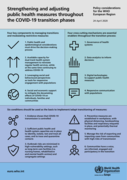
Policy considerations
for the WHO European Region
This document provides key considerations for Member States to help them to decide on the modulation
of large-scale restrictive public health measures
(i.e. movement restrictions and large-scale physical distancing), while at the
...
same time strengthening core public health service capacities (to identify, isolate,
test and treat every patient and quarantine contacts) together with personal protective measures (hand hygiene and respiratory etiquette) and individual physical distancing (>1 metre distance). The transition should be informed by national, subnational or even community-level risk assessments as the transmission of COVID-19 is typically not homogeneous within a country.
more
Policy considerations for the WHO European Region
24 April 2020
UNCTAD sets out actions to support least developed countries in the global low-carbon transition
New report says COP27 is an opportunity to accelerate action to achieve mutually beneficial climate and development goals in the world's most vulnera
...
ble countries.
more

R4D conducted a thorough desk review and qualitative fiscal space analysis, 19 interviews about financing for the three diseases and the extent of alignment between public financial management systems and health policy objectives, and a validation workshop with government officials.
Tanzania’ ... s disease response faces a triple transition challenge: replacing donor funding, closing the resource gap that would exist even with donor funding, and more efficiently delivering on disease response objectives. more
Tanzania’ ... s disease response faces a triple transition challenge: replacing donor funding, closing the resource gap that would exist even with donor funding, and more efficiently delivering on disease response objectives. more
With sustained economic growth in many parts of the developing world, an increasing number of countries are transitioning away from the most subsidized development finance as they exceed income and other qualification requirements. Cross-country evidence suggests that Development Assistance Committe
...
e (DAC) donors view the crossing over of the World Bank’s International Development Association (IDA) eligibility threshold to signal that a country needs less aid, with subsequent reductions in both IDA and other donors’ concessional funding. Within the health sector, it is particularly important to understand the implications of these status changes for children under five years of age since improving early childhood health is critical to fostering health and social and economic development. Therefore, we examine the implications of the IDA transition by measuring the extent t which World Bank commitments—including both IDA and IBRD—are directed to infant and child health needs in Nigeria. Ordinary Least Squares (OLS) models were used in a difference-indifferences (DID) strategy to compare World Bank IBRD/IDA lending before and after the crossover to regions with varying initial levels of under-five and infant need.
more
Analysing Disrupted Health Sectors
Department of Recovery and Transition Programmes Health Action in Crises
World Health Organization
(2009)
A Modular Manual. This practical, experience-based, action-oriented manual on Analysing Disrupted Health Sectors in crisis includes: countries on the verge of an economic, political and/or military catastrophe, protracted crises and situations of transitio
...
n from disaster to recovery. The intended users are apprentice analysts, already with field experience, familiar with quantitative techniques, attempting to analyse a disrupted health sector
more

Health Systems in Transition. Vol. 5 No.3 2015
Bangladesh Health Systems in Transition

(Health Systems in Transition, Vol. 4, No. 3, 2014)
Myanmar’s transition to a market‐based economy is accompanied by rapid development of the private manufacturing sector, which has large potential for improving economic growth. The overall success of the sector, however, should not be taken for
...
granted. Future advances will greatly depend on the policy and business environment in which manufacturing activities take place. It is, therefore, important to better understand the business environment and help inform policies conducive to sustainable economic growth.
more
Nations will more quickly transition to clean energy if they redirect government funds away from subsidising unhealthy commodities– in particular fossil fuels. Such action would reduce air pollution and greenhouse gas emissions, thereby mitigating
...
climate change and saving lives. Countries must reexamine current economic incentives to industries that harm health as an essential step towards creating coherent policies that sustain growth, support clean energy expansion and prevent noncommunicable diseases (NCDs).
more
Policy note: Cambodia Health Systems in Transition.
The health system includes a mix of public and private providers. The use of private providers is much greater among the wealthy, while the use of informal-sector health providers is greater a ... mong the poor. Due to these circumstances there is considerable scope to establish appropriate public-private cooperation and to reinforce the regulatory mandate of the Ministry of Health (MOH). more
The health system includes a mix of public and private providers. The use of private providers is much greater among the wealthy, while the use of informal-sector health providers is greater a ... mong the poor. Due to these circumstances there is considerable scope to establish appropriate public-private cooperation and to reinforce the regulatory mandate of the Ministry of Health (MOH). more
Policy Note #1: Myanmar Health Systems in Transition Policy Notes Series
The Government of the Republic of the Union of Myanmar is committed to achieving universal health coverage (UHC) by 2030. In practice, this means that over the next 15 yea ... rs the aim is to progressively ensure that all people in all parts of the country have access to the health-care services they need – both preventive and curative – without suffering financial hardship when paying for them.
This policy note is the first in a set of four. It provides an overview of the challenges to be overcome in making progress toward UHC and sets out recommendations for how they can be tackled. The other notes look in more detail at three specific issues: how UHC can improve equity, and how strengthening the township health system and expanding financial risk protection contribute to UHC. more
The Government of the Republic of the Union of Myanmar is committed to achieving universal health coverage (UHC) by 2030. In practice, this means that over the next 15 yea ... rs the aim is to progressively ensure that all people in all parts of the country have access to the health-care services they need – both preventive and curative – without suffering financial hardship when paying for them.
This policy note is the first in a set of four. It provides an overview of the challenges to be overcome in making progress toward UHC and sets out recommendations for how they can be tackled. The other notes look in more detail at three specific issues: how UHC can improve equity, and how strengthening the township health system and expanding financial risk protection contribute to UHC. more

Policy Note #2: Myanmar Health Systems in Transition Policy Notes Series
Myanmar is a country in which people’s access to health services is determined more by where they live than their need for care – a situation that is fundamentally ine ... quitable. The challenge is to reduce levels of inequity between different groups in the population and different geographical areas, and most particularly to ensure that health services reach poor and disadvantaged groups, including minorities and those living in conflict-affected areas. more
Myanmar is a country in which people’s access to health services is determined more by where they live than their need for care – a situation that is fundamentally ine ... quitable. The challenge is to reduce levels of inequity between different groups in the population and different geographical areas, and most particularly to ensure that health services reach poor and disadvantaged groups, including minorities and those living in conflict-affected areas. more
Policy Note #3: Myanmar Health Systems in Transition Policy Notes Series
A network of basic health facilities has been established in each of the 330 townships, covering both rural and urban areas. For the vast majority of Myanmar’s people, p ... articularly the 70% who reside in rural areas, the township health system (THS) is the only government-funded source of preventive, promotive and curative services.
To achieve the national policy objective of progressing towards universal health coverage (UHC) through a primary health-care approach by 2030, the THS is critical to success. It is responsible for the bulk of health care delivery – particularly in rural areas – and is at the heart of national health development in Myanmar. However, if the THS is to be the backbone of health care provision, it currently suffers from a severe case of osteoporosis. more
A network of basic health facilities has been established in each of the 330 townships, covering both rural and urban areas. For the vast majority of Myanmar’s people, p ... articularly the 70% who reside in rural areas, the township health system (THS) is the only government-funded source of preventive, promotive and curative services.
To achieve the national policy objective of progressing towards universal health coverage (UHC) through a primary health-care approach by 2030, the THS is critical to success. It is responsible for the bulk of health care delivery – particularly in rural areas – and is at the heart of national health development in Myanmar. However, if the THS is to be the backbone of health care provision, it currently suffers from a severe case of osteoporosis. more

Policy Note #4: Myanmar Health Systems in Transition Policy Notes Series
Protecting people from financial hardship when they fall ill is one of the two key elements of universal health coverage (UHC). In practice, this means that the majority o ... f health care costs have to be met from government revenues so that services are provided free or with a small affordable co-payment. The alternative is to rely on pre-payment through some form of insurance, where risks are pooled across all contributors.
The challenge in Myanmar is that at present neither approach is functioning. Government spending is too low to meet people’s health needs and the proportion of the population covered by insurance is negligible. As a result, families face a stark choice in the event of serious illness: either defer treatment and face the consequences, or incur what can amount to catastrophic expenses and a downward spiral of disinvestment and poverty. more
Protecting people from financial hardship when they fall ill is one of the two key elements of universal health coverage (UHC). In practice, this means that the majority o ... f health care costs have to be met from government revenues so that services are provided free or with a small affordable co-payment. The alternative is to rely on pre-payment through some form of insurance, where risks are pooled across all contributors.
The challenge in Myanmar is that at present neither approach is functioning. Government spending is too low to meet people’s health needs and the proportion of the population covered by insurance is negligible. As a result, families face a stark choice in the event of serious illness: either defer treatment and face the consequences, or incur what can amount to catastrophic expenses and a downward spiral of disinvestment and poverty. more
This report presents an overview of the transition process in Azerbaijan, some sustainability aspects and challenges stemming from donor withdrawal from TB-related activities, along with recommendations on how to overcome
...
transition-related difficulties and ensure sustainability.
more
Infectious diseases are constantly in transition. New diseases develop, known dis-eases become widespread or reemerge, and occasionally a disease is eradicated.Infectious diseases such as HIV, tuberculosis, and cholera are significant causes ofillne
...
ss and death in many parts of the world. Health care personnel are on thefront lines, helping to protect their clients from infectious diseases and treatingthem when infections occur. During the course of their work, health care person-nel perform clinical procedures or other activities that can expose both them andtheir clients to potentially infectious microorganisms. Many of their clients aresick and thus may be more susceptible to infections or may have infections thatcan be transmitted to others. Fortunately, all staff working at health care facilities can perform simple proce-dures to minimize risk—to themselves and clients—and reduce the spread ofinfections. These practices can be integrated at minimal cost into the routineworkday at clinics and hospitals around the world. This reference booklet isspecifically designed for use at all levels of the health care system, from thelargest hospitals to the smallest dispensaries or health posts, in settings whereresources are scarce. This booklet, which was first published in 1999, has now been updated. Whilemost practices remain the same, there have been a few important changes—forexample, in recommendations related to hand hygiene and standard precautions.Nonetheless, this booklet continues to present practical recommendations forsimple and relatively low-cost procedures that can be implemented anywhere,with basic supplies and little to no high-technology equipment.
more
