
Filter
284
Text search:
substandard
medicines
Featured
24
94
Language
Document type
135
63
32
20
16
7
5
4
2
Countries
13
12
9
9
9
8
7
7
7
6
6
5
5
4
4
4
4
4
4
4
3
3
3
2
2
2
2
2
2
2
2
2
2
2
2
1
1
1
1
1
1
1
1
1
1
1
1
1
1
1
Authors & Publishers
Publication Years
Category
108
15
14
11
10
3
3
1
Toolboxes
50
31
24
19
10
7
6
6
5
5
5
4
4
4
2
1
1
1
1
1
Two test methods on dexamethasone tablets and injections
Made under Section 5 (c) of the Tanzania Food, Drugs and Cosmetics Act, 2003 | Second Edition

Survey of the Quality of Selected Antimalarial Medicines Circulating in Six Countries of Sub-Saharan Africa
recommended
The survey aimed at evaluating the quality of selected antimalarials in six countries of sub-Saharan Africa (Cameroon, Ethiopia, Ghana, Kenya, Nigeria and the United Republic of Tanzania). These countries have been supported by WHO to strengthen their regulatory controls o
...
Direct acting antivirals (DAAs) have revolutionized treatment for hepatitis C. Combi-
nations of DAAs can cure infection with HCV in 12 weeks, are highly effective and
have limited side-effects. Affordability of DAAs has improved significantly, but access remains lim-
i
...
100 test methods for 100 active pharmaceutical ingredients
For existing Minilab projects that want to replace old manuals or initiatives that want to start new projects, the new "Minilab Edition 2020" can be obtained at the preferential price of 50 € from our logistic partner Technologie Transfer
...

The safety of medicines in Zambia - why health workers need to take action | Produced by the National Pharmacovigilance Unit (NPVU)
The Zimbabwe National Pharmacovigilance Policy Handbook, 2nd Edition updates the November 2013 version to indicate the Zimbabwe National Pharmacovigilance (PV) Centre’s compliance with the WHO Pharmacovigilance Indicators Handbook 2015.

This document by Medicines for Malaria Venture (MMV) highlights the significant burden of malaria on children worldwide, emphasizing the need for effective prevention, diagnosis, and treatment strategies. It reviews current challenges and progress i
...
The occurrence of a high percentage of couterfeit medicines on the global medicines market is often attributed to a lack of effective regulation and a weak enforcement capacity. This review, while f
...
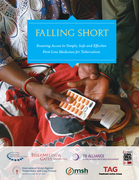
Ensuring Access to Simple, Safe and Effective First-Line Medicines for Tuberculosis.
Accessed in November 2017.

The Pharmacovigilance team in WHO aims to assure the safety of medicines and vaccines by ensuring reliable and timely exchange of information on safety issues, promoting pharmacovigilance activities throughout the Organization and encouraging partic
...

Global UNIDO Project: Strengthening the local production of essential medicines in least developed and developing countries
Pharmaceutical regulators are at the forefront of ensuring that only safe and effective medicines are authorized and available in the market. This document builds on the recommendations in the above publication and has been prepared to specifically
...
This interagency report provides recommendations for assuring quality of medicines during key activities of country-level procurement agencies, namely prequalification of pharmaceutical products and manufacturers; purchase of pharmaceutical products
...
Antibiotics 2022, 11(3), 329; https://doi.org/10.3390/antibiotics11030329.
The authors found that the most-represented antibiotics on the Rwandan market were amoxicillin, co-trimoxazole and cloxacillin. No counterfeit antibiotics were found in this study. However,
...
