
Filter
1293
Text search:
global
health
ethics
Featured
123
300
Language
Document type
580
331
194
97
42
24
15
5
2
2
Countries
61
48
39
39
33
26
24
21
20
20
20
20
20
18
18
18
18
16
14
14
13
13
12
10
10
9
9
8
8
8
7
7
7
7
7
7
7
6
6
6
6
5
5
5
5
4
4
4
4
3
3
3
3
3
3
3
2
2
2
2
2
2
2
2
2
2
2
2
2
2
2
2
2
2
2
2
2
1
1
1
1
1
1
1
1
1
1
1
1
1
1
1
1
1
1
1
1
1
1
Authors & Publishers
Publication Years
Category
478
106
82
72
66
21
12
2
Toolboxes
124
119
82
61
61
46
44
38
37
36
32
29
27
26
26
21
20
16
10
10
8
6
5
4
3
GMS Journalfor MedicalEducation2018, Vol. 35(3),ISSN 2366-5017

The standards define 10 key competencies for health and care workers to support self-care in their clinical practice as well as the specific, measurable behaviours that demonstrate those competencies, focusing on people-centredness; decision-making;
...
The WHO/UNICEF JMP report, WASH in Health Care Facilities, is the first comprehensive global assessment of water, sanitation and hygiene (WASH) in health
...
Annals of Global Health,Vol.81,No.2, 239-247
At the 2008 inaugural meeting of the Consortium of Universities for Global
...
Science of The Total Environment Volume 764, 10 April 2021, 142919



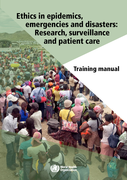
Responses to epidemics, emergencies and disasters raise many ethical issues for the people involved, including public health specialists and policy makers. This training manual provides material on ethical issues in research, surveillance and patie
...

This course consists of a series of ten cases to introduce trainees and others involved in global health research and service to ethical issues that may arise during short-term training experiences
...

The primary audience for this guidance is persons
working directly in vector-borne disease prevention
and control, including programme managers,
researchers and field workers. A brief technical
background is provided for the benefit of persons
without expertise in vector-borne diseases; readers
...

Our e-learning courses are designed to cover every step, process, and issue that needs to be understood in order to conduct high quality research. Every course is written to be globally applicable, so for all diseases and all regions. They are also highly pragmatic and adaptable. Each course is car
...
The Global vector control response 2017–2030 (GVCR) provides a new strategy to strengthen vector control worldwide through increased capacity, improved surveillance, better coordination and integrated action across sectors and diseases.
In Ma ...
In Ma ...

The goal of the strategy is to prevent seasonal influenza, control the spread of influenza from animals to humans, and prepare for the next influenza pandemic.
The new strategy is the most comprehensive and far-reaching that WHO has ever developed for influenza. It outlines a path to protect popul
...
The EYE strategy is a comprehensive and long-term strategy built on lessons learned that aims at ending yellow fever epidemics by 2026, and consists of three strategic objectives:
protect at-risk populations;
prevent international spread; and
contain outbreaks rapidly.

The Global guidance framework for the responsible use of the life sciences: mitigating biorisks and governing dual-use research (the framework) aims to provide values and principles, tools and mechanisms to support Member States and key stakeholders
...

The WHO Global tuberculosis report 2024 provides a comprehensive and up-to-date assessment of the TB epidemic, and of progress in prevention, diagnosis and treatment of the disease, at global, regio
...

Global tuberculosis report 2025
recommended
The WHO Global tuberculosis report 2025 provides a comprehensive and up-to-date assessment of the TB epidemic and of progress in prevention, diagnosis and treatment of the disease, at global, region
...
