
Filter
1864
Text search:
occupational
risk
Featured
230
399
Language
Document type
903
362
281
148
69
39
32
9
6
5
5
4
Countries
100
80
71
55
54
39
38
32
29
28
24
24
23
22
20
20
19
19
19
18
16
16
15
14
14
14
14
13
13
12
11
10
10
10
10
10
10
9
8
8
7
7
7
6
6
6
5
5
5
4
4
4
4
4
4
3
3
3
3
3
3
2
2
2
2
2
2
2
2
2
2
2
2
2
2
1
1
1
1
1
1
1
1
1
1
1
1
1
1
1
1
1
1
1
1
1
1
1
1
Authors & Publishers
Publication Years
Category
644
150
122
113
39
22
19
Toolboxes
243
228
105
100
93
90
66
58
52
46
42
40
40
30
29
28
28
28
11
9
9
4
3
2
1
In response to the COVID-19 outbreak, this guidance provides information on infection and prevention control (IPC) for older people, their friends and families, carers, and healthcare providers. Anyone who manages, works, volunteers or provides care at any type of facilities where older people recei
...
Objective of this document: Present a summary of the administrative measures that serve as the basis for implementation of infection prevention and control (IPC)measures in the context of COVID-19

This document aims to provide guidance to healthcare facilities and healthcare providers in the European Union/European Economic Area (EU/EEA) and the United Kingdom (UK) on preparedness and infection prevention and control (IPC) measures for the management of possible and confirmed cases of COVID-1
...

This guide is available in English, French, Spanish, Russian, Arabic and Chinese
This guide consolidates COVID-19 guidance for human resources for health managers and policy-makers at national, subnational and facility levels to design, manage and preserve the workforce necessary to manage the COVI
...
Archives of Disease in Childhood 2021;106:238-240.

The COVID-19 Vaccine (Whole Virion Inactivated) BBV152, COVAXIN® vaccine explainer includes key information on the vaccine specific requirements.

COVID-19 outbreak is associated with the generation of many types of infectious wastes, including infected masks, gloves and other protective equipment, together with a higher volume of general waste of the same nature.
A implementation Matrix approved by the Cabinet of the Government of South Africa

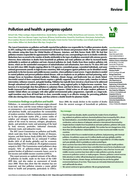
Pollution and health: a progress update
recommended
The Lancet Planetary Health Published:May 17, 2022DOI:https://doi.org/10.1016/S2542-5196(22)00090-0
Every year pollution causes 9 million deaths—1 in every 6 deaths worldwide, according to a Lancet Commission on pollution and health.
While the number of deaths caused by household air pollution a
...

Ethnic disparities in COVID-19 persist, with increased rates of infection, severe disease, and death among people from minority ethnic groups. COVID-19 vaccination rates also remain lowest in these communities compared with white people in the UK. Among people older than 18 years, the proportion who
...

Interim rapid response guidance, 10 June 2022.
It includes considerations for certain populations such as patients with mild disease with considerations for community care, patients with moderate to severe disease, sexually active persons, pregnant or breastfeeding women, children and young persons
...

The World Health Organization (WHO) recognizes the challenges countries face for maintaining their COVID-19 response while addressing competing public health challenges, conflicts, climate change and economic crises.
It remains critical for national programmes to continue to offer testing for COVI
...
At its 48th session of Codex Committee on Food Hygiene (CCFH), the Committee noted the importance of water quality and safety in food production and processing. CCFH requested the Food and Agriculture Organization of the United Nations
(FAO) and the World Health Organization (WHO) to provide guidan
...
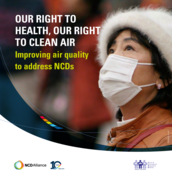
This policy brief explores the impact of air pollution on health and address the air quality issue in the response to noncommunicable diseases (NCDs). It also provides key actions that policy makers, NGOs and health professionals can take to ensure that every one can breathe clean air.
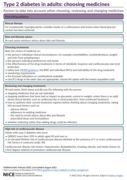
Factors to take into account when choosing, reviewing and changing medicines.
Rescue therapy:
For symptomatic hyperglycaemia, consider insulin or a sulfonylurea and review when blood glucose control has been achieved.
Diet and lifestyle advice:
At each point reinforce advice about diet and life
...
