
Filter
1594
Text search:
Américas
Featured
173
324
Language
Document type
562
435
239
100
94
51
31
29
26
10
5
5
3
2
1
Countries
244
135
44
26
25
22
18
14
13
12
12
10
9
9
8
8
8
7
7
7
7
7
6
6
6
6
6
5
5
5
5
5
5
5
5
4
4
4
4
4
4
4
4
4
4
3
3
3
3
3
3
3
3
3
3
3
2
2
2
2
2
2
2
2
2
2
2
2
2
2
2
1
1
1
1
1
1
1
1
1
1
1
1
1
1
1
1
1
1
1
1
1
1
1
1
1
1
1
1
1
1
1
1
1
1
1
1
1
Authors & Publishers
Publication Years
Category
329
179
135
112
77
26
18
1
Toolboxes
186
178
147
116
81
80
63
47
43
43
41
39
38
36
33
27
25
22
18
17
17
14
14
7
4
1
Small island developing states (SIDS) are a set of islands and coastal states that share similar sustainable development challenges, as a result of their size, geography and vulnerability to climate change. Thirty-nine WHO member states in four regions – the African Region, the Region of the
...
Este informe presenta los resultados de la colaboración entre la Organización Panamericana de la Salud y sus Estados Miembros para analizar las barreras de acceso a la atención primaria de salud, así como para formular opciones de políticas encaminadas a reducirlas y eliminarlas de manera progr
...

The Resolution Population and Individual Approaches to the Prevention and Management of Diabetes and Obesity was approved by the 48th Directing Council of the Pan American Health Organization, September 29- October 3, 2008, in response to the epidemic of obesity and diabetes currently affecting the
...

Neonatal tetanus (NT), a severe newborn illness from the toxigenic strains of Clostridium tetani, persists in middle- and low-income countries due to non-sterile childbirth practices. Unlike smallpox and polio, tetanus cannot be eradicated: Clostridium tetani spores exist in the environment, and ani
...
The Pan American Health Organization (PAHO) provides comprehensive information on noncommunicable diseases (NCDs), including cardiovascular diseases, cancers, diabetes, and chronic respiratory diseases. The website emphasizes that NCDs are the leading cause of death and disability globally, accounti
...
The Pan American Health Organization (PAHO) provides comprehensive information on noncommunicable diseases (NCDs), including cardiovascular diseases, cancers, diabetes, and chronic respiratory diseases. The website emphasizes that NCDs are the leading cause of death and disability globally, accounti
...
Given the circulation of the variant of clade I of mpox virus (MPXV) in the African Region, which is associated in the African Region with sustained transmission and the occurrence of cases in a wider range of age groups, including children, the Pan American Health Organization/World Health Organiza
...
Planning for public health emergencies should ensure that capabilities developed during previous emergencies are maintained, incorporated, and put into practice when a new event of public health concern arises. Investments in pandemic preparedness lead to more rapid detection and a stronger response
...
Chagas disease is a parasitic, systemic, and chronic disease caused by the protozoan Trypanosoma cruzi, with risk factors strongly link to low socioeconomic factors. Chagas disease is considered a neglected tropical disease. It is endemic in 21 countries in the
...
This case study in Chile focused on the following two strategic levers of the WHO/UNICEF PHC Operational Framework during the implementation period 2022–2023: “Political Commitment and Leadership” and “Governance and Policy Frameworks”. This included examining how support from the three le
...
Según la Organización Panamerticana de la Salud (OPS), las enfermedades no transmisibles (ENT): cardiopatías coronarias, accidentes cerebrovasculares, cáncer, diabetes y enfermedades pulmonares crónicas, son responsables del 81% de todas las muertes en la Región de las
...

This plan, approved by the Organization’s 62nd Directing Council, was shaped by extensive consultations with countries and stakeholders, and commits to transformative health outcomes over the next six years, tackling noncommunicable diseases (NCDs), mental health, health security, fragmented healt
...
Trop. Med. Infect. Dis. 2019, 4, 40; Schistosomiasis is an infectious disease caused by helminth parasites of the genus Schistosoma. Worldwide, an estimated 250 million people are infected with these parasites with the majority of cases occurring in sub-Saharan Africa. Within Asia, three species of
...

A erradicação da varíola humana (mpox em inglês) foi certificada em 1980. A varíola símia (mpox em inglês) é endêmica nos países da África Central e Ocidental desde a sua primeira detecção, em 1958. Trata-se de uma zoonose cujos casos geralmente ocorrem perto de florestas tropicais, ond
...
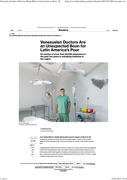
Over 22,000 medical professionals fled Venezuela from 2012-2017 and sought jobs in other Latin American countries.
The influx of specialists in places like Chile, Argentina, Colombia, and Peru has helped address critical gaps in care—patients in poorer or rural communities wait months for special
...
last updated 29 March 2016

Interim Guidance
