
Filter
871
Text search:
World
Health
Organization,
Western
Pacific
Region
Featured
105
203
Language
Document type
332
251
138
57
42
15
12
11
7
3
1
1
Countries
80
33
30
23
17
16
16
14
13
11
10
10
9
7
7
7
6
6
6
5
5
5
5
4
4
4
4
4
3
3
3
3
3
3
3
3
3
3
3
3
2
2
2
2
2
2
2
2
2
2
2
1
1
1
1
1
1
1
1
1
1
1
1
1
1
1
1
1
1
1
1
1
1
1
Authors & Publishers
Publication Years
Category
171
105
75
60
52
18
12
Toolboxes
83
60
60
51
42
41
40
35
34
32
28
23
23
22
22
18
16
14
13
10
8
6
4
2
2
1
Health care-associated infections (HAIs) affect patients and health systems every day, causing immense suffering, driving higher health-care costs
...

An overview of validation structures and responsibilities at national, regional and global levels.
This governance document supplements the global guidance document. Validation of elimination requires rigorous assessment at the national, regional and global levels of the impact and process indicato
...

English and French.
WEEKLY EPIDEMIOLOGICAL RECORD, NO 37, 13 SEPTEMBER 2024, 505-524
This report on global leishmaniasis surveillance follows those published in 2016–2023.2–6 Six indicators of leishmaniasis are publicly available from the Global Health Observatory (GHO).7 In addition to the GHO, country profiles with up to 30 in
...

The World Health Organization provides regional and national strategies and operational plans that aim to support countries in work to achieve meas
...
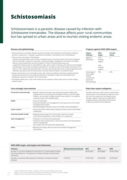
Schistosomiasis is a parasitic disease caused by infection with
Schistosoma trematodes. The disease affects poor rural communities
but has spread to urban areas and to tourists visiting endemic areas
Bulletin of the World Health Organization 2016. doi: http://dx.doi.org/10.2471/BLT.16.171082
Objective: To describe the temporal and geographical
...
A tool for measuring alcohol policy implementation
Antimalarial drug resistance has emerged as a threat to global malaria control efforts, particularly in the Greater Mekong subregion. Drawing on data collected through more than 1000 therapeutic efficacy studies as well as molecular marker studies of Plasmodium falciparum drug resistance, the Report
...

Practical actions in cities to strengthen preparedness for the COVID-19 pandemic and beyond
recommended
This document accompanies the interim guidance on “Strengthening Preparedness for COVID-19 in cities and urban settings”. It provides local authorities, leaders and policy-makers in cities with a checklist tool to ensure that key areas have been covered. An excel version that local authorities m
...

Weekly epidemiological update on COVID-19, 28 September 2022
Interim rapid response guidance, 10 June 2022.
It includes considerations for certain populations such as patients with mild disease with considerations for community care, patients with moderate to severe disease, sexually active persons, pregnant or breastfeeding women, children and young persons
...

Report of a global meeting on yaws eradication surveillance, monitoring and evaluation: Geneva, 29–30 January 2018. World Health Organization.
Всемирная организация здравоохранения (2018). Практическое руководство по разработке и проведению имитационных учений в целях проверки и подтверждения планов обесÐ
...

This report reviews the current situation in relation to national capacity to address NCDs and the progress made at country level over the past decade. It highlights that, while progress is being made, there is still much work to be done to create the infrastructure, policies, surveillance and
...
As of October 2017, the global database comprised almost 30 000 records, including results from bioassays to measure phenotypic resistance, and biochemical and molecular tests for resistance mechanisms. The current report presents an overview of data on malaria vector resistance for 2010 to 2016. It
...
