
Filter
2330
Text search:
health
threats
Featured
222
575
Language
2267
80
53
48
39
22
17
16
7
4
3
3
3
3
3
3
3
3
2
2
2
2
2
2
2
2
2
2
2
1
1
1
1
1
1
1
1
1
1
1
1
1
1
1
1
1
1
1
1
1
1
Document type
951
602
301
156
150
47
44
27
25
7
7
6
3
2
1
Countries
192
59
54
52
52
51
49
44
44
42
36
29
29
27
26
25
23
23
21
20
20
20
20
19
19
18
17
17
17
14
12
12
12
12
12
11
11
11
10
10
10
9
9
9
8
8
8
8
8
8
7
7
6
6
6
6
5
5
5
5
5
5
5
4
4
4
4
4
3
3
3
3
3
3
3
3
3
3
3
3
2
2
2
2
2
2
2
2
2
2
2
2
2
1
1
1
1
1
1
1
1
1
1
1
1
1
1
1
1
1
1
1
1
1
1
1
1
1
1
1
1
1
1
1
1
Authors & Publishers
335
72
66
66
63
31
27
26
25
23
20
17
16
16
15
14
14
13
13
13
13
12
12
12
12
12
12
11
11
11
10
9
9
8
8
8
8
7
7
7
7
7
7
7
7
7
6
6
6
6
6
6
6
6
6
6
6
6
6
5
5
5
5
5
5
5
5
5
5
5
5
5
5
4
4
4
4
4
4
4
4
4
4
4
4
4
4
4
4
4
4
4
4
4
4
4
4
3
3
3
3
3
3
3
3
3
3
3
3
3
3
3
3
3
3
3
3
3
3
3
3
3
3
3
3
3
3
3
3
3
3
3
3
3
3
3
3
3
3
3
3
3
3
3
3
3
3
3
3
3
3
2
2
2
2
2
2
2
2
2
2
2
2
2
2
2
2
2
2
2
2
2
2
2
2
2
2
2
2
2
2
2
2
2
2
2
2
2
2
2
2
2
2
2
2
2
2
2
2
2
2
2
2
2
2
2
2
2
2
2
2
2
2
2
2
2
2
2
2
2
2
2
2
2
2
2
2
2
2
2
2
2
2
2
2
2
2
2
2
2
2
2
2
2
2
2
2
2
2
2
2
2
2
2
2
2
2
2
2
2
2
2
2
2
2
2
2
2
2
2
2
2
2
2
2
2
2
2
2
2
2
2
2
2
2
2
2
2
2
2
2
2
2
2
2
2
2
2
2
1
1
1
1
1
1
1
1
1
1
1
1
1
1
1
1
1
1
1
1
1
1
1
1
1
1
1
1
1
1
1
1
1
1
1
1
1
1
1
1
1
1
1
1
1
1
1
1
1
1
1
1
1
1
1
1
1
1
1
1
1
1
1
1
1
1
1
1
1
1
1
1
1
1
1
1
1
1
1
1
1
1
1
1
1
1
1
1
1
1
1
1
1
1
1
1
1
1
1
1
1
1
1
1
1
1
1
1
1
1
1
1
1
1
1
1
1
1
1
1
1
1
1
1
1
1
1
1
1
1
1
1
1
1
1
1
1
1
1
1
1
1
1
1
1
1
1
1
1
1
1
1
1
1
1
1
1
1
1
1
1
1
1
1
1
1
1
1
1
1
1
1
1
1
1
1
1
1
1
1
1
1
1
1
1
1
1
1
1
1
1
1
1
1
1
1
1
1
1
1
1
1
1
1
1
1
1
1
1
1
1
1
1
1
1
1
1
1
1
1
1
1
1
1
1
1
1
1
1
1
1
1
1
1
1
1
1
1
1
1
1
1
1
1
1
1
1
1
1
1
1
1
1
1
1
1
1
1
1
1
1
1
1
1
1
1
1
1
1
1
1
1
1
1
1
1
1
1
1
1
1
1
1
1
1
1
1
1
1
1
1
1
1
1
1
1
1
1
1
1
1
1
1
1
1
1
1
1
1
1
1
1
1
1
1
1
1
1
1
1
1
1
1
1
1
1
1
1
1
1
1
1
1
1
1
1
1
1
1
1
1
1
1
1
1
1
1
1
1
1
1
1
1
1
1
1
1
1
1
1
1
1
1
1
1
1
1
1
1
1
1
1
1
1
1
1
1
1
1
1
1
1
1
1
1
1
1
1
1
1
1
1
1
1
1
1
1
1
1
1
1
1
1
1
1
1
1
1
1
1
1
1
1
1
1
1
1
1
1
1
1
1
1
1
1
1
1
1
1
1
1
1
1
1
1
1
1
1
1
1
1
1
1
1
1
1
1
1
1
1
1
1
1
1
1
1
1
1
1
1
1
1
1
1
1
1
1
1
1
1
1
1
1
1
1
1
1
1
1
1
1
1
1
1
1
1
1
1
1
1
1
1
1
1
1
1
1
1
1
1
1
1
1
1
1
1
1
1
1
1
1
1
1
1
1
1
1
1
1
1
1
1
1
1
1
1
1
1
1
1
1
1
1
1
1
1
1
1
1
1
1
1
1
1
1
1
1
1
1
1
1
1
1
1
1
1
1
1
1
1
1
1
1
1
1
1
1
1
1
1
1
1
1
1
1
1
1
1
1
1
1
1
1
1
1
1
1
1
1
1
1
1
1
1
1
1
1
1
1
1
1
1
1
1
1
1
1
1
1
1
1
1
1
1
1
1
1
1
1
1
1
1
1
1
1
1
1
1
1
1
1
1
1
1
1
1
1
1
1
1
1
1
1
1
1
1
1
1
1
1
1
1
1
1
1
1
1
1
1
1
1
1
1
1
1
1
1
1
1
1
1
1
1
1
1
1
1
1
1
1
1
1
1
1
1
1
1
1
1
1
1
1
1
1
1
1
1
1
1
1
1
1
1
1
1
1
1
1
1
1
1
1
1
1
1
1
1
1
1
1
1
1
1
1
1
1
1
1
1
1
1
1
1
1
1
1
1
1
1
1
1
1
1
1
1
1
1
1
1
1
1
1
1
1
1
1
1
1
1
1
1
1
1
1
1
1
1
1
1
1
1
1
1
1
1
1
1
1
1
1
1
1
1
1
1
1
1
1
1
1
1
1
1
1
1
1
1
1
1
1
1
1
1
1
1
1
1
1
1
1
1
1
1
1
1
1
1
1
1
1
1
1
1
1
1
1
1
1
1
1
1
1
1
1
1
1
1
1
1
1
1
1
1
1
1
1
1
1
1
1
1
1
1
1
1
1
1
1
1
1
1
1
1
1
1
1
1
1
1
1
1
1
1
1
1
1
1
1
1
1
1
1
1
1
1
1
1
1
1
1
1
1
1
1
1
1
1
1
1
1
1
1
1
1
1
1
1
1
1
1
1
1
1
1
1
1
1
1
1
1
1
1
1
1
1
1
1
1
1
1
1
1
1
1
1
1
1
1
1
1
1
1
1
1
1
1
1
1
1
1
1
1
1
1
1
1
1
1
1
1
1
1
1
1
1
1
1
1
1
1
1
1
1
1
1
1
1
1
1
1
1
1
1
1
1
1
1
1
1
1
1
1
1
1
1
1
1
1
1
1
1
1
1
1
1
1
1
1
1
1
1
1
1
1
1
1
1
1
1
1
1
1
1
1
1
1
1
1
1
1
1
1
1
1
1
1
1
1
1
1
1
1
1
1
1
1
1
1
1
1
1
1
1
1
1
1
1
1
1
1
1
1
1
1
1
1
1
1
1
1
1
1
1
1
1
1
1
1
1
1
1
1
1
1
1
1
1
1
1
1
1
1
1
1
1
1
1
1
1
1
1
1
1
1
1
1
1
1
1
1
1
1
1
1
1
1
1
1
1
1
1
1
1
1
1
1
1
1
1
1
1
1
1
1
1
1
1
1
1
1
1
1
1
1
1
1
1
1
1
1
1
1
1
1
1
1
1
1
1
1
1
1
1
1
1
1
1
1
1
1
1
1
1
1
1
1
1
1
1
1
1
1
1
1
1
1
1
1
1
1
1
1
1
1
1
1
1
1
1
1
1
1
1
1
1
1
1
1
1
1
1
1
1
1
1
1
1
1
1
1
1
1
1
1
1
1
1
1
1
1
1
1
1
1
1
1
1
1
1
1
1
1
1
1
1
1
1
1
1
1
1
1
1
1
1
1
1
1
1
1
1
1
1
1
1
1
1
1
1
1
1
1
1
1
1
1
1
1
1
1
1
1
1
1
1
1
1
1
1
1
1
1
1
1
1
1
1
1
1
1
1
1
1
1
1
1
1
1
1
1
1
1
1
1
1
1
1
1
1
1
1
1
1
1
1
1
1
1
1
1
1
1
1
1
1
1
1
1
1
1
1
1
1
1
1
1
1
1
1
1
1
1
1
1
1
1
1
1
1
1
1
1
1
1
1
1
1
1
1
1
1
1
1
1
1
1
1
1
1
1
1
1
1
1
1
1
1
1
1
1
1
1
1
1
1
1
1
1
1
1
1
1
1
1
1
1
1
1
1
1
1
1
1
1
1
1
1
1
1
1
1
1
1
1
1
1
1
1
1
1
1
1
1
1
1
1
1
1
1
1
1
1
1
1
1
1
1
1
1
1
1
1
1
1
1
1
1
1
1
1
1
1
1
1
1
1
1
1
1
1
1
1
1
1
1
1
1
1
1
1
1
1
1
1
1
1
1
1
1
1
1
1
1
1
1
1
1
1
1
1
1
1
1
1
1
1
1
1
1
1
1
1
1
1
1
1
1
1
1
1
1
1
1
1
1
1
1
1
1
1
Publication Years
1
964
1203
158
4
Category
706
263
127
105
69
51
13
Toolboxes
226
205
167
147
128
111
81
77
75
64
55
54
52
49
41
40
36
35
33
28
19
14
11
9
7
2
1
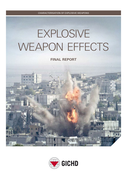
States, the United Nations and civil society organisations continue to raise concerns about the humanitarian impact caused by the use of explosive weapons in populated areas (EWIPA). This issue is currently being examined from political, legal, socio-economic and humanitarian perspectives. The GICHD
...
has undertaken research to provide a technical perspective on the destructive effects of selected explosive weapons to inform the international debate.
The research project attempts to reduce an observed knowledge gap regarding EWIPA. It seeks to provide clarity concerning the immediate physical effects and terminology used when discussing explosive weapons. The project is guided by a group of experts dealing with weapons-related research and practitioners who address the implications of explosive weapons in humanitarian, policy, advocacy and legal fields.
more
The document is a practical guide on how to prepare for and respond to emergencies and disasters. It explains that disasters such as floods, fires, severe weather, or power outages can happen at any time and that individuals should be prepared in advance. The guide provides advice on personal prepar
...
edness, including storing food and water, maintaining hygiene, preparing a medicine kit, and keeping important documents ready. It also describes how to act during specific emergency situations, such as fires, floods, or hazardous material incidents, and emphasizes the importance of first aid, emergency communication, and following official warnings. Overall, the text aims to help people become more self-reliant and capable of protecting themselves and others in crisis situations.
more
UNICEF Strategic Plan 2018-2021. Draft Theory of Change Paper


This case study examines the humanitarian response to the conflict-related crisis in the North-East of Nigeria, focusing primarily on the period from 2015 to the end of 2016. The aim is test the central hypotheses of the Emergency Gap project: that the current structure, conceptual underpinning and
...
prevalent mindset of the international humanitarian system limits its capacity to be effective in response to conflict-related emergencies.
As with many conflict-related crises, the emergency in north-east Nigeria has deep and complex roots in the history of the region. The conflict began in 2009 and quickly developed beyond the control of the authorities. It unfolded in the midst of pre-existing political, social and economic tensions, making an effective humanitarian response exceedingly difficult. Despite this complexity, what is clear is that the crisis has resulted in a sprawling humanitarian disaster that has killed over 25,000 people as a direct result of the violence, and continues to devastate many more lives through hunger, psychological trauma and lack of access to healthcare. more
As with many conflict-related crises, the emergency in north-east Nigeria has deep and complex roots in the history of the region. The conflict began in 2009 and quickly developed beyond the control of the authorities. It unfolded in the midst of pre-existing political, social and economic tensions, making an effective humanitarian response exceedingly difficult. Despite this complexity, what is clear is that the crisis has resulted in a sprawling humanitarian disaster that has killed over 25,000 people as a direct result of the violence, and continues to devastate many more lives through hunger, psychological trauma and lack of access to healthcare. more

This working paper is a case study on South Sudan as an important refugee country of origin. The case study looks at issues of forced displacement in South Sudan and underscores the linkages between internally displaced persons and South Sudanese refugees. The case study highlights the importance of
...
understanding local contexts and root drivers of conflict and displacement. It reviews evaluations of programmes in South Sudan, including past efforts at state building and refugee resettlement to look at learning within the international community. The study was undertaken as part of a wider research project on learning from evaluations to improve responses to situations of forced displacement .
more
Safety and security for national humanitarian workers
Stoddard, Abby ; Harmer, Adele ; Haver, Katherine
Office for the Coordination of Humanitarian Affairs (OCHA)
(2011)
C1
Annex I to: To stay and deliver, good practice for humanitarians in complex security environments
The principal findings of the report include that despite overall improvements in aid agencies’ security risk management, national aid workers perceive continued inequities in security suppor ... t compared with their international counterparts. National aid workers, while less subject to major attacks per capita than international aid workers, nevertheless form the majority of victims, and their specific security needs require more attention. more
The principal findings of the report include that despite overall improvements in aid agencies’ security risk management, national aid workers perceive continued inequities in security suppor ... t compared with their international counterparts. National aid workers, while less subject to major attacks per capita than international aid workers, nevertheless form the majority of victims, and their specific security needs require more attention. more

Nationally, Senegal met the MDG target for water supply access. It did this by engaging the public and private sectors to effectively invest and report on investments. It focused on larger population centers, less on remote regions of the country. Its achievements set the stage for more equitable an
...
d widespread service provision as the country now works to achieve the SDGs, requiring sustainable management of universal access. This case study documents the progression of the sector between 1990 and 2015, and analyzes the impact of local systems created in Senegal to respond to the water and sanitation challenge.
more
Democratic dispensation in 1994 created a political and social platform that reshaped life in South Africa. There was a surge in common belief that the inequity and wrong of Apartheid should and could be rectified. Equity of access to water and sanitation were obvious targets for improvement. In 199
...
4, an estimated 14–15 million South Africans were without access to an improved water supply, while close to 21 million - more than half of the population at that time - did not have access to improved sanitation facilities. These problems were most severe in poorer rural areas. The water and sanitation sector became unified by the vision of universal access for all South Africans. This case study documents the progression of the sector between 1994 and 2016, and analyzes the impact of local systems created in South Africa to respond to the water and sanitation challenge.
more
A comprehensive compilation is provided of the medicinal plants of the Southeast Asian country of Myanmar (formerly Burma). This contribution, containing 123 families, 367 genera, and 472 species, was compiled from earlier treatments, monographs, books, and pamphlets, with some medicinal uses and pr
...
eparations translated from Burmese to English. The entry for each species includes the Latin binomial, author(s), common Myanmar and English names, range, medicinal uses and preparations, and additional notes. Of the 472 species, 63 or 13% of them have been assessed for conservation status and are listed in the IUCN Red List of Threatened Species (IUCN 2017). Two species are listed as Extinct in the Wild, four as Threatened (two Endangered, two Vulnerable), two as Near Threatened, 48 Least Concerned, and seven Data Deficient. Botanic gardens worldwide hold 444 species (94%) within their living collections, while 28 species (6%) are not found any botanic garden. Preserving the traditional knowledge of Myanmar healers contributes to Target 13 of the Global Strategy for Plant Conservation
more

An action research conducted in Bang Shau village Northern Shan State, Myanmar

This Technical Brief focuses on appraising and prioritising options for climate resilience with a view to informing water, sanitation and hygiene (WASH) programme and project design.
This Technical Brief:
- provides a simple scorecard/checklist approach to use as a starting point for appr ... aising and prioritising options, and as an awareness-raising activity - covers all aspects of WASH
- has a predominantly rural focus, to align with the rest of the Strategic Framework and Technical Briefs
- focuses on current and near future options over the next 15–20 years, which fits in with WASH programming timescales and development
- includes WASH examples to show how the approach can be applied. more
This Technical Brief:
- provides a simple scorecard/checklist approach to use as a starting point for appr ... aising and prioritising options, and as an awareness-raising activity - covers all aspects of WASH
- has a predominantly rural focus, to align with the rest of the Strategic Framework and Technical Briefs
- focuses on current and near future options over the next 15–20 years, which fits in with WASH programming timescales and development
- includes WASH examples to show how the approach can be applied. more


This baseline survey and report examine the Durable Peace Programme (DPP) in Myanmar, which delivers a broad range of activities. The report provides an insight into the current situation facing both internally displaced persons (IDPs) and conflict-affected non-IDP communities in Kachin state, Myanm
...
ar. It is based on a comprehensive and systematic research process involving just over 2,200 interviews conducted in 12 townships across Kachin. The research provides data and analysis on the socioeconomic situation, attitudes towards peace and conflict, gender dynamics, return and resettlement, among others. The Durable Peace Programme Consortium has decided to share the results of this baseline, as it provides insights into the Kachin context for interested stakeholders, and also to encourage cooperation and information sharing. The report adopts a highly visual approach to communicate the large amount of data collected.
more

Planning and Implementation Training. Myanmar
This training module on resilient development planning in Myanmar consists of a 2.5 hours session, at the end of which, the participants will:
a) Have a common understanding on development and disaster linkages.
b) Be able to identify the ... various factors which contribute towards disaster risk including climate change in Myanmar.
c) Be able to identify measures for risk resilient development process in Myanmar.
The three main learning units include:
1. Disaster and development linkages.
2. Components and drivers of disaster risk including climate change.
3. Mainstreaming disaster and climate risk reduction into development. more
This training module on resilient development planning in Myanmar consists of a 2.5 hours session, at the end of which, the participants will:
a) Have a common understanding on development and disaster linkages.
b) Be able to identify the ... various factors which contribute towards disaster risk including climate change in Myanmar.
c) Be able to identify measures for risk resilient development process in Myanmar.
The three main learning units include:
1. Disaster and development linkages.
2. Components and drivers of disaster risk including climate change.
3. Mainstreaming disaster and climate risk reduction into development. more

This resource aims to provide relevant and practical guidance to DRR practitioners (policy and programme colleagues), on how to ensure inclusion - particularly of vulnerable groups - in Community-Based DRR (CBDRR) initiatives in Myanmar. It comprises an overall Framework for inclusive CBDRR and a nu
...
mber of tools/resources including: 1) a checklist for inclusion in the 7 steps of the CBDRR process, 2) a guideline for documenting inclusion, 3) a template for assessing inclusion and 4) a compendium of tools and guidelines relevant to inclusive CBDRR.
The Inclusive Framework and Toolkit for Community-Based DRR in Myanmar is a resource produced by the Myanmar Consortium for Community Resilience (MCCR), a consortium led by ActionAid, with ACF, HelpAge, Oxfam, Plan and UN-Habitat. more
The Inclusive Framework and Toolkit for Community-Based DRR in Myanmar is a resource produced by the Myanmar Consortium for Community Resilience (MCCR), a consortium led by ActionAid, with ACF, HelpAge, Oxfam, Plan and UN-Habitat. more
