
Filter
2347
Text search:
Epidemiological
Surveillance
Featured
263
590
Language
Document type
1024
453
432
165
144
56
31
29
7
2
2
1
Countries
128
97
73
69
60
56
51
49
38
38
37
37
31
30
29
28
25
24
23
22
21
21
20
19
18
17
17
17
17
16
15
14
14
14
13
13
13
12
12
12
10
10
10
9
9
9
9
9
8
8
8
8
7
7
7
7
6
6
6
6
6
5
5
5
5
4
4
4
4
4
4
4
4
4
4
4
4
4
3
3
3
3
3
3
3
3
3
3
3
3
2
2
2
2
2
2
2
2
2
2
2
2
2
2
1
1
1
1
1
1
1
1
1
1
1
1
1
1
1
1
1
1
1
1
1
1
1
1
1
1
1
1
Authors & Publishers
Publication Years
Category
786
237
146
111
50
31
26
Toolboxes
301
199
193
130
105
92
86
85
76
66
58
53
53
43
38
30
27
23
23
19
18
18
11
7
2
2

31 Oct 2022 his plan outlines how the ACT-Accelerator will support countries as the world transitions to long-term COVID-19 control.
Recognizing the evolving nature of the COVID-19 virus and pandemic, the plan outlines changes to ACT-A’s set-up and ways of working, to ensure countries co
...

Addressing comorbidities and risk factors for TB is a crucial component of Pillar one of the End TB Strategy, which focuses on integrated patient-centred care and prevention, including action on TB and comorbidities. The Framework for collaborative action on TB and comorbidities aims to support coun
...

Three classess of tests are now recommended in the latest consolidated guideles on tests for tuberculosis infection. It includes for the first-time a new class of Mycobacterium tuberculosis antigen-based skin tests (TBSTs), and the two existing classes of tests: the tuberculin skin test (TST) and t
...

Buruli ulcer : management of Mycobacterium ulcerans disease : a manual for health care providers
recommended
This manual is addressed to health care providers dealing with Mycobacterium ulcerans disease (Buruli ulcer). The manual aims to achieve a better understanding of the disease, its clinical presentation and its surgical management. The manual is aimed particularly at district health care providers. A
...

The "Questions and Answers on Prevention and control of Alcohol related harm" has been developed by WHO country office in Viet Nam with technical contribution from national and international experts in the field. This publication provides scientific evidences on harms of alcohol use to the health of
...
The socioeconomic factors and public health inadequacies that facilitated the rapid spread of this infection continue to exist. As it is a new and emerging disease it has not received sufficient coverage yet in the medical curricula of Member States. Specific treatment is not available, and there is
...

In 1997, the Fiftieth World Health Assembly adopted resolution WHA50.29 on the elimination of
lymphatic filariasis as a public health problem. Preliminary guidance from WHO printed in 2011 referred to “verification” as the official process by which the achievements of the Global Programme to El
...

Parasites & Vectors volume 15, Article number: 389 (2022)
Dengue is one of the common arboviral infections and is a public health problem in South East Asia. The aim of this systematic review and meta-analysis was to evaluate the prevalence and distribution of dengue in SAARC (South Asian Associ
...
Lymphatic filariasis is a neglected tropical disease that can cause permanent disability through disruption of the lymphatic system. This disease is caused by parasitic filarial worms that are transmitted by mosquitos. Mass drug administration (MDA) of antihelmintics is recommended by WHO to elimina
...

The indicators and questions in this document are designed for use by national AIDS programmes and partners to assess the state of a country’s HIV and AIDS response, and to measure progress towards achieving national HIV targets. Countries are encouraged to integrate these indicators and questions
...
PLoS Neglected Tropical diseases August 16, 2021 https://doi.org/10.1371/journal.pntd.0009697
Chagas disease, also known as American trypanosomiasis, is a neglected tropical disease transmitted by triatomine insects, first identified in 1909. Chagas disease affects approximately 6–7 million peop
...

The sixteenth meeting of the Strategic and Technical Advisory Group for Neglected Tropical Diseases (STAG-NTD) was held as a hybrid meeting, 27–28 September 2022.
Dr Ren Minghui, Assistant Director-General, Universal Health Coverage/Communicable and Noncommunicable Diseases, welcomed participan
...

Over 6 million people worldwide are infected with Trypanosoma cruzi, the protozoan that causes Chagas disease
(CD). T. cruzi is transmitted by triatomine insects, congenitally, through uncontrolled blood donations and organ transplants,
and via consumption of food or drink contaminated by triatomi
...

Trachoma is an eye infection that for thousands of years caused many people to go blind across all continents. As the result of development and targeted interventions, trachoma is now limited to an estimated 57 countries, often affecting the poorest
populations of the world. Today, more than 2 mill
...

PLoS Negl Trop Dis 13(10): e0007694. In 2005, the World Health Organization (WHO) recognized Chagas disease (CD; Trypanosoma cruzi infection) as a neglected tropical disease (NTD) [1] and included it into the global plan to combat NTDs [2]. The Target 3.3 of the United Nations Sustainable Developmen
...
Mem Inst Oswaldo Cruz, Rio de Janeiro, Vol. 117: e200460, 2022
Integrating the multiple dimensions of the problem into a coherent approach adapted to field realities and needs represents an immense challenge, but the payoff is more effective and sustainable experiences, with higher social awareness
...
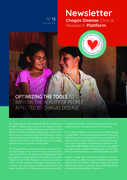
To support its R&D activities on Chagas disease, DNDi launched the Chagas Clinical Research Platform (CCRP). The platform brings together partners, experts, and stakeholders to provide support for evaluation and development of new treatments for Chagas disease. The patient-centred platform aims to f
...

Schistosomiasis is widely recognized as a disease that is socially determined. An understanding of the social and behavioural factors linked to disease transmission and control should play a vital role in designing policies and strategies for schistosomiasis prevention and control. To this must be a
...

Schistosoma haematobium is a parasitic digenetic trematode responsible for schistosomiasis (also known as bilharzia). The disease is caused by penetration of the skin by the parasite, spread by intermediate host molluscs in stagnant waters, and can be treated by administration of praziquantel. Schis
...

Schistosomiasis is a public health problem in tropical and subtropical regions of Africa, Asia, the Caribbean and South America. It is one of the neglected tropical diseases (NTDs) - a group of diseases and conditions that affect particularly low-income populations, worldwide.
Last year, WHO laun
...
