
Filter
791
Text search:
Ba,
M.
Featured
57
152
Language
Document type
344
209
116
34
30
23
20
5
4
3
1
Countries
37
30
26
20
19
19
19
15
13
12
10
10
9
9
8
7
7
7
6
6
6
6
6
6
6
6
5
5
5
5
5
4
4
4
4
4
4
4
4
4
3
3
3
3
3
3
3
3
3
2
2
2
2
2
2
2
2
2
2
2
2
2
2
1
1
1
1
1
1
1
1
1
1
1
1
1
1
1
1
Authors & Publishers
Publication Years
Category
265
63
46
39
23
15
10
Toolboxes
119
70
40
38
38
37
30
26
23
20
19
17
16
14
12
11
9
9
8
7
7
4
4
2
1
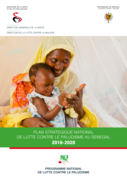
L’impact des interventions de lutte contre le paludisme, ces dernières années, a fortement modifié la répartition géographique du fardeau de la maladie. Cette nouvelle configuration impose une stratification plus opérationnelle permettant d’adapter les interventions aux caractéristiques Ã
...

La santé de la reproduction des adolescent(e)s reste encore une préoccupation de
santé publique. Le but de cet article est de partager l’expérience d’un projet visant
l’intégration des services de santé de la reproduction en milieu scolaire au Sénégal et
d’exposer les leçons
...
Ce guide qui s’adresse à tous les prestataires de soins impliqués dans la prise en charge des enfants, peut être utilisé aussi bien au niveau des structures sanitaires publiques que privées.
Son objectif général est d’améliorer la prise en charge de la tuberculose de l’enfant au Sé
...
Accessed on 31.01.2020
Suivant les recommandations de la Stratégie Stop TB le Sénégal s’inscrit dans une optique de renforcement de la prise en charge de la tuberculose dans ce groupe vulnérable. Pour ce faire, la mise en place de documents standardisés et consensuels de référence, adap
...
BMC Pregnancy Childbirth 20, 379 (2020). https://doi.org/10.1186/s12884-020-03064-x

Mental Health Policy and Service Guidance Package
Languages: Arabic, English, French, Chinese, Russian
Senegal has adopted the World Health Organization–Joint United Nations Programme on HIV/AIDS recommended 90-90-90 targets.5 The adoption of this strategy means that the country is expected, by 2020, to have 90% of its population living with HIV diagnosed, 90% of all those diagnosed receiving susta
...

Thirty-three years after its discovery, the Human Immunodeficiency Virus (HIV), responsible for the AIDS pandemic, remains a major public health problem despite advanced researches providing better diagnostic and therapeutic tools. The virus targets especially CD4+ T cells, leading to deficiency of
...
The systematic surveillance of antibiotic use and antibiotic re-sistance prevalence in humans and animals is imperative for managingbacterial infectious disease (JPIAMR, 2019;WHO, 2015). Many low-income countries currently face substantial challenges in building national surveillance systems due to
...
BMJ Global Health2020;5:e002014. doi:10.1136/bmjgh-2019-002014

Current and expected problems such as ageing, increased prevalence of chronic conditions and multi-morbidity, increased emphasison healthy lifestyle and prevention, and substitution for care from hospitals by care provided in the community encourage countries worldwide to develop new models of prima
...

Objectives: This paper reviews the mental health policies that have been implemented in Chile in response to the COVID-19 pandemic and the international context of countries' responses. Even before the start of the pandemic, there were significant barriers to access mental health services in Chile,
...

The document "Diabetes and Ramadan: Practical Guidelines 2021," published by Elsevier, provides updated guidance for managing diabetes during Ramadan fasting. Developed by the International Diabetes Federation (IDF) and the Diabetes and Ramadan (DAR) International Alliance, the guidelines address ke
...
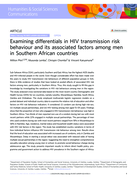
HUMANITIES AND SOCIAL SCIENCES COMMUNICATIONS | (2022)9:295 | https://doi.org/10.1057/s41599-022-01312-3 .
Sub-Saharan Africa (SSA), particularly Southern and East Africa, has the highest AIDS deaths
and HIV-infected people in the world. Even though considerable effort has been made over
the yea
...
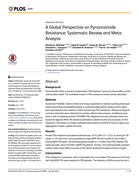
PLOS ONE | DOI:10.1371/journal.pone.0133869 July 28, 2015, p.1-16
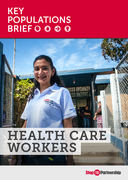
Key populations brief.
Normas y Guía técnica
Kenya has great potential for enhancing education for individuals with intellectual disabilities. The fact that it has recognized the need to care for learners with special needs is commendable. In comparison to many African countries, Kenya and Nigeria are ahead in developing programs for special e
...
Int J Health Geogr. 2002; 1: 5.
Published online 2002 Dec 20. doi: 10.1186/1476-072X-1-5
PMCID: PMC149400
PMID: 12537588
