
Filter
160
Featured
3
8
Language
Document type
46
44
16
12
12
7
6
5
4
3
2
1
1
1
Countries / Regions
65
14
7
5
4
4
4
4
4
3
3
3
3
2
2
2
2
2
2
2
1
1
1
1
1
1
1
1
1
1
1
1
1
1
1
1
1
Authors & Publishers
Publication Years
Category
30
9
7
6
6
5
5
3
3
2
2
2
2
1
1
1
1
1
1
1
1
1
1
1
1
1
1
1
1
1
1
Toolboxes
21
14
10
9
7
5
5
5
4
4
3
3
3
3
3
3
3
3
2
2
2
2
2
2
2
2
2
2
2
2
2
2
2
1
1
1
1
1
1
1
1
1
1
1
1
1
1
1
1
1
1
1
1
1
1
1
1
1
1
1
1
1
1
1
1
1
1
1
1
1
1
1
1
1
1
1
1
1
1
1
1
1
1
1
1
1
1

The health impacts of climate change are no longer a distant threat. They are being felt here and now and becoming more extreme.
To address these threats, the WHO Asia-Pacific Centre for Environment and Health in the Western Pacific Region (ACE) was established in 2019 through a partnership with
...

PHSM are vital in reducing the risk and scale of infectious disease transmission and lowering hospitalization and deaths. Examples include contact tracing, quarantine and isolation, mask use, ventilation, school or workplace measures, mobility restrictions and travel requirements.
While these mea
...

EWARS is a surveillance system developed by the World Health Organization to detect and respond quickly to disease outbreaks in emergency settings where normal health systems are disrupted. It allows health facilities to report priority diseases on a regular basis and generates alerts when unusual p
...

The Western Pacific Region, being the most diverse region in the World, is beset by unique public health challenges and is considered a hotspot for outbreaks and emerging and re-emerging infectious diseases, such as SARS, MERS, avian influenza, Zika and dengue. Currently there are 3 global emergenci
...

This document aims to provide public health authorities in European Union and European Economic Area (EU/EEA) countries with guidance for improved preparedness planning taking the lessons that have been identified through various activities in the context of recent public health crises (e.g. COVID-1
...
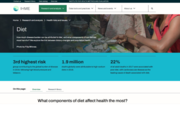
The webpage from the Institute for Health Metrics and Evaluation (IHME) discusses the global impact of diet on health, highlighting poor dietary habits as a major contributor to deaths worldwide, primarily through cardiovascular diseases. It emphasizes the health risks of high sodium intake and insu
...

The ERF provides WHO staff with essential guidance on how the Organization manages the assessment, grading and response to public health events and emergencies with health consequences, in support of Member States and affected communities. The ERF adopts an all-hazards approach and it is therefore a
...
Africa CDC Institute of Pathogen Genomics (IPG) was launched in November 2019 and operates under the Division of Laboratory Systems and Networks.
IPG coordinate the implementation of molecular diagnostics, pathogen genomics and bioinformatics in National Public Health Institutions (NPHIs) and/or Re
...
The website "Learning About Diabetes" provides easy-to-understand educational materials for people with diabetes and their families. It focuses on improving diabetes self-management through visually engaging resources, such as illustrated guides, videos, and tools. The content covers topics like blo
...
The website "Learning About Diabetes" provides easy-to-understand educational materials for people with diabetes and their families. It focuses on improving diabetes self-management through visually engaging resources, such as illustrated guides, videos, and tools. The content covers topics like blo
...
The website "Learning About Diabetes" provides easy-to-understand educational materials for people with diabetes and their families. It focuses on improving diabetes self-management through visually engaging resources, such as illustrated guides, videos, and tools. The content covers topics like blo
...

The South African Heart Association's webpage provides comprehensive information about rheumatic heart disease (RHD). It addresses the causes, symptoms, and diagnostic methods of this condition. Additionally, it outlines prevention strategies and treatment options to raise awareness about RHD and pr
...
The Federal Centre for Health Education (BZgA) emphasizes the critical role of drug prevention in enhancing public health in Germany. Annually, the country faces significant premature mortality due to substance use: at least 110,000 deaths from smoking, 40,000 from harmful alcohol consumption, and a
...

The far-reaching impacts of the COVID-19 pandemic underscore the critical need for evidence-informed, transparent and inclusive decision-making. Policy-makers have grappled with complex choices amidst uncertainty. They have constantly reassessed response measures while navigating their economic impl
...

Mpox continues to affect people around the world. A new framework released today by WHO will guide health authorities, communities and other stakeholders in preventing and controlling mpox outbreaks, eliminating human-to-human transmission of the disease, and reducing spillover of the virus from ani
...

Health system resilience is not an inevitable byproduct of any investment in health but must be intentionally programmed and developed with necessary input, investment and contextualization. This technical product aims to guide national, subnational, and global health actors to operationalize the co
...

Public health emergencies, including pandemics, highlight the need for health systems and services that are prepared, resilient and ready to respond to health security threats. Endorsed by Member States in 2023, the Asia Pacific Health Security Action Framework (APHSAF) is designed to engage m
...
The Defeat-NCD Partnership prioritises poorer countries because they bear the brunt of the enormous impact of NCDs with some 48% of premature deaths occurring in low and lower-middle income countries. The resident of a low-income country faces a lifetime chance of 20-30% of dying from an NCD under t
...
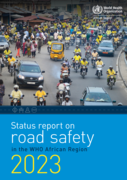
This report highlights the increasing public health
burden of road traffic injuries and fatalities in
the Region. Road traffic deaths are becoming a
significant problem in Africa, rising at a faster rate
than in any other region. Fatalities increased by
nearly one fifth in the decade from 2010
...
Como disciplina, la salud pública comenzó en las ciudades. Sin embargo, debido al rápido aumento
de las tasas de urbanización en todo el mundo, muchas ciudades también están exponiendo
involuntariamente a sus ciudadanos a factores de riesgo de dos amenazas para la salud que se
cobran millon
...
