
Filter
70
Breadcrumb:
Disaster Response
Featured
16
4
Language
Document type
16
15
12
10
9
4
2
2
Countries
6
2
2
2
2
1
1
1
1
1
1
1
1
Authors & Publishers
Publication Years
Category
10
9
4
3
3
2
2
2
2
2
1
1
1
1
1
1
1
1
1
1
Toolboxes
15
11
7
6
5
5
5
4
3
3
3
3
2
2
2
2
2
2
2
2
2
2
2
2
2
2
2
2
2
1
1
1
1
1
1
1
1
1
1
1
1
1
1
1
1
1
1
1
1
1
1
1
1
1
1
1
1
1
1
1
1
1
1
1
1
1
1
1
1

The webpage “Health emergency readiness for response operations” on the OpenWHO platform presents an online learning course developed by the World Health Organization (WHO) to introduce the concept of operational readiness for health emergency response. The training explains how governments, hea
...
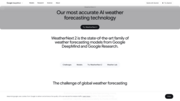
The webpage presents WeatherNext 2, an advanced AI-based weather forecasting model developed by Google DeepMind. It explains how the system uses machine learning to analyze large amounts of atmospheric data and produce fast and accurate weather predictions. The model is designed to improve forecasti
...

The 2026 appeal seeks nearly US$ 1 billion to respond to 36 emergencies worldwide, including 14 Grade 3 emergencies requiring the highest level of organizational response. These emergencies span sudden-onset and protracted humanitarian crises where health needs are critical.
Here you can download the report in English, French, Spanish and Arabic.
The World Disasters Report 2026 warns that harmful information and dehumanising narratives are increasingly undermining trust, putting the lives of humanitarian workers and communities at risk. In polarized and politically cha
...
The latest disease outbreaks around the world notified to the World Health Organization.
AI for Good. Space-based information for Disaster Management and Emergency Response
Open WHO Channels
recommended
Search for relevant channels for outbreak management, pandemic prevention, infectious diseases managment
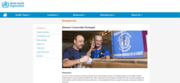
Disease Commodity Packages
recommended
The DCPs are a series of disease specific datasheets that list the critical commodities and the technical specifications for each commodity per disease. The DCPs inform Member States and operational partners of commodity requirements and potential gaps in the health emergency supply chain. From an o
...
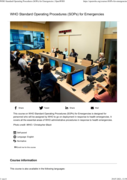
The objective of this course is to provide high-level information and contextual understanding of WHO Standard Operating Procedures (SOPs) for Emergencies.
We will explore a range of topics, ranging from the Emergency Response Framework (ERF), to planning, grants and finance, procurement, risk mana
...

Ready4Response is a multi-tiered core curriculum that aims to develop consistent learning standards across the emergency response workforces at national level. It equips participants with essential competencies needed to work within public health emergency response.

Lessons learned from recent public health events such as the COVID-19 pandemic, Ebola virus disease, Zika virus disease outbreaks, and other public health threats, including earthquakes and floods, have highlighted the need for countries to continuously develop, strengthen, and maintain capacities r
...

Integrated Outbreak Analytics (IOA) applies a multidisciplinary approach to understanding outbreak dynamics and to inform outbreak response. It aims to drive comprehensive, accountable, and effective public health and clinical strategies by enabling communities, and national and subnational health a
...
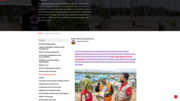
Early warning systems are an essential tool for risk management and disaster preparedness that help save lives and minimize the potential impact of disasters. To be effective, early warning systems need to rely on the direct participation of at-risk communities, facilitate public education and aware
...


The ADPC Digital Library is a comprehensive hub for all the resources, publications, and knowledge products developed by ADPC. It provides easy access to a wide range of materials, including research reports, policy briefs, training manuals, case studies, and technical guidelines on disaster risk re
...

An After Action Review (AAR) is a qualitative review of actions taken in response to an event of public health concern. It is a means of identifying and documenting best practices and challenges demonstrated by the response to the event.

As the United Nations’ public health agency, WHO has an important role to play in the global public health response to events involving the possible deliberate use of biological and chemical hazards against a human population.

Go.Data is a software for contact tracing and data collection in outbreak response developed by WHO in collaboration with partners in the Global Outbreak Alert and Response Network (GOARN). Go.Data focuses on case and contact data, including laboratory data, and on contact follow-up and visualizatio
...

Joint External Evaluation Open WHO
recommended
A Joint External Evaluation (JEE) is an essential component of the International Health Regulations (IHR) Monitoring and Evaluation Framework (IHR MEF). The process involves a self-assessment by the country, followed by an evaluation conducted by an independent JEE team using a standardized tool. Th
...

Prevention of and Response to Sexual Exploitation, Abuse and Harassment (PRSEAH) is a core action to be implemented as a part of WHO’s mandate in the countries in which it has activated the incident management system.
