
Filter
34
Featured
3
3
Language
Document type
8
5
3
3
3
3
3
2
2
1
1
Countries / Regions
2
2
1
1
1
1
1
Authors & Publishers
Publication Years
Category
2
1
1
1
1
1
1
1
1
1
1
Toolboxes
13
12
6
4
2
2
2
1
1
1
1
1
1
1
1
1
1
1
1
1
1
1
1
1
1
1
El Centro Colaborador de la OPS/OMS para el Estudio del Dengue y su Control, el Instituto de Medicina Tropical “Pedro Kouri”, la Sociedad Cubana de Microbiología y Parasitología y el Ministerio de Salud Pública de la República de Cuba, y la Organización Panamericana de la Salud/Organizació
...
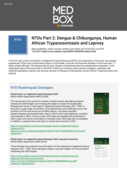
Issue Brief: Neglected Tropical Diseases Part 2
recommended
In this subsequent part of the issue brief on the NTD Toolbox you will learn about general strategies, roadmaps, key
treatment guidelines, reports, and training material on Dengue & Chikungunya, Human African Trypanosomiasis and
Leprosy.

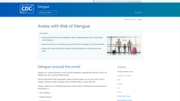
Almost half of the world's population, about 4 billion people, live in areas with a risk of dengue. Anyone who lives in or travels to an area with risk of dengue is at risk for infection.Before you travel, find country-specific travel information to help you plan and pack.
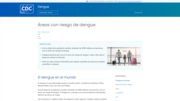
Casi la mitad de la población mundial, alrededor de 4000 millones de personas, vive en áreas con riesgo de dengue.
Cualquier persona que viva en un área con riesgo de dengue o viaje a ella está en riesgo de contraer la infección.
Antes de viajar, busque información para viajeros específica
...
Gain insights from epidemiological data on dengue coincidence, prevalence & deaths from around the world

WHO guidelines for clinical management of arboviral diseases: dengue, chikungunya, Zika and yellow fever
recommended
The new WHO guidelines provide clinical management recommendations for four of the most widespread arboviruses affecting humans: dengue, chikungunya, Zika, and yellow fever.
An integrated approach is vital, as these four diseases often present with similar symptoms, especially in the early stages
...
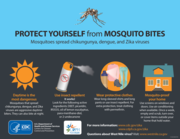
The poster is a public health communication tool designed to prevent the transmission of diseases such as chikungunya, dengue and Zika. The poster emphasises that Aedes mosquitoes bite aggressively during the day and sometimes at night, and recommends the key prevention strategies.
Accessed on 27
...
Weekly epidemiological recordRelevé épidémiologique hebdomadaire 3 MAY 2024, 99th YEAR / 3 MAI 2024, 99e ANNÉE
No 18, 2024, 99, 203–224
The WHO position papers are concerned primarily with the use of vaccines in large-scale vaccination programmes.
The position papers are intended for use by
...
This toolkit is a comprehensive set of practical tools and resources designed to support country-level risk communication and community engagement (RCCE) practitioners, decision-makers, and partners to plan and implement readiness and response activities for dengue fever outbreaks. The toolkit conta
...
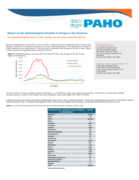
Between epidemiological weeks (EW) 1 and 22 of 2024, a total of 9,541,015 suspected cases of dengue were reported, resulting in a cumulative incidence of 1,011 per 100,000 population. This represents an increase of 230% compared to the same period in 2023 and 421% compared to the average of the last
...
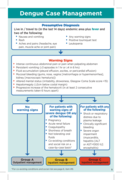
Flow Charts

Health communication has proven to play a crucial role in addressing diseases such as dengue, Zika and chikungunya, for which there are no definitive or easily accessible vaccines. In this context, this discipline becomes a fundamental tool to promote the change behavior and promote preventive pract
...
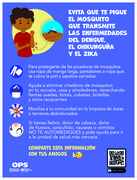
Para protegerte de las picaduras de moquitos usa ropa de manga larga, pantalones o ropa que te cubra la piel y zapatos cerrados
Podcast: Why is Dengue fever spreading to places it did not exist before? What are the symptoms and treatments? What about vaccines? Dr Raman Velayudhan explains in Science in 5.
Arbovirus (arthropod-borne virus) is defined as any virus that is transmitted to humans and/or other vertebrates by certain species of blood-feeding arthropods, mostly insects (flies and mosquitoes) and arachnids (ticks). Arbovirus is a descriptive term based on transmission by vectors with particul
...
Questions and answer regarding Dengue (immunization and vaccines)
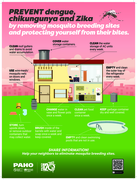
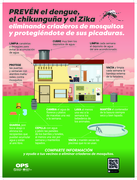
Prevention recommendations at home. PREVENT dengue, chikungunya and Zika by eliminating mosquito breeding sites and protecting yourself from mosquito bites.
