
Filter
105
Featured
30
6
Language
Document type
69
14
12
4
3
2
1
Countries
3
3
3
2
2
2
2
2
1
1
Authors & Publishers
Publication Years
Category
9
4
4
1
Common presentations of other significant mental health complaints include: depressed mood, irritability, anxiety, stress, extreme tiredness, unexplained physical complaints. Other significant mental health complaints are frequently seen in non-specialized health settings, but are often treated inap
...
This module aims to provide basic guidance on management of range of mental health complaints not coveredelsewhere in this guide. Some of these complaints may be similar to depression, but upon closer examamination are distinct from the conditions covered in this guide. Other mental health complaint
...

Session outline
•Introduction to epilepsy.
•Assessment of epilepsy.
•Management of epilepsy.
•Follow-up of a person with epilepsy.
•Review or materials and skills.

Session outline
•Introduction to dementia
•Assessment of dementia
•Management of dementia
•Follow-up
•Review

It includes different activities for the different material provided in mhGAP
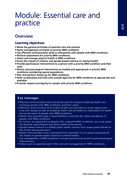
Overview
Learning objectives
• Name the general principles of essential care and practice.
• Name management principles of priority MNS conditions.
• Use effective communication skills in interactions with people with MNS conditions.
• Perform assessments for priority MNS conditions.
â
...

Session Outline
•General Principles
•Essentials of mental health care and clinical practice: Assessments
•Essentials of mental health care and clinical practice: Management
•Essentials of mental health care and clinical practice: Follow-up
•Reviews
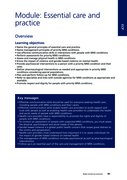
Key messages include Effective communication skills should be used for everyone seeking health care,
including people with MNS conditions and their carers; Effective communication skills enable health-care providers to build rapport and trust with people as well as enabling health-care providers to
...
Session outline
•Introduction to depression
•Assessment of depression
•Management of depression
•Follow-up
•Review
DEP supporting material
• Person stories
• Role plays – role plays 3 and 4 are extra material for
supplementary activities
• Multiple choice questions
• Video links
Session outline
•Introduction to psychoses.
•Assessment of psychoses.
•Management of psychoses.
•Follow-up.
•Review.
Session outline
•Introduction to self-harm/suicide.
•Assessment of self-harm/suicide.
•Management of self-harm/suicide.
•Follow-up.
Q7. SCOPING QUESTION: In adults with moderate-severe depressive disorder, what is the effectiveness and safety of antidepressant medication (ADM) in comparison with psychological treatment?
The WHO mhGAP programme’s existing guidelines recommend that either structured brief psychological treatm
...

В этом разделе «Руководства mhGAP по принятию мер в отношении психических и неврологических расстройств» приведены рекомендации по оценке и оказанию помощи при остÑ
...
“mhGAP Intervention Guide for mental, neurological and substance use disorders in non-specialized health settings” is a technical tool for implementation of the mhGAP Programme. The Intervention Guide has been developed through a systematic review of evidence, followed by an international consul
...

This module should always be used together with the
mhGAP Intervention Guide for Mental, Neurological
and Substance Use Disorders in Non-specialized Health
Settings (WHO, 2010), which outlines relevant general
principles of care and management of a range of other
mental, neurological and substa
...

What can you expect?
As a future facilitator your role will be to learn about the structure of mhGAP-IG, how to teach the materials and utilize opportunities to prastice facilitation and supervision skills.
As a supervisor your role will be to serve as a point of reference for non-specialized heal
...

Q 1: Are antidepressants (Tricyclic Antidepressants (TCA) and Selective Serotonin Reuptake Inhibitors (SSRI)) better (more
effective than/as safe as) than treatment as usual (placebo) in adults with depressive episode/disorder?
