
Filter
1631
Filtered Results: 1631
Text search:
WHO,
Ministry
of
Health
Uganda
Featured
Recommendations
147
New Publications
441
Language
Document type
No document type
925
Studies & Reports
335
Guidelines
159
Manuals
81
Strategic & Response Plan
60
Training Material
36
Situation Updates
17
Fact sheets
13
Brochures
2
Infographics
2
App
1
Countries / Regions
Uganda
223
Kenya
90
Global
82
Rwanda
57
Africa
53
Ethiopia
44
South Sudan
40
Sierra Leone
39
Zambia
39
Tanzania
38
Congo, Democratic Republic of
36
Liberia
32
Nigeria
29
Malawi
28
South Africa
20
Ghana
18
East and Southern Africa
17
Zimbabwe
16
Namibia
16
Guinea
14
Senegal
13
Mozambique
13
Nepal
12
Lesotho
11
India
11
Cameroon
10
Bangladesh
10
West and Central Africa
9
Botswana
8
Eswatini/ Swaziland
8
Syria
6
Burkina Faso
6
Latin America and the Carribbean
6
Central African Republic
6
Colombia
5
Burundi
5
Haiti
5
Jordan
5
Western and Central Europe
5
Somalia
5
South–East Asia Region
4
Sudan
4
Mali
4
Angola
4
Myanmar / Burma
4
Pakistan
4
Ukraine
3
Togo
3
Iran
3
Afghanistan
3
Cambodia
3
Germany
3
Lebanon
3
Eastern Europe
3
Brazil
3
Chad
3
Thailand
2
China
2
Laos
2
Peru
2
Philippines
2
Asia
2
Eastern Europe and Central Asia
2
Southern Africa
2
Côte d’Ivoire / Ivory Coast
2
Argentina
2
Vietnam
2
Russia
2
Yemen
2
Indonesia
2
Iraq
2
Madagascar
2
North Korea
1
Benin
1
Chile
1
Albania
1
Estonia
1
Vanuatu
1
Morocco
1
Venezuela
1
Saudi Arabia
1
Middle East and North Africa
1
North America
1
Gabon
1
Turkmenistan
1
Mauritius
1
Tunisia
1
Morocco
1
Bolivia
1
Papua New Guinea
1
Sri Lanka
1
Djibouti
1
Egypt
1
Romania
1
Greece
1
Georgia
1
Ecuador
1
Solomon Islands
1
Authors & Publishers
Publication Years
Category
Countries
615
Clinical Guidelines
109
Women & Child Health
96
Public Health
84
Key Resources
73
Capacity Building
38
Pharmacy & Technologies
12
Annual Report MEDBOX
1
Toolboxes
HIV
200
Mental Health
90
Ebola & Marburg
84
COVID-19
84
TB
77
Disability
75
AMR
56
NTDs
54
Planetary Health
43
Caregiver
42
Conflict
35
Health Financing Toolbox
29
Malaria
28
Rapid Response
27
Refugee
25
Pharmacy
24
Global Health Education
18
NCDs
15
Zika
14
2.0 Rapid Response
11
Cholera
6
Natural Hazards
5
Social Ethics
4
Specific Hazards
3
Polio
3
South Sudan
2

Despite the existence of criminal law, which is an important aspect of anti-FGM policies and programmes, there is not much research on the effects of cross-border practices that invalidate the law as a deterrent. Much remains unknown about the practice of cross-border FGM, specifically about gaps in...

Women, girls and marginalized groups who are largely dependent on natural resources for livelihoods are among the hardest hit by extreme weather patterns. These weather patterns limit their access to food, water, shelter, education and access to essential health services, including those that addres...
World Health Organization Department of Reproductive Health and Research
Brocher Foundation, Hermance, Geneva, Switzerland, 27–29 April 2016
This report describes findings from a telephone survey with 1,323 people conducted in February 2021. The survey examined how people respond to public health and social measures (PHSMs) to prevent COVID-19. The sample is representative of households with access to a landline or cell phone, but does n...

This report describes findings from a telephone survey with 1,328 people conducted in February 2021. The survey examined how people respond to public health and social measures (PHSMs) to prevent COVID-19. The sample is representative of households with access to a landline or cell phone, but does n...
This guide can inform any partner that manages or supports public health supply chains. Ministries of health, technical assistance partners, or non-governmental organization (NGO) operating distribution systems can all benefit from conducting a costing exercise and can use the material presented in ...
This publication provides a problem analysis of the U.S. cuts in global health and derives concrete recommendations for action for medical actors. The focus is on analyzing the direct effects on health-specific development cooperation.

In 2017, $37.4 billion of development assistance was provided to low- and middleincome countries to maintain or improve health. This amount is down slightly compared to 2016, and since 2010, development assistance for health (DAH) has grown at an annualized rate of 1.0%. While global development ass...
Massoda Tonye et al. Malar J (2018) 17:156
https://doi.org/10.1186/s12936-018-2284-7
Background: In 2011, the demographic and health survey (DHS) in Cameroon was combined with the multiple indicator
cluster survey. Malaria parasitological data were collected, but the survey period did not overl...

Submitted to the US Agency for International Development by the
Systems for Improved Access to Pharmaceuticals and Services (SIAPS) Program.
This manual provides a framework to identify problems and design interventions to improve access to and use of medicines for children. It is a resource for ...
This study complements the growing amount of research on the psychosocial impact of war on chil-dren in Sierra Leone by examining local perceptions of child mental health, formal and informal care systems, help-seeking behaviour and stigma
Yoder et al. Int J Ment Health Syst (2016) 10:48 DOI 10.11...

ABSTRACT
More than 500 million people worldwide live with cardiovascular disease (CVD). Health systems today face fundamental challenges in delivering optimal care due to ageing populations, healthcare workforce constraints, financing, availability and affordability of CVD medicine, and service del...
Rwanda: Ebola Preparedness Emergency Plan of Action (EPoA) Final Report - DREF Operation n° MDRRW017
Eleven (11) districts in Rwanda were initially were considered most at risk of the outbreak, namely:
• Rusizi, Nyamasheke, Karongi, Rutsiro, Rubavu (bordering DRC)
• Musanze, Burera, Gicumbi and Nyagatare (bordering Uganda)
• Kigali city (comprised of 3 localities) due to the presence of Ki...
BMC Public Health (2019) 19:1608
https://doi.org/10.1186/s12889-019-7853-3
The report underscores that sexual and reproductive health and rights are often the first to be sacrificed during epidemics and that the gains of the past decade must be protected. The report also makes it clear that scarce resources must be focused on the most marginalized women and girls, includin...
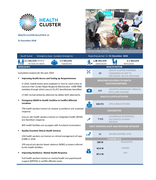
Emergency WASH in Health Facilities in Conflict Affected Locations 756 health workers trained on disease surveillance and outbreak response.
Around 142 health workers trained on integrated health (WASH and Nutrition) response. 405 health facilities are equipped with functional incinerators.
Qual...

Multiple pandemics, numerous outbreaks, thousands of lives lost and billions of dollars of national income wiped out—all since the turn of this century, in barely 17 years—and yet the world’s investments in pandemic preparedness and response remain woefully inadequate. We know by now that the ...

These guidelines have been developed in simple, user-friendly language and they explain the procedures for patients’ access to and the safe management of Schedule I and II drugs that are necessary for the treatment and relief of moderate to severe pain. They provide both procedures for acquisition...
An international field study by African and German theologicans and health workers.
These guidelines – an update to the World Health Organization’s 2015 publication Consolidated strategic information guidelines – present a set of essential aggregate indicators and guidance on choosing, collecting and systematically analysing strategic information to manage and monitor the nat...
