
Filter
871
Filtered Results: 871
Text search:
Wallis,
C.
Featured
Recommendations
89
New Publications
232
Language
Document type
No document type
494
Guidelines
130
Studies & Reports
122
Manuals
74
Training Material
20
Strategic & Response Plan
18
Fact sheets
10
Infographics
2
Situation Updates
1
Countries / Regions
India
58
Global
28
South Africa
28
Nigeria
22
Liberia
21
Namibia
20
Kenya
19
Bangladesh
18
Sierra Leone
16
Philippines
16
Western and Central Europe
14
Uganda
14
Nepal
13
Ethiopia
12
Ghana
11
Latin America and the Carribbean
9
Zambia
9
Myanmar / Burma
9
Tanzania
8
Malawi
7
Zimbabwe
7
Africa
7
Brazil
7
Venezuela
5
Middle East and North Africa
5
Russia
5
Rwanda
4
Senegal
4
Guinea
4
Mozambique
4
Asia
4
South–East Asia Region
4
Eastern Europe
4
Botswana
4
Tajikistan
3
Colombia
3
Ukraine
3
Syria
3
Haiti
3
Cambodia
3
Congo, Democratic Republic of
3
Western Pacific Region
3
South Sudan
3
Lesotho
2
Cameroon
2
Peru
2
Germany
2
Bosnia and Herzegovina
2
Indonesia
2
Iraq
2
Somalia
2
Ecuador
2
Eswatini/ Swaziland
2
Serbia
1
Turkey
1
Benin
1
China
1
Kazakhstan
1
Albania
1
Laos
1
Kyrgyzstan
1
Afghanistan
1
Morocco
1
Mongolia
1
USA
1
West and Central Africa
1
Eastern Europe and Central Asia
1
North America
1
Turkmenistan
1
Algeria
1
East and Southern Africa
1
Argentina
1
Vietnam
1
Papua New Guinea
1
Moldova
1
Sudan
1
Yemen
1
Greece
1
Central African Republic
1
Honduras
1
Mali
1
Bhutan
1
Madagascar
1
Pakistan
1
Authors & Publishers
Publication Years
Category
Countries
334
Clinical Guidelines
83
Key Resources
82
Public Health
52
Women & Child Health
32
Capacity Building
22
Pharmacy & Technologies
16
Toolboxes
TB
56
HIV
45
Planetary Health
45
Mental Health
42
NTDs
40
COVID-19
38
Caregiver
36
Natural Hazards
32
Disability
28
Ebola & Marburg
23
Pharmacy
20
Malaria
19
Rapid Response
16
AMR
16
NCDs
15
Refugee
12
2.0 Rapid Response
12
Conflict
10
Global Health Education
10
Specific Hazards
7
Zika
7
Cholera
4
Polio
4
Social Ethics
3
Health Financing Toolbox
2
This document is a guide defining requirements for quality and safety for malaria rapid diagnostic testing services to safeguard the quality of the results, the safety of the operators and patients and that of the environment for use by national malaria control programmes, regulators, implementers a...
Essential obstetric and newborn care
recommended
Essential obstetric and newborn care is designed as a tool to help protect mothers and their children in adverse environments. It is intended for midwives, doctors with obstetrics training, and health care personnel who deal with obstetric emergencies.

This template dossier complements and should be used after fulfilling the criteria and preconditions specified in the Process of validation of elimination of kala-azar as a public health problem in South-East Asia. The national kala-azar programme should be in the consolidation phase of elimination;...
While the ratification of the Convention and its Optional Protocol has proceeded rapidly, knowledge on how to implement and monitor them has not kept pace. Conscious of this challenge, my Office has developed this Training Guide on the Convention and its Optional Protocol. It is complemented by eigh...

2nd edition
Communicable Diseases Control in Emergencies
recommended
A field manual

Available in English, French, Spanish and Russian from the website https://apps.who.int/iris/handle/10665/344562
The creaNon of ‘friendly spaces’ for women and girls has been a key
strategy in the protecNon and empowerment of women 1 and girls in South
Sudan since conflict re-erupted in the country in December 2013. This
document provides guidance on the aims of these spaces, and how they
can best be e...

This handbook presents basic content and tips for implementing a school-based risk reduction programme. It is organised into five modules: its importance; approach and process; activities to benefit children up to five years old; activities for students aged 5–17; and activities for young people a...
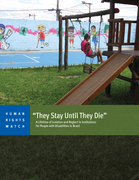
This report found that many people with disabilities enter institutions as children and remain there for their entire lives. Most of these institutions visited by Human Rights Watch researchers did not provide for more than people’s basic needs, such as food and hygiene, with scarce contact with t...
Overview.
The COVID-19 pandemic is the latest crisis facing the world, but unless humans release their grip on nature, it won’t be the last, according to a new report by the United Nations Development Programme (UNDP), which includes a new experimental index on human progress that takes into acco...
In resource restriced countries

The report identifies major global gaps in WASH services: one third of health care facilities do not have what is needed to clean hands where care is provided; one in four facilities have no water services, and 10% have no sanitation services. This means that 1.8 billion people use facilities that l...
