
Filter
123
Filtered Results: 123
Text search:
Global
Council
on
Inequality,
AIDS
and
Pandemics
Featured
Recommendations
9
New Publications
22
Language
Document type
No document type
60
Studies & Reports
39
Guidelines
10
Strategic & Response Plan
6
Manuals
4
Training Material
2
Situation Updates
1
Resource Platforms
1
Countries / Regions
Global
11
Zambia
6
Nigeria
5
Africa
4
South Africa
4
Namibia
4
Kenya
3
Lesotho
3
Ghana
3
Latin America and the Carribbean
3
East and Southern Africa
3
Botswana
3
Sierra Leone
2
Malawi
2
Mozambique
2
Uganda
2
Ethiopia
2
Liberia
2
India
2
North Macedonia
1
Nepal
1
Colombia
1
Thailand
1
Mexico
1
Ukraine
1
Senegal
1
Kyrgyzstan
1
Burkina Faso
1
Zimbabwe
1
Morocco
1
Guinea
1
Asia
1
Venezuela
1
Hungary
1
Congo, Democratic Republic of
1
West and Central Africa
1
Middle East and North Africa
1
South–East Asia Region
1
Western and Central Europe
1
Jamaica
1
Norway
1
Portugal
1
Southern Africa
1
Argentina
1
Lebanon
1
Bangladesh
1
Brazil
1
Russia
1
Georgia
1
Indonesia
1
Myanmar / Burma
1
Authors & Publishers
Publication Years
Category
Countries
49
Women & Child Health
10
Key Resources
7
Public Health
6
Capacity Building
3
Clinical Guidelines
2
Pharmacy & Technologies
1
Toolboxes
HIV
23
Global Health Education
11
COVID-19
10
Health Financing Toolbox
7
Mental Health
6
Planetary Health
5
Caregiver
4
Disability
3
Rapid Response
2
Refugee
2
TB
2
Conflict
2
Natural Hazards
1
Ebola & Marburg
1
Social Ethics
1
Pharmacy
1

The Council was established in late 2020 by Dr Tedros Adhanom
Ghebreyesus (Director-General, WHO) to provide new economic thinking – reassessing how health and wellbeing are valued, produced and distributed across the economy. An all-female group of 10 distinguished economists and area experts, t...
The UNAIDS 2020 global report is a call to action. It highlights the scale of the HIV epidemic and how it runs along the fault lines of inequalities.
Accessed: 26.09.2019
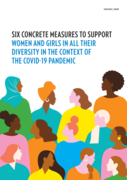
The report underscores that sexual and reproductive health and rights are often the first to be sacrificed during epidemics and that the gains of the past decade must be protected. The report also makes it clear that scarce resources must be focused on the most marginalized women and girls, includin...

Vanquishing violence and vulnerability in humanitarian settings
Background paper for the joint African Union–UNAIDS (in capacity of serving
Chair of H6) high-level side event at the 73rd United Nations General Assembly,
24 September 2018, at UNHQ, Conference Room 3
The power of the Global Drug Policy Index lies in its key objective: to score and
rank how countries are faring in different areas of drug policy as identified in the
UN report ‘What we have learned over the last ten years: A summary of knowledge
acquired and produced by the UN system on drug-r...

This report explores the reasons why global health is critical to medicine and what this means for medical education. It argues that an understanding of global health is important for all students and practicing doctors, rather than being an ‘add-on’ or ‘option’ for specialization.

One of the many gender inequities in the health and care workforce that COVID-19 has exposed is around the fit and design of Personal Protective Equipment (PPE). The rapid onset and scale of COVID-19 led to shortages of PPE in most countries, causing preventable infection and mortality among healthc...

Access to safe, effective and quality-assured health products and technologies is crucial for achieving universal health coverage and primary health care goals. The continued growth of the aging population; increasing burden of noncommunicable diseases; growing burden of mental health issues; climat...
The COVID-19 pandemic has exacerbated and added yet another layer of vulnerability to an already dire web of vulnerabilities of girls in the African continent, which constitute about 49% of the total child population. Critically, gender equality and girls’ multidimensional vulnerability have been ...

Available in Arabic, Chinese, English, French, Russian and Spanish. You can download a summary of the main report and background documents!
The report demonstrates that the current system—at both national and international levels— was not adequate to protect people from COVID-19. The time it t...

This document aims to assist policy‑makers, health care providers and researchers to understand key concepts in health ethics and to identify basic ethical questions surrounding health and health care. It illustrates the challenges of applying ethical principles to global public health and outline...

The objective of Health in the Americas: Overview of the Region of the Americas in the Context of the COVID-19 Pandemic is to respond to the need to address important public health issues in an increasingly timely manner, while serving as a platform with a close focus on specific issues of regional ...

Technical Note
Recently, the approach to hazardous events has undergone a considerable shift, away from reactive activities focused on managing and responding to events and towards a more proactive process of emergency and disaster risk management (DRM). The ultimate goal of this shift in focus is ...

The World Health Organization (WHO) is releasing the second edition of its Global Accelerated Action for the Health of Adolescents (AA-HA!) guidance. The document aims to equip governments to respond to the health and well-being challenges, opportunities and needs of adolescents.
The guidance pro...

Violence against women and girls is widespread in the Region of the Americas, resulting in enormous consequences for the health and wellbeing of women and girls, their families and communities. These costs are unacceptable and they can be prevented through evidence-based action, including the health...
CATALYST DIALOGUE ON HEALTH FINANCING
Insights from a debate on how to increase funding for health and spend existing funds more effectively.
Catalyst Dialogue participants:
Christoph Benn, Director for Global Health Diplomacy, Joep Lange Institute • Jayati Ghosh, Professor of Economics, Univer...
